[P]UTNEY — Just before last year’s general election, participants at the annual Vermont Vision for a Multicultural Future conference talked up the possibility of the nation’s first black president welcoming the first female commander in chief.
Then Donald Trump won.
Attendees at the 2017 event late last week could have lost themselves in headlines reporting a proposed travel ban targeting Muslims, fights over Confederate monuments, and a flood of workplace sexual harassment claims. Instead, they focused on the future.
“The new resident in the White House and his administration compels us to redouble our efforts to teach and expand the practice of civility, deepen our understanding of our neighbors and mitigate the impact our biases have across the sectors and organizational structures within our personal spheres of influence,” said Curtiss Reed Jr., executive director of the Vermont Partnership for Fairness and Diversity.
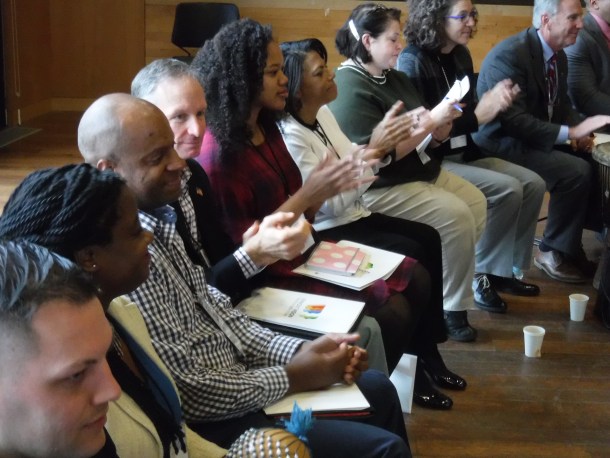
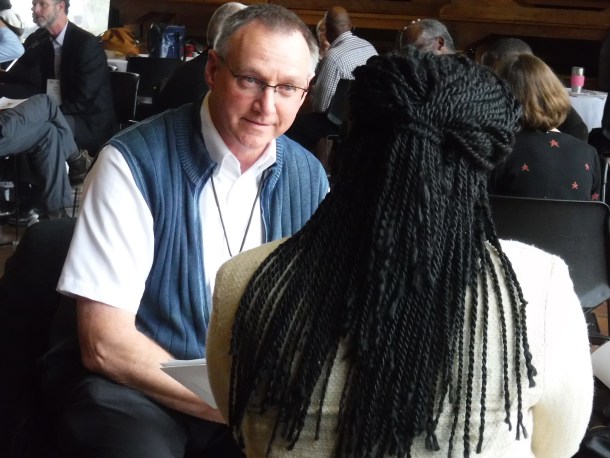
The sixth annual conference at the Putney School assembled 60 local and state leaders who talked frankly about the challenges of that charge.
“Vermont is not actually the whitest state in the union, we’re the second-whitest,” said the Rev. Arnold Thomas, pastor of Good Shepherd Lutheran Church in Jericho. “Maine is the whitest. New Hampshire is the third-whitest. You can’t get any whiter than northern New England.”

“There are such few spaces in Vermont where we have this range of diversity,” said state Rep. Kiah Morris, D-Bennington, one of just four people of color in the 180-member Legislature.
State government had the highest number of attendees, with representation from the Vermont State Police, the departments of Corrections and Human Resources and the agencies of Commerce and Community Development, Education, Natural Resources and Transportation.
The latter agency has an Office of Civil Rights that “works to ensure equal opportunity and access for all VTrans employees, job applicants, contractors, and the public,” its website says. Through such efforts, the percentage of female and minority transportation workers has increased from less than 3 percent five years ago to upward of 12 percent and counting today.
“Change is very uncomfortable in a white-male-dominated field,” said Ernie Patnoe, state maintenance transportation administrator, “but it has been well received.”
Vermont may nearly tie Maine as the nation’s whitest state (about 95 percent of each population is Caucasian, the U.S. Census Bureau estimates). But the number of Green Mountain State residents born someplace else — only 25 percent of the citizenry in 1960 — is up to almost 50 percent, with people who identify themselves as other than white accounting for nearly 60 percent of growth in the latest census.
Brattleboro Town Manager Peter Elwell was one of several local leaders seeking an answer. About 15 percent of his community’s 800 ninth- through 12th-graders identify as something other than white. But there are no people of color among his municipal government’s 200 staffers.
“I’d like to understand how we can encourage diversity in our workplaces,” Elwell said.
To learn, participants attended sessions with such titles as “Recruiting Racial Diversity Outside the Usual Channels,” “Facilitating Difficult Conversations Concerning Race, Gender and Other Differences” and “Mindfully Modernizing the Quintessential Image of Vermont.”
“No one thing is going to make all the difference,” said And Morse, the Transportation Agency’s civil rights program manager.
“It’s up to us,” Rep. Morris concluded, “to be able to create meaningful change.”