

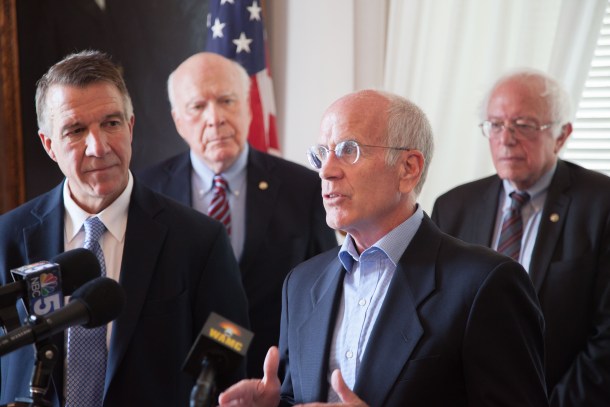
[I]n a show of bipartisanship, Gov. Phil Scott joined Vermont’s congressional delegation and legislative leaders to speak out against a health insurance bill being considered in the U.S. Senate.
Scott, a Republican, said the bill would create an unmanageable deficit in the state budget if passed, and that leaders in Congress should be working across party lines to replace the Affordable Care Act with something both Republicans and Democrats would support.
Monday’s news conference came two days after the Republican majority leader in the U.S. Senate announced he would delay consideration of the bill, the Better Care Reconciliation Act, until a key member, Sen. John McCain, R-Ariz., recovered from an unexpected surgery.
That vote, which was originally scheduled for June, could now be delayed several more weeks.
The bill is the fourth attempt in Congress to repeal and replace the 2010 Affordable Care Act, also known as Obamacare. A similar bill has already passed the U.S. House.
The Senate’s bill would cut federal funding for Medicaid by hundreds of billions of dollars over the next several years, defund Planned Parenthood for one year, and allow insurance companies to offer less coverage to patients at equal or greater prices.
Leaders and health care experts have said the bill could cost 51,000 Vermonters their health insurance, affect 19,000 Vermonters who visit Planned Parenthood every year, and raise insurance premiums for people using Vermont Health Connect.
“The proposed reductions in Medicaid would leave our state with a budget deficit we could not absorb without cutting health care services for the people who need them the most or significantly raise taxes on already overtaxed Vermonters,” Scott said.
“I agree health care is too costly and the increasing cost is unsustainable,” Scott said. “It is a burden on our employers, families, individuals and taxpayers. The path forward must build on the state-federal partnership and by supporting state innovations that make coverage affordable and improve the health of our residents.”
He called for more cross-party cooperation on health legislation.

“I do not think the Affordable Care Act was perfect by any means, but what may be its biggest shortcoming was that it did not have support — bipartisan support — when it ultimately passed in 2010, and it is imperative we learn from that misstep,” he said.
“We should not make that mistake again because the results will be the same: One team will eventually win and many American citizens will lose.”
Vermont Senate Minority Leader Dustin Degree, R-Franklin, said Medicaid covers 15,000 people in Franklin County and that kicking some off their insurance would not stop them from having health problems.
“I, like many of my colleagues, have been frustrated by how much faster health care costs — public and private — have grown than the economy or wages in the last decade,” he said.
“However, I do not think that the cuts envisioned in the federal health care bill will stop people from getting sick and requiring services,” he said. “Nor do I think it will help Vermonters afford those expenses they’ve incurred.”
Vermont House Minority Leader Don Turner, R-Milton, said nearly 200,000 people in the state receive some kind of Medicaid benefit, and they rely on that coverage too much for it to be taken away from them.
“That means everyday working Vermonters,” Turner said. “Vermont families with parents and grandparents in nursing homes and receiving community services would be affected. And Vermonters receiving treatment for opioid addiction from Medicaid would also be affected.”
“Medicaid expansion over the last 10 years, and even prior to the ACA, created a precedent that we cannot repeal overnight without a plan in place to mitigate any adverse financial impacts on the state and on Vermonters,” he said.
Sen. Patrick Leahy, D-Vt., showed anger as he cited statistics about the people across Vermont and the country who could be affected by cuts to their Medicaid health insurance: pregnant women, low-income children, people with disabilities, and senior citizens in nursing homes.
Leahy pointed to a boy from West Rutland, Reilly Jakubiak, who has a condition so rare that only five people in the country have it. He said the boy’s parents use Medicaid as secondary insurance to their commercial insurance to pay for a portion of the $100,000 in medications he uses every year.
Leahy also described how Medicaid gives money to schools to cover “essential education services” for children in special education programs. Eventually he pushed his scripted talking points to the side of the podium and raised his voice again.
“These are not statistics,” he said. “These are real people. I guarantee you can go into any neighborhood, any one of your neighborhoods, and you’re going to find people who need this.”
“And I think it’s immoral in the wealthiest, most powerful nation on Earth to pass something to fit a bumper slogan,” he said. “It is wrong, and I will not vote for it.”
Sen. Bernie Sanders, I-Vt., called the Better Care Reconciliation Act “the most dangerous and destructive piece of legislation ever brought before the United States Senate in the modern history of this country.”
He said “every major health care organization” in the country opposes the bill, including the American Medical Association, the American Hospital Association, the American Cancer Society and AARP.
He said the bill would not lower health care costs but would allow insurance companies to sell people “junk health coverage.”
“In other words, it would give you the freedom to buy cheap insurance,” he said. “Unfortunately, that insurance will not cover your needs, and if you end up in the hospital you’re going to end up with huge deductibles.”
Sanders said healthier people, with cheaper health care needs, would choose the cheap health insurance, while “sicker people will be forced into another pool in which for pre-existing conditions the cost will soar.”
Sanders also slammed Republicans for pushing the bill through the Senate without holding a single public hearing. He said a bill that deals with health care — which is nearly 20 percent of the nation’s economy — should have public hearings.
Rep. Peter Welch, D-Vt., said the lower chamber sent its version of Obamacare repeal over to the Senate with a limited public process and without getting feedback from nonpartisan economists who work for Congress. (Those economists later estimated that more than 20 million people would no longer have health insurance.)
Instead, Welch said members of his committee received a copy of the bill on a Tuesday morning, then held a 27-hour hearing while members tried to amend the bill as they went along, before the bill passed out of the committee on a party-line vote.
“It’s so bad, the question I really think a lot of Vermonters ask is, ‘How can this be what is presented as reform when, essentially, reform gets translated into taking 22 million people off of health care and giving $800 billion to folks making over $1 million a year?’” Welch said.
“And here’s the answer as I see it,” he said. “There is a philosophy at work in Washington that says, ‘When it comes to addressing the biggest challenges that we all share — and health care and health care security for our families is one of the biggest — you’re on your own.’”
Leahy said there are Republican senators who oppose the bill but tell him only privately, such as in the Senate gym or dining room. He said in an interview: “If it lost by one vote, it would lose by seven or eight” once senators saw how their colleagues would vote.
/

