

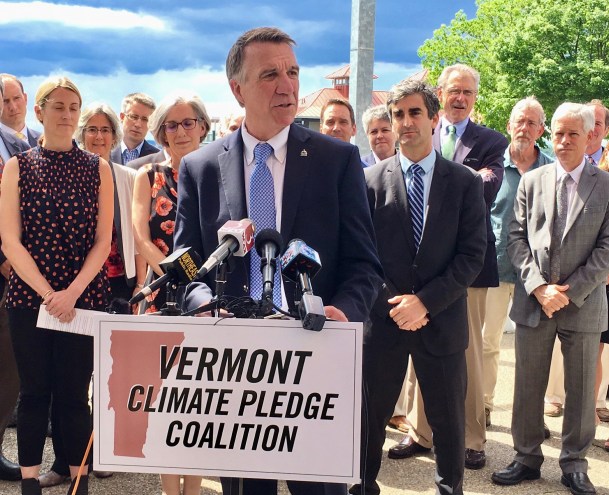
Mayor Miro Weinberger called President Donald Trump’s decision a disaster and a “historic mistake” that places the onus for meeting targets in the international agreement on states, municipalities and the private sector.
To that end, Weinberger and Gov. Phil Scott announced the Vermont Climate Pledge Coalition. It will collect voluntary pledges from cities, towns, colleges, businesses and others to reduce greenhouse gas emissions and invest in renewable energy and efficiency projects.
Those pledges will be presented at a conference in the fall. The Agency of Natural Resources will help estimate the pledges’ collective impact on emissions. The pledges will then be “bundled” and presented to We Are Still In, a group organized by former New York City Mayor Michael Bloomberg that is handling similar pledges nationwide, Weinberger said.
The Vermont Climate Pledge Coalition will track whether members are meeting their pledges and will offer support to meet those goals. But, as with the Paris accord, there is no enforcement mechanism.
Ashley Orgain, director of mission advocacy and engagement for the home products retailer Seventh Generation, praised the initiative and said her company is excited to participate.
“It’s hard to have a healthy business on a sick planet,” Orgain said.
Seventh Generation has instituted what it calls a self-imposed internal carbon tax, calculating a figure for the carbon dioxide it emits. Orgain said the company then allocates that money to purchase energy from renewable sources, increase efficiency at the company and in its supply chain, or purchase carbon offsets.
“Carbon pricing is good corporate citizenship,” she added, noting that Microsoft, Dow Chemical and Ben & Jerry’s have placed an internal price on carbon.
Orgain called for wider use of carbon pricing, calling it “an essential solution for Vermont.”
Scott said his administration is committed to meeting emissions reduction and renewable energy targets for Vermont set by his predecessor. Those goals call for greenhouse gas emissions to be reduced 40 percent below 1990 levels and for 90 percent of energy used in the state to come from renewable sources by 2050.
Imposing a price on carbon isn’t the way to achieve those goals, he said. The governor said he would apply the same lens his administration uses in all policy areas to addressing climate change: Will it help grow the economy, increase affordability and protect the most vulnerable?
Lawmakers have proposed various ways of taxing carbon emissions.
“I believe (carbon pricing) would put downward pressure on revenues around Vermont,” Scott said. “We have to remain competitive. If we did it as a country that might be one thing, but to do it as one state would be very difficult.”
Scott also rejected industrial wind power projects on ridgelines, saying they’re not needed to reach Vermont’s renewable energy and emission reduction targets. “I think there’s other technology to replace that. If it was the only option it might be a different story,” he said.
Instead, the governor said the state should make greater use of tax credits to support efficiency and renewable energy. He pointed to tax credits for conservation, electric vehicles and renewable energy in his proposed budget.
“It didn’t pass, but that doesn’t mean we stop,” Scott said.
Scott said he would be forming his own commission to chart a course for meeting the statewide emission reduction and renewable energy goals.

