


[W]ASHINGTON — U.S. Sen. Bernie Sanders, I-Vt., introduced legislation last week that would transition the American energy grid to 100 percent renewable energy by 2050, an ambitious goal with echoes of Vermont’s Comprehensive Energy Plan.
The most comprehensive green energy bill introduced in Congress, the so-called “100 by ‘50 Act” is co-sponsored by U.S. Sens. Jeff Merkley, D-Ore., Cory Booker, D-N.J., and Edward Markey, D-Mass. No Republicans have signed on to the bill, all but ensuring that it will see little action in the conservative-controlled Congress.
Still, legislators were upbeat and optimistic about the future of American energy production while introducing the bill. According to the New York Times, solar energy and wind power jobs today far outnumber employment opportunities in coal production. Vermont leads the nation in clean energy jobs per capita, and has adopted the goal of obtaining 90 percent of its energy needs from renewable sources by 2050.
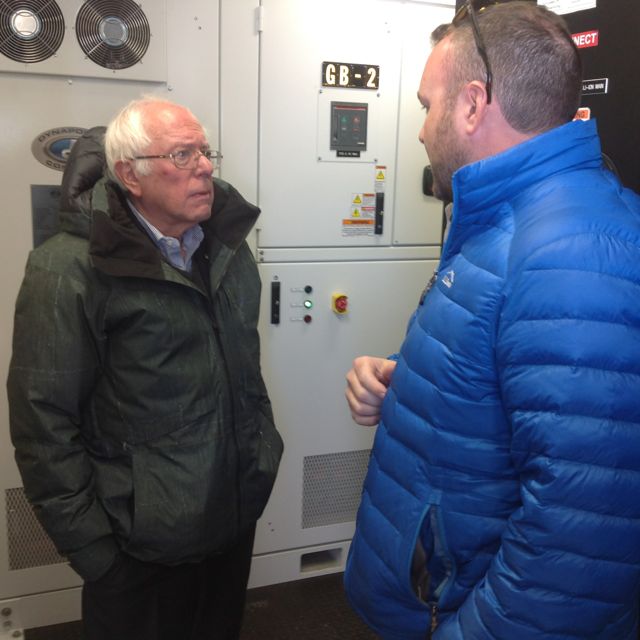
“The good news is that despite President Trump we are winning this battle,” Sanders said Thursday. “In Vermont and all over this country, we are seeing communities moving toward energy efficiency and we are seeing the price of renewable energy plummet. Our job is to think big, not small. We can win the war against climate change. We can win the war in transforming our energy system and put millions of people to work doing that. We can create a planet that will be healthy and habitable for our children. There is no issue more important.”
To meet such ambitious goals, Sanders’ plan borrows a number of the tactics employed in the Vermont plan, including major investments in renewable energy production and energy efficient heating and electric infrastructure.
It’s unclear exactly how much the bill would cost, but the price tag is almost certainly quite high. The legislation, if enacted, would establish a massive job program for green energy jobs, offer need-based grants to strengthen and streamline water, broadband and electric grids across the country and create a Climate Fund to bolster the green energy economy.
The bill also makes permanent a number tax credits, including ones available for building efficient homes and purchasing efficient cars.
Section 301 of the bill requires electric suppliers across the country to phase out their use of fossil fuels by 2050. Starting in 2022, no more than 70 percent of an electric retailer’s energy would be allowed to come from dirty sources. Each year, the threshold would fall by 2.5 percent, until 2050, when the grid would have to be entirely green.
Money would be allocated to make public transportation more affordable and more efficient, and institute strict new automotive standards to create zero emissions vehicles.
The bill would also phase out a handful of generous subsidies offered to oil and mining while imposing new taxes on energy extraction. The legislation would also impose harsher financial liabilities for oil spills.
While ratcheting up the cost of dirty energy production in an effort to kill the industry, the bill would also institute generous unemployment assistance and training programs for workers displaced by the massive shift in energy production.
To accomplish Sanders’ lofty goals, a National Climate Change Council would be established to draft a plan to meet the ambitious green energy goals. The council would be composed of key federal officials, including the secretaries of Education, Transportation and Treasury.

The bill was hailed by a handful of environmental groups, including the Sierra Club and the League of Conservation Voters.
“One hundred is an important number,” said Bill McKibben, the founder of 350.org. “Instead of making changes around the margins, this bill would finally commit America to the wholesale energy transformation that technology has made possible and affordable, and that an eroding climate makes utterly essential.”
While McKibben lumped praise on the bill, he also acknowledged its slim chances of passage.
“This bill won’t pass Congress immediately — the fossil fuel industry will see to that,” he said. “But it will change the debate in fundamental ways.”

