[R]utland City officials say they are preparing to cut down about 100,000 red pines in its watershed before an insect not visible to the human eye infects and kills them.
The move will allow the city to harvest the still standing trees to sell as timber and prevent greater forest fire danger if the red pines were left to die where they are now, according to Jeff Wennberg, Rutland City’s public works commissioner.
The culprit: Red pine scale, he said, a tiny brown insect that is extremely difficult to see, but its impact on trees is unmistakeable.
“The insect doesn’t kill the trees,” Wennberg said. “It’s the fungus that they carry. They bore into the sapwood and then it infects the tree, causing the tree to die from the bottom up.”
The nearly microscopic bug makes its home in the red pine, a tall and straight tree, added Dave Schneider, city forester.
“They suck the sap out of the tree, or in this case, out of the base of the needles,” he said. While the red pine scale enjoys the sap, Schneider said, the insect is infecting the tree with a pathogen, though exactly what that pathogen isn’t entirely clear.
“We have never really gotten a complete answer on that,” he said.
The city forester said Wednesday that it was more than two years ago when he first began seeing red pines dying from the lower branches on up, a prime symptom on red pine scale. The orange lower limbs and needles among the earlier indicators.
Researchers from the University of New Hampshire studying invasive species were contacted and later confirmed the presence of red pine scale.
The red pine scale, which doesn’t particularly like the cold, had been thought to reach only as north as Connecticut, where it has been detected as far as a back as the mid-1930. However, Schneider said, in recent years it appears to be moving north, detected in Vermont and New Hampshire.
Once infected, a tree usually lasts two years before it dies. And once dead, the tree has lost its value.
The city has received a “heavy cut” permit from the state to harvest the trees, which are all mature, while they still have worth, according to Wennberg.
“The other reason, if they are allowed to die, especially if they’re standing, they become quite a fire hazard,” Wennberg said. “That’s sort of the worst possible thing we can think of that would happen to impact our water quality.”
The trees are in stands planted in the 1920s and 1930s, he said, to re-establish forestry in land that had earlier been fields and pastures as part of farms on Wheelerville Road in the watershed.
The farms were no longer in operation because an earlier typhus epidemic was traced back to the domesticated cattle from the farms along Wheelerville Road, Schneider said.
“Our water was being contaminated,” the city forester said, “so when it came to protecting the water the city decided that it would be best if they purchased the property and replanted them to forest growth.”
He said of the red pine, “It was perfectly appropriate tree to grow in our watershed at the time.”
Red pines, Schneider said, grow quickly, and on average measure about 18 inches in diameter and stand roughly 80 to 90 feet tall.
The red pines, tall and straight, are a prime choice of wood for utility poles, the city forester said.
There are 17 different parcels that make up the 150 acres where the city intends to cut down the red pine trees, the commissioner said.
“They’re not huge areas independently,” Wennberg said, “but collectively it’s a pretty large cut.”
The city owns about 4,000 acres in the watershed that is actually located in Mendon. Wennberg said he has met with Mendon officials to make them aware of what’s planned.
He added that the city does harvest trees from the watershed on a regular basis as part of its forest management practices.
“The difference this time is these stands tend to be right along Wheelerville Road. That means that the harvest will be very visible,” he said. “We wanted to notify the public because a lot of people are going to see this and say, ‘What are they doing.’”
The cut can only take place in dry or frozen conditions, Wennberg said, meaning a great deal of the work will take place in the winter. However, the public works commissioner added, there are some locations, in relatively flat areas, where trees may be cut down in late summer if conditions are dry enough.
“We expect to be starting late summer or this coming winter, it will probably take about two years,” he said. “There will be multiple timber sales.”
The project will be broken into a few bids for companies to harvest red pines in different areas, according to Wennberg, allowing smaller loggers an opportunity to compete for the work.
“We’ll dole them out in two, or three, or four tracts at a time,” he said. “That will spread it out over time and hopefully spread it out over the loggers.”
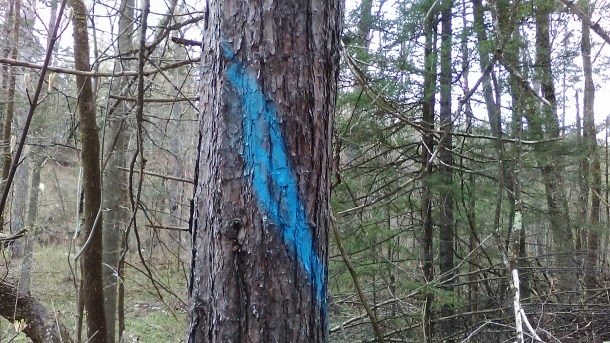
The red pines slated for harvest are emblazoned with painted blue markings.
Revenue from the timber sale will go into the city’s water fund. Typically, Wennberg said, the city takes in about $60,000 a year from timber sales.
In past years, he said he would expect that the timber from a red pine harvest of this size would bring in up to $250,000. However, with so many of the trees being cut down due to red pine scale around the region, the market has softened.
Wennberg said he would be happy if the sales took in $60,000 for each of the next two years.
Schneider and Wennberg both said by carefully harvesting the red pines, the “understory,”or underlying layer of vegetation, will be allowed to grow and fill in the area.
“We hope will get good natural regeneration,” Schneider said. “The forest is very resilient.”
Asked if any animals in the forest had a particular attachment to red pines, the city forester named at least one.
“Red squirrels love their cones,” he said.
Correction: The diameter of the trees was incorrect in earlier versions. The trees are about 18 inches, not feet, in diameter, according to Schneider.