

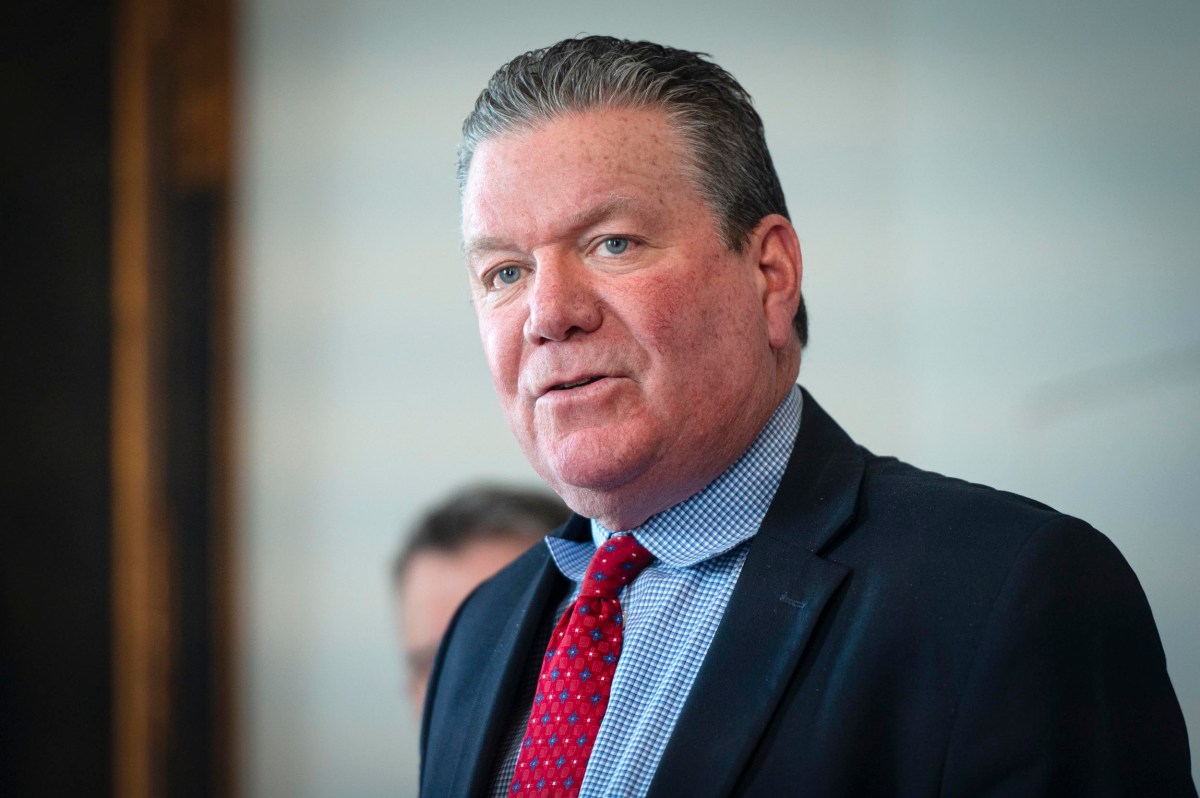
MONTPELIER — Gov. Phil Scott’s administration says a 2025 law it backed that created new tax breaks for military retirees and a range of other tax exemptions resulted in about $10 million in refunds for people around the state so far this year.
The Republican governor said at a press conference Wednesday that he’ll propose another slate of tax breaks at the start of next year’s legislative session if he is elected again. He declined to say what, specifically, that package would include.
The administration’s focus on tax cuts came a week after Democratic voters nominated Amanda Janoo to challenge him in this fall’s election, who made raising taxes, in her case on the state’s wealthiest residents, a key pillar of her campaign.
In response to a reporter’s question, Scott on Wednesday reiterated his opposition to that idea. Both Scott and Janoo say their plans are aimed at making the state more affordable for working-class people. The debate is likely to feature on the campaign trail in the coming months.
The governor made the case that the taxpayer benefits of the 2025 law showed he had the receipts to earn voters’ trust again.
“Here’s the bottom line: we need to keep pushing forward with practical solutions that deliver real results for Vermonters,” he said. “And that’s exactly what I intend to do.”
In addition to exemptions for many military retirees, the 2025 law — which passed with overwhelming support in the state House and Senate — also set out tax breaks for low-income workers, families with young children and retirees on Social Security.
Scott has pushed to eliminate taxes on military pensions for years, saying it would encourage more veterans to move to Vermont and boost the state’s economy. Skeptical Democrats argued the tax break would unnecessarily benefit some high-income households and unfairly single out one deserving group over others.
Last year, however, support for the idea developed across party lines. As a compromise, the final legislation exempted military pensions and military survivor benefits for households whose adjusted gross incomes are under $125,000, and created a partial exemption for those making less than $175,000.
Scott attributed that swell of support to the greater number of Republicans elected to the Legislature in 2024, which he says made the Democratic leaders of both chambers more inclined to consider his proposals.
“I don’t believe we would have gotten this small amount of tax relief had the voters not weighed in from the voting booth,” he said Wednesday.
Scott’s tax commissioner, Bill Shouldice, shared data on the amount each piece of the 2025 law directed back to taxpayers this year. The changes to how military benefits are taxed, for one, refunded $1.9 million to more than 2,400 people, he said.
The law also expanded eligibility for Vermont’s child tax credit to include families with 6-year-olds, which directed $3.6 million back to about 4,000 households. Previously, those with kids up to 5 years old were eligible. Meanwhile, its boost to the state’s earned income tax credit available for low-income workers without children sent $2.4 million back to about 11,000 filers, according to Shouldice. The credit for those workers now maxes out at $649.
Another change in the law raised the income thresholds at which Social Security benefits are fully or partially tax-exempt, directing $1.3 million back to about 8,000 people. Those thresholds are now up to $55,000 for single filers and $70,000 for married filers. Another change, which created a partial tax credit for veterans who make less than $30,000, directed just shy of $440,000 to about 1,900 people.
When Scott signed the law in 2025, analysts estimated that it would send $13.5 million back to taxpayers. That’s higher than the roughly $10 million Shouldice detailed Wednesday.
Sarah Mearhoff, a spokesperson for the Vermont Department of Taxes, said in a statement that the total amount refunded could still increase as more people file their tax returns ahead of the Oct. 15 extension deadline, writing, “We hope to see this number climb.”
Vermont remains among a minority of states that does not fully exempt military pensions from income taxes. The proposal may be a part of Scott’s package for the 2027 legislative session, which starts in January.
Vermont Adjutant General Henry “Hank” Harder, the head of the state’s National Guard, voiced support for that change during Wednesday’s press conference.
“If we want to be a state that not only honors service, but actively competes with other states, we need to keep our veterans and their families here in Vermont — and attract more talent,” Harder said.
Disclaimer: Sarah Mearhoff previously reported for VTDigger.
