


And new documents show that more than half of that concrete – 1.1 million cubic feet – might be buried on site as part of a “rubblization” plan developed by NorthStar Group Services, the company that wants to buy the shut-down Vernon nuclear plant.
Both NorthStar and current plant owner Entergy pledge that only clean concrete will be used as fill. And administrators are touting the plan’s benefits, saying it will save millions of dollars and keep thousands of trucks off local roads.
Vermont Yankee has “large quantities of uncontaminated concrete acceptable for reuse as fill that would provide economic benefits, with no health or safety risk due to residual radioactivity, and avoid unnecessary traffic, transportation and disposal offsite,” Steven Scheurich, an Entergy vice president, wrote in documents filed with the state Public Service Board.
But the proposal could prove to be a sticking point for state officials and activists. Ray Shadis, a technical adviser with the watchdog group New England Coalition, argues that NorthStar is planning, “in essence, a capped landfill.”
“It’s a very important issue for us,” Shadis said. “It’s a major issue.”
Entergy is seeking approval from the Vermont Public Service Board and the federal Nuclear Regulatory Commission to sell Vermont Yankee to NorthStar, a New York-based decommissioning company.
NorthStar says it can clean up most of the site – with the exception of a spent fuel storage facility – by 2030 and possibly as early as 2026. That’s decades sooner than Entergy had been planning.
But some observers are wondering about NorthStar’s ability to follow through on its promises. That skepticism – or, at the very least, curiosity – is apparent in the 10 entities that have been granted permission to intervene in the Public Service Board’s deliberations.
In late April, NorthStar and Entergy filed hundreds of pages of responses to discovery questions posed by some of those intervenors. The documents cover a variety of issues, but restoration and future use of the Vermont Yankee site are prominent topics.
For instance, the original Public Service Board documents filed by NorthStar and Entergy contained analysis of an 8.25 megawatt solar array that could be built on the property after decommissioning.

“If and when solar power generation or any other redevelopment becomes a proposal rather than just a possibility, NorthStar will consult with the town of Vernon and seek and obtain any required legal approvals,” State wrote.
NorthStar does reiterate, however, that a large portion of the property is expected to be released for redevelopment even while radioactive spent fuel remains.
“Release of the non-(spent fuel) portions of the site has been approved by the NRC for a number of decommissioned nuclear power facilities, including all three Yankee plants (in New England),” State wrote.
Of more immediate concern is NorthStar’s cleanup work, which could start as soon as 2019 if the sale goes through. Radiological issues are the NRC’s purview, but the state has jurisdiction over nonradiological cleanup and site restoration.
In discovery responses provided to the state Agency of Natural Resources, State defends his plan to remove underground structures at Vermont Yankee down to a depth of 4 feet.
There are exceptions to that plan; for instance, NorthStar has said any structures containing asbestos would be removed regardless of depth. But overall, State said, the 4-foot proposal “strikes an appropriate balance of preparing the site for reuse in numerous ways while not imposing unnecessary costs on the project.”
“Structures below 4 feet in depth pose little to no threat to future residents of the site,” he wrote.
Rubblization is a related issue.
State said the plan is to use Vermont Yankee’s crushed concrete as fill from a point “above the groundwater level” to approximately 5 feet below grade. Above that would be “either clean soils or granular materials depending on the location and intended area’s reuse.”
Places where concrete fill might be used include the “deep basements” of the cooling towers, turbine building and main plant area, State wrote.
There are potential cost savings: NorthStar administrators have told Entergy that the decommissioning company “could save millions of dollars if it were allowed to rubblize and dispose non-contaminated concrete on site,” Scheurich wrote.
State added that the approach would benefit “the safety of the community” by eliminating the need for an estimated 4,000 disposal truck trips.
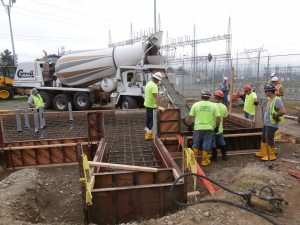
But Entergy says there’s room for negotiation on that topic. Scheurich points out that the rubblization language is placed within the context of a pledge that the state and Vermont Yankee “would work in good faith to negotiate site restoration standards, including ‘rubblization,’ and propose them to the (Public Service Board) for approval.”
Shadis doesn’t see it that way, asserting that Entergy and NorthStar are trying to get out of a recent binding agreement.
“It’s a real disservice to the system that we have for NorthStar to unilaterally decide that, we’re not going to go with that,” he said.
His objections to rubblization are, in part, based on his contention that Vermont Yankee can and should be more than an industrial site. “Establishing a concrete dump – a landfill – would be hugely disrespectful of that site,” he said.
Shadis also is concerned about pollutants leaching into groundwater and, eventually, into the nearby Connecticut River. State contends, however, that “NorthStar does not anticipate any change to the groundwater” due to reuse of Vermont Yankee’s concrete.
The issue may come down to whether NorthStar can ensure that its proposed fill is, in fact, clean. Shadis acknowledged that “there’s the possibility that that could happen if they’re very, very careful and thorough about their scanning and analysis.”
That kind of analysis, however, is not easy. In his discovery responses, State notes that the advantages of rubblization “would potentially be offset by additional costs associated with characterization and processing of the concrete.”
State points out that concrete was used as fill at Yankee Rowe in Massachusetts and was approved for such use at Connecticut Yankee.
But the discovery documents also show that Maine Yankee chose not to pursue rubblization. According to an administrator involved in that plant’s decommissioning, that’s because it was more “cost-effective to send most of the demolition waste … for disposal without undertaking the time and effort to separate out clean from contaminated waste.”

