

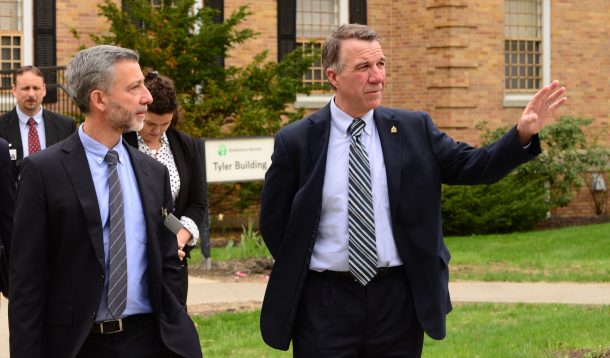
Until Monday, however, he had never been to the Brattleboro Retreat.
Scott and Retreat administrators spent part of a chilly spring morning touring the hospital’s sprawling campus, talking about addiction and mental health services while visiting with staff and patients.
With Scott finishing up the fourth month of his first term as governor, his Retreat stop was more of a relationship-building exercise than an in-depth policy discussion. But one theme emerged: Building a better care system requires more than adding treatment beds.
“They’re at capacity right now,” Scott said of the Retreat. “Their statement was that they weren’t as interested in adding beds as in making a change in how we deliver services. It’s something that we’re interested in as well.”
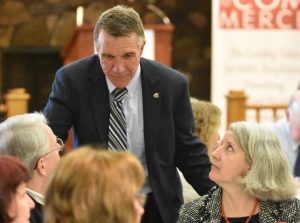
The centerpiece of Scott’s Monday swing through Brattleboro was the Chamber of Commerce’s annual luncheon with the governor. Amid the expected talk of economic and tax policies, Scott also spent a fair amount of time talking about one of the Retreat’s core missions: treating addiction.
Speaking on the home turf of former Gov. Peter Shumlin, Scott acknowledged his predecessor’s role bringing the state’s opiate problem to the forefront several years ago.
“I give a great deal of credit to Gov. Shumlin for highlighting this initially,” Scott said. “When he did, I wasn’t quite sure that this was something we should be highlighting, but I was proven wrong.”
Scott noted that he also has appointed a director of drug abuse prevention and has convened a summit “to address some of the employment opportunities in terms of more (addiction) counselors that we desperately need.”
Additionally, Scott said he’s talking with other New England governors “to try to do whatever we can regionally to address this issue.”
“Many states are facing this as well, but it seems to hit us a little bit harder, and maybe it’s because of our smaller population,” he said.
Scott got a look at the regional “hub” program for medication-assisted addiction treatment during his tour of the Retreat.
The local hub has not been plagued by the long waits seen elsewhere in the state.
“It’s been successful,” said Louis Josephson, the Retreat’s president and chief executive officer. “We’re completely subscribed, but there’s no waiting list. We’re right at capacity.”
Josephson told Scott that the Retreat is expanding hub-related services: Administrators expect to soon open a child care center for hub patients on the Retreat campus after hearing there was a need for such a service.
“That’s going to be a first in the state,” Josephson said.

The Retreat, Scott added, is “critical to our overall approach to treating mental health in parity with (physical) health care issues that we face.”
A common theme in mental health debates is Vermont’s lack of enough inpatient treatment beds. The problem forces some psychiatric patients to wait in emergency rooms that are ill-equipped to care for them.
But Josephson said he talked with the governor about more complex needs that reach beyond the Retreat’s walls.
Josephson has argued that “a strong, adequately funded network of community mental health services” could help patients avoid hospitalization at the Retreat. The same goes for telepsychiatry, with the idea being that the Retreat could remotely and rapidly provide help when a mental health patient arrives at a hospital emergency department.
On the other side of the coin, Josephson also argues that the state lacks adequate “step-down” services for patients who are ready to leave the Retreat but don’t have anywhere to go.
Josephson isn’t saying the Retreat doesn’t need more treatment capacity. But he boiled down his message to the governor this way: “I think there’s a lot we can do before we build more beds.”
Scott agrees. On both addiction treatment and mental health care, he said, “we look forward to working with the Retreat to make sure that they are a critical piece of the health care (system) in the state.”

