Editor’s note: This commentary, by Rick Wackernagel, an itinerant climate activist, was first published in the Feb. 15 issue of Green Energy Times www.greenenergytimes.org and is reprinted with permission. Sources and budgets are available from the online version of this article.
[I]n Vermont – and elsewhere — we need to accelerate adoption of low-carbon practices and technologies to achieve our climate goals. To increase adoption rates we need to address four main barriers:
• high upfront costs of energy efficiency and renewable energy
• limited financial resources
• lack of knowledge of low-carbon alternatives
• lack of confidence that low-carbon alternatives will perform as advertised
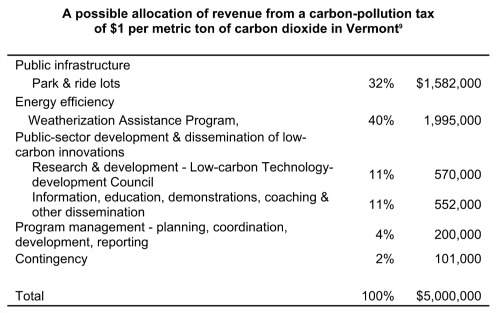
A small carbon tax could significantly help us address these barriers. It could pay for cost-effective programs currently limited by lack of funds. A tax of $1 per metric ton of carbon dioxide would cost less than 1 cent per gallon of gasoline and generate about $5 million per year. Here are possible ways this tax could help.
• Reducing energy use in low-income households. These households have very limited capacity to pay for energy efficiency. Vermont’s Weatherization Assistance Program (WAP) is the state’s largest effort to help them, prioritizing households below 60 percent of median income. In some places, WAP has three-year waiting lists. Vermont has a goal of getting 90 percent of its energy from renewable sources by 2050. At current funding, WAP could reach just 79 percent of these households that year. Adding $2 million per year gets us to 88 percent. If research and development efforts can reduce weatherization costs 10 percent, we can get to 93 percent.
• Relieving the shortage of park & ride space. Eight areas of Vermont with high residential densities have no park & ride areas within 10 miles. Eleven of 79 park & ride lots are frequently over capacity. We could reduce the number of underserved areas by half and remedy the shortage of spaces at existing lots by 20 percent for a little over $1.5 million.
A carbon tax can be a way to make adopting low-carbon practices and technologies easier, cheaper and less risky.
• Reducing the cost of low-carbon technologies. Although costs of renewable energy have dropped, high upfront costs still plague low-carbon technologies. In the long term, these technologies are cheaper. In the short term, however, they take a lot of money. Vermont’s Energy Action Network estimates the upfront costs of investments needed to achieve our 90 percent renewable by 2050 goal at $33 billion. Research and development can reduce these costs. The public sector has an important role here. It can undertake research and development the private sector finds unattractive, for example, emphasizing low-cost practices and technologies.
• Niches for research and development in Vermont exist. These are in the form of combinations of unique need and resources. One need is thermal-efficiency upgrades, which the Energy Action Network estimates will cost $9 billion. One resource is Vermont’s housing stock, among the oldest in the country. Vermont also has an abundance of skill, knowledge and motivation. Just as one indicator, roughly 1,000 building professionals attended Efficiency Vermont’s 10th Building Better by Design conference this February. A technology development council could be the means. Such councils have produced rapid innovation in East Asia. Drawing members from public, nonprofit and private sectors, these councils identify and prioritize opportunities, and coordinate their development. To the building professionals above, we could add architects, engineers, physicists and other scientists from Dartmouth, Middlebury, the University of Vermont and Vermont Technical College. If the only thing the council accomplishes is reducing the cost of thermal upgrades by 10 percent, we will come out $880 million ahead.
• Informing, educating and demonstrating. Recent pilot projects build familiarity with and confidence in low-carbon alternatives. Here are just three in and around Vermont.
• Solarize Upper Valley tripled installed photovoltaic capacities within a year in participating communities. The project director then developed a do-it-yourself Solarize toolkit. Now, technical specialists can remotely support communities running their own Solarize campaigns. Two specialists, costing $270,000, could cover Vermont’s remaining towns in three years. Meanwhile, studies show faster adoption after the campaign than before, and diffusion into neighboring communities.
• Zero Energy Now converted 22 conventional Vermont homes into high-performance, energy-efficient homes with photovoltaic power systems. The conversion produced an average return on investment of 9 percent. A statewide demonstration group of 50 homes would cost $150,000, with homeowner incentives and site visits for prospective ZENers.
• Addison County Community Trust and Cathedral Square Corp. redeveloped a blighted mobile-home park into Vermont’s first net-zero-energy, affordable rental community, “McKnight Lane7.” It features modular homes constructed by Wilder, Vermont-based VERMOD. This project replaced an uninhabitable mobile-home park with much needed new affordable housing. Each home includes a Sonnen back-up battery, which provides energy resiliency. Rent for these Vermods is less than an average member of Weatherization Assistance Program’s high-priority group pays for rent and energy in a conventional manufactured home. A feasibility study for redeveloping other suitable mobile home parks will cost $130,000.
Financial assistance, lower-cost low-carbon alternatives, information and demonstrations add up to increased rates of adoption. A carbon tax can be a way to make adopting low-carbon practices and technologies easier, cheaper and less risky. These principles could support plans for other states.