

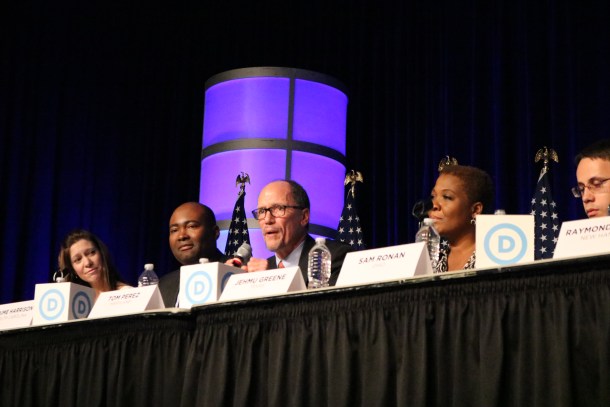
[B]ALTIMORE — Inside the Baltimore Convention Center on Saturday — one floor above the Motor Trend International Car Show — the 10 candidates racing to remodel the Democratic National Committee into a humming political machine offered their closing arguments.
Like any proper auto show, the DNC forum was teeming with branded merchandise. Inside an expansive debate hall — which was filled with 1,000 core party leaders from across the country — large blue “D” logos were everywhere. A placard hanging behind the candidates heralded the Democratic Party simply as “Our Future.”
And while each candidate running to chair the DNC offered their own hopeful vision for the future, a consensus quickly emerged that the committee has made grave mistakes in the past.
During President Barack Obama’s eight years in office, Republicans made unprecedented electoral gains across the country. The GOP has picked up 919 state legislative seats since 2009, resulting in 32 states where the party holds both legislative chambers — an all-time high. In 24 of these 32 states, there is also a Republican governor.
In just six states do Democrats control both the executive branch and the two legislative bodies, according to the National Conference of State Legislatures. In Vermont, the Legislature is true blue, but Republican Gov. Phil Scott has signaled he is willing to act as a check on liberal legislation, pledging to veto a paid family leave bill as well as any increases in taxes or fees.
The DNC and the Democratic Congressional Campaign Committee have been largely blamed for the series of punishing losses over the past few years. The party is also under intense pressure from the left, which sees its political message as more resonant that Democratic talking points of the past. An organic protest movement fueled by the left is demanding legislators resist the policies of President Donald Trump while pitching more progressive ones.

People on the left are also frustrated by the way the DNC treated their messiah, Sen. Bernie Sanders, I-Vt., during his uphill presidential bid.
There was no mention Saturday of the DNC’s former full-time chair — Debbie Wasserman Schultz — who was pushed out on the eve of the party’s national convention after leaked emails exposed her apparent preference for Hillary Clinton’s candidacy.
Still, the mistakes of her tenure hung thick in the air as candidates acknowledged that Sanders wasn’t given an entirely fair shot.
Longtime New Hampshire party leader Raymond Buckley — who is considered a longshot candidate for chair — recalled accompanying Sanders into the Statehouse in Concord to ensure the longtime independent would be allowed to register as a Democratic candidate ahead of the first-in-the-nation primary.
Buckley also railed against the joint fundraising agreement the DNC reached with Clinton’s campaign during primary season, which struck Team Sanders as collusion. He added that the power of the Democratic Party apparatus has long been concentrated in the District of Columbia while state party leaders closer to the people are ignored.
“For the last eight years I’ve been a vice chair, and I don’t know what the hell is going on in this party any more than you,” Buckley told the crowd.

Candidates pledged to reform the nominating system in key ways, making direct appeals to disgruntled Sanderistas. They criticized the lackluster primary debate schedule, wherein the democratic socialist got limited TV time to sell his campaign. Others proposed a more randomized timetable of state primary and caucus dates in order to quash any hint that the calendar was drafted to benefit a candidate.
Candidates made vague promises about reforming the superdelegate system, a point of controversy during the campaign, though no one pledged to abolish it.
“Everything we do must be transparent,” said former Labor Secretary Tom Perez, who is seen as a top contender for the job. “The culture of the DNC has been far too secretive.”
Perez is a longtime public servant, who has served as the director of CASA de Maryland, an immigration advocacy organization. He was the assistant attorney general for the Justice Department’s Civil Rights Division under Obama before becoming labor secretary in 2013. He fought at Labor to implement new federal work guidelines, though many have been recently overturned by the courts as beyond the scope of executive powers. One such rule, blocked by a federal injunction in November, would have expanded overtime pay requirements for 4 million more workers across the country.
While Perez has been critical of the DNC’s treatment of Sanders — going as far as to say the primary was “rigged” against him before walking that line back — some on the far left see him as too close to the Democratic establishment.
Perez was on Clinton’s short list of vice presidential picks and has received support from top party figures, including former Vice President Joe Biden and former Attorney General Eric Holder. While he preaches many progressive ideas, Perez is also cautious as the party looks to reshape itself. He is concurrently looking to energize the left and woo moderates back into the party.
“We’ve got to make sure that everybody has a seat at the table in this process, and we do so by making sure that we are out there listening to people,” Perez said Saturday.
His main challenger is Rep. Keith Ellison, D-Minn.
Ellison was a top surrogate for Sanders on the campaign trail and has received the endorsement of the Vermont senator, as well as fellow liberal darling Sen. Elizabeth Warren, D-Mass. (Ellison has brought on one of Sanders’ top presidential campaign staffers, Nick Carter, of Vermont, to do member outreach.)

Ellison became the first Muslim member of Congress in 2007 and co-chairs the House Progressive Caucus. He cut his political teeth in law school as an organizer against police brutality in Minnesota. Ellison’s community outreach in his congressional district is legendary and translated into impressive voter numbers. In the 2016 presidential race, 75 percent of eligible residents in Ellison’s Minneapolis district went to the polls.
“We’ve got to be on the line, carrying the sign,” Ellison said Saturday. “And I’m telling you, the reason I’ve got the support of so many grass-roots folks is because when there’s a picket line to be walking on, I’m on that line. When there’s a strike vote, I’m in that meeting. And we will be together, standing up, to convert our protest and First Amendment rights into electoral gains at the ballot box.”
The disparity between the two candidates’ backgrounds has conjured the narrative of the DNC race as a rematch between the Sanders and Clinton wings of the party.
That framing is somewhat simplistic, though, as both candidates have attracted support from a number of respected unions, and both agree that local outreach in all 50 states must be the path forward. The two have remained respectful, even complimentary, throughout many weeks of campaigning for the job.
“When Tom was secretary of labor, I had no better friend over there. He was a tireless advocate,” Ellison said Saturday. He added that while the candidates may offer varying strategies, Saturday’s forum was “a family meeting.”
Dean backs an outsider
Although Perez and Ellison are considered the top two competitors in the race, Howard Dean, a former DNC chair and Vermont governor, sees the race differently.
Dean predicted the race would be won by a younger candidate, one whose political skills were forged outside Washington. While Dean said he wouldn’t likely be endorsing a candidate, he spoke favorably of two candidates: Pete Buttigieg and Jaime Harrison.
Harrison, the 40-year-old leader of South Carolina’s Democratic Party, thinks the party’s main problem is that its soaring rhetoric doesn’t result in concrete actions.
“Our problem is not that we have not been telling people what we believe in, and what our values are,” Harrison said Saturday. “That is our problem: We have been telling it to them and not showing it to them.”
Harrison spoke of a program he set up in his state party focused on small acts of service to the community that engendered faith in the party, from fixing up homes to helping teens fill out FAFSA forms.
Buttigieg, 35, is the Democratic mayor of South Bend, Indiana. He is a Harvard-educated Rhodes scholar who served as a Navy intelligence officer in Afghanistan. He is also the first openly gay executive officeholder in Indiana. In high school, Buttigieg won the John F. Kennedy Profiles in Courage Essay Contest for his submission hailing then-Rep. Sanders’ political work.
“Sanders’ positions on many difficult issues are commendable, but his real impact has been as a reaction to the cynical climate which threatens the effectiveness of the democratic system,” Buttigieg wrote. “His energy, candor, conviction, and ability to bring people together stand against the current of opportunism, moral compromise, and partisanship which runs rampant on the American political scene.”
Neither Ellison nor Perez has locked up a majority of support from the 447 DNC members, who will meet in Atlanta this month to vote for the chair. Dean believes that as voters cement their decisions, candidates with close ties to Washington will suffer.

“This is an outside-the-Beltway campaign, and the DNC voters want true outsiders,” Dean said Saturday by phone from Vermont. “Being a preferred candidate of anyone inside Washington is the kiss of death.”
Dean initially threw his hat into the ring for DNC chair before backing out in early December. He has been advising a number of the candidates for chair behind the scenes, and his campaign message of a “50-state, 50-year strategy” has been adopted by Buttigieg.
“It’s time my generation stepped aside,” Dean said Saturday. “We can advise and coach, but we need to let the young people get in the DNC and start running it.”
In his remarks Saturday, Buttigieg positioned himself as the candidate who “isn’t the product of one faction or another faction, but who’s here to deliver the fresh start that our party needs.”
Burlington Mayor Miro Weinberger believes in Buttigieg.
The two have bonded through their work together in a host of mayoral networks, including the Metro Lab Network, which partners municipalities and universities with the goal of finding innovative solutions for urban problems.
“He truly knows how to organize at the local level,” Weinberger said. “All the candidates for chair talk about rebuilding the party from the local level up, and Pete has the experience to do that.”
Weinberger has pitched Buttigieg to Vermont’s five voting DNC members. He argues that if Ellison or Perez doesn’t pass the 50 percent threshold required to win the race, Buttigieg could be a perfect compromise candidate who could draw support from all factions within the party.
Vermonters look to state party’s needs
Vermont’s DNC members have held conference calls with all the major candidates for chair and say they are unified in their support of Ellison.
Two of Vermont’s five voting DNC members attended the Baltimore forum to hear the candidates make their final pitches.
After the event, Vermont Democratic Party Chair Dottie Deans said she was convinced that Ellison would best rehabilitate the party.
She expressed Vermont’s exasperation at the DNC, portraying it as a national organization unconcerned with state issues. She said the monthly stipends from the organization are never enough and that the national organization offers no financial support for the Vermont party to keep staffers working on outreach when elections end.
“The number from the DNC has always been in question. We’ve always fought for more,” Deans said. “It’s difficult for people to connect with the Democratic Party in the states if the doors are locked up after the election.”
“We can’t just go to sleep for a year and a half between elections,” added Vermont Vice Chair Tim Jerman, who is also supporting Ellison. “We need to go where we haven’t gone. We need to talk to the people and listen to what they need.”

Jerman said the Green Mountain State often feels forgotten, unable to book political speakers or gain access to critical campaign resources and infrastructure.
Jerman contended it would have been much easier to muster support for Democratic gubernatorial candidate Sue Minter if the Clinton campaign had a greater presence in the state.
“The Hillary campaign had almost no presence in Vermont, and all you saw were Trump signs,” Jerman said. “I think that hurt us.”
Deans said there was complacency ahead of Election Day.
“There was a feeling that this was a slam dunk,” she said. “But we were rudely awakened of the night of Nov. 8.”
Deans said the Vermont Democratic Party would be hobbled if not for ceaseless fundraising support from Sen. Patrick Leahy, D-Vt, and Rep. Peter Welch, D-Vt.
“Patrick Leahy has been a godsend for us. Peter too, in his own ways,” Deans said. “They are the backbone of support for our party.”
In early December, Vermont’s DNC members had a 40-minute conference call with Ellison.
Burlington’s Mary Sullivan, who as a superdelegate pledged her support to Sanders, said she chose Ellison shortly after that phone call.
“He stood out as having the vision, the presence, the oratory skills as well as nuts and bolts experience of how to run campaigns,” she said.
Terje Anderson also believes it’s Ellison who understands the political moment. Anderson, who became a DNC member in the late 1980s, said the organization is in desperate need of new young talent.
“I’m amazed at how many people are still around from the (Bill) Clinton days in the ’90s,” Anderson said. “I’m not sure that’s healthy.”
Secretary of State Jim Condos also believes that the DNC has an identity crisis and needs a major shakeup.
“I think we need to move away from all semblance of where we’ve been,” said Condos, who is leaning toward Ellison. “Tom Perez has too many ties to the existing system, to Barack and (interim DNC Chair) Donna Brazile and Debbie Wasserman Schultz. We need to get away from that for now.”

