

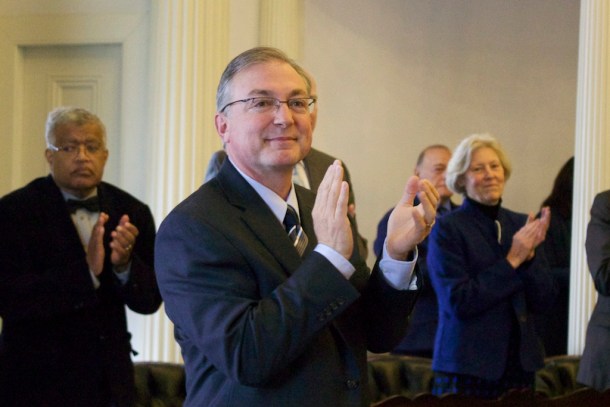
That’s according to Sen. Philip Baruth, the new chair of the Senate Education Committee, who helped write the education reform bill that passed two years ago. The idea behind it was to encourage and eventually require school districts to merge and form larger units to better serve students and better manage costs.
Theoretically, those larger districts would then have an easier time down the road evaluating which schools are needed as the number of students declines. But those decisions, Baruth said, would be made at the local level, not as directives from Montpelier.
“Your own little school board is tasked with one thing: keeping your school open, keeping your teachers in place, changing nothing really. But if you broaden that out a little and you have two or three towns right next to each other, then the question becomes: How can we best use the resources?” said Baruth, a Chittenden County Democrat.
In passing the law “we believed that slightly larger governance districts would still be local,” he said.
Districts representing more than half the students in Vermont have had successful merger talks, according to Baruth, displaying a color-coded map showing the status of talks across the state.
In this edition of Digger Dialogue, the senator insisted the prime goal of Act 46 was not to close schools. Baruth, a writer, said that point was included twice in the bill just to be clear. However, he acknowledged repeating it also indicated that shutting down schools was what many believed was the principal objective.
“It’s never been the intention to close small schools,” Baruth said. “With that said, once you form this larger governance unit, it may be that you now have six schools and everybody’s taken care, everybody’s happy in five of them, and everybody votes unanimously that we don’t need that building operating anymore. We’ll close that to provide more resources in our five buildings.”
“When people hear closing a school, what they hear is my community is going to be left out, my kids are going to be left out. This new board will have it as their responsibility to make sure everyone is happy with what happens,” he said.
The number of students in kindergarten through 12th grade in Vermont has declined from 107,000 in 1997 to approximately 88,000 last year.
There have been problems with Act 46, Baruth acknowledged, and he is collecting information to put together a bill to make changes.
Gov. Phil Scott said during the campaign that Act 46 was “falling far short of the cost containment and property tax solution Vermonters are looking for.”
