

[M]embers of the Legislature’s budget committees are concerned about the future of federal funding for Vermont. The state depends on Washington for about a third of its budget.
President-elect Donald Trump and congressional Republicans have vowed to substantially alter federal funding for health care, transportation and environmental protection. But state budget writers are uncertain of what to expect, and when to expect it.
Rep. Kitty Toll, D-Danville, the chair of House Appropriations, said the question of how changes in federal policy could affect Vermont is one of her greatest concerns.
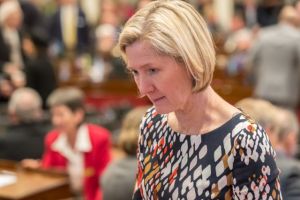
“What I worry most about is what’s going to happen in Washington,” Toll said Friday. “There’s an uneasiness.”
More than $2 billion of the state’s $5.8 billion budget in fiscal year 2017 came from federal funds.
According to a tally from the Department of Finance and Management, the largest share of federal money, $1.1 billion, is for the Medicaid program.
More than $325 million went to transportation purposes. An additional $266 million was directed toward non-Medicaid-related human services needs, and $136 million was used for education.
Federal money pays at least part of the compensation for about 4,200 state employees, according to an estimate by an analyst with the department. That’s about half of the state workforce.
Toll said there is always some question when building a budget at the state level of what to expect from the federal government. “But there seems to be particular discomfort this year in the unknowns,” she said.
Erica MacKellar, a policy specialist at the National Council of State Legislators, said last month that the nationwide nonpartisan organization was not speculating at that time about what changes could be on the horizon for federal money for state programs.
“Everyone’s sort of in a wait-and-see mode,” MacKellar said. “There’s a lot more questions than answers.”
Stephen Klein, who heads the nonpartisan Legislative Joint Fiscal Office, echoed the uncertainty last week.
“We just don’t know a lot,” he said.
According to Klein, it’s unlikely that changes in federal funding will come right away. One reason is the timing: The federal fiscal year begins Oct. 1; Vermont’s starts July 1. He expects to see changes from Washington becoming clear later in the year.
It’s likely that the Federal Funds Information for States won’t have information about how national policy changes that impact state funding until June, Klein said.
Sen. Jane Kitchel, D-Caledonia, the chair of Senate Appropriations Committee, said if dramatic changes to federal funding are made by Congress and Trump that would affect the 2018 fiscal year budget, there would likely be a special session of the Vermont Legislature.
In a statement Friday, Sen. Patrick Leahy, D-Vt., acknowledged the anxiety of states over future financial support from the federal level.
“There is great uncertainty about whether the Trump administration and Congress will push off to the states many responsibilities on which the federal government has long been an essential partner,” Leahy said.
Leahy opted in November to leave his post as his party’s leader on the Senate Judiciary Committee to become the ranking member on Appropriations. He said he felt he could better defend Vermonters’ interests from a leadership position on the money committee.
Last week he reiterated that he plans to fight for federal support for Vermont.

Commissioner of Finance and Management Andy Pallito said in December that questions about the stability of money from Washington are not novel.
“The uncertainty was really, really high a couple of years ago when they shut the federal government down,” Pallito said.
The money Vermont receives from the federal government could change under the incoming administration, he said. However, exactly what might change is not clear.
“It’s too soon to tell,” he said.
In an interview in December, Rep. Mitzi Johnson, D-South Hero, the former chair of House Appropriations who last week became House speaker, said she will be keeping an eye on changes to lower-profile streams of federal money.
“There’s a lot of attention on the Affordable Care Act, but I’m not sure that’s the piece that we have to worry most about right now,” Johnson said.
She expects states of all political stripes will lean on the federal government if there are dramatic changes to funding for certain health care programs, like Medicaid.
Johnson has more concerns about smaller discretionary federal grants that support work by a variety of state agencies, including the Department of Public Safety and the Agency of Natural Resources.
“I think those are the things we’re really going to have to watch out for because, frankly, they’re quieter and easier than the big headlines of cutting the Affordable Care Act,” Johnson said.
House Minority Leader Don Turner, R-Milton, said he has consistently been wary of Vermont’s over dependence on money from Washington.
A report from the Joint Fiscal Office shows that Vermont ranks among the top five states that receive federal funding.
“We are way too dependent on the federal dollar in my opinion,” Turner said.
