


The first Thursday after the first Monday in January may seem ho-hum after the holidays. But for a select few Vermonters, it’s the stuff of history.
“When I first walked into the hall, there was a throng of people and a tremendous feeling of excitement,” Madeleine Kunin recalls. “When the doorkeeper announced, ‘The next governor of the state of Vermont,’ there was a sense this was a turning point in my life.”
Vermont has inaugurated 76 governors since Thomas Chittenden recited an oath from the 1777 state constitution he helped draft. This week Phil Scott will raise his right hand and repeat the same words six living peers have spoken. But as Scott’s predecessors from the past half-century can attest, the address that follows is very much one’s own.
Philip Hoff: Democratic dawn
Philip Hoff made history in 1963 upon his swearing-in as the first Democrat elected governor by Vermont voters.
“The place was packed. They couldn’t get everybody in,” the Burlington lawyer, then 38 and now 92, recalled in a past interview with this reporter. “My good Republican parents came up and participated. My father used to say, ‘Phil says he’s a Democrat, but he’ll get over it.’”

First, however, the newly elected governor had to clear a few other obstacles.
“One of the problems of coming in as governor after 109 years without a Democrat is you don’t have a body of people who you can draw from. I wasn’t able to put a foot in the office until I was sworn in. Right off the bat you have a problem. My inaugural address consisted of, ‘We don’t have enough information yet to make decisions.’”
Hoff instead gave lawmakers a one-year budget (previously, governors drafted two-year plans) and asked them to adjourn until his administration could review the state’s economic and educational needs.
Deane Davis: Taxing speech
Hoff served six years, then made way for Republican Deane Davis, who was inaugurated in 1969.
Davis, unlike his predecessors, didn’t come from the Legislature, but instead from the president’s office of Montpelier’s National Life Insurance Co. The 68-year-old was all business — he proposed the state’s current sales tax in his inaugural address. But he had time for emotion, too.
“As I stood there during the preliminaries, I recalled that this was a pageant I had witnessed several times before but had never, of course, participated in,” Davis wrote in his self-titled autobiography just before his death in 1990.
“At first I felt a sense of unreality. Then my mind flashed back to my growing-up days on Allen Street in Barre. I saw and heard again in memory my father and mother and was achingly aware of all the sacrifices they had made for their nine children. They were always so proud when their children spoke pieces in public or won other minor honors. Most of all, I remembered how much my father hoped at the end of his life that his children and grandchildren would achieve some of the things he had once hoped to achieve. How much I wished that my father and mother could have been there.”
Thomas Salmon: Catholic prayers
Davis announced his retirement long before leaving four years later, but his successor, Thomas Salmon, didn’t decide to run until after attending the Democratic National Convention the summer of 1972. He upset the Republican favorite that autumn and was inaugurated in the winter of 1973.
Salmon was the second Democrat and the first Catholic elected governor by Vermont voters. As a result, the Rockingham lawyer started his inaugural day with Mass at a Montpelier church.
“That was important because I’m sure the big guy up there had something to do with me getting elected,” Salmon, then 40 and now 84, once recalled in an interview. “To this day, I’m the only Catholic who has served as governor of the state of Vermont.”
Salmon’s speech was short, giving him just enough time to repeat his campaign slogan for strong environmental protection laws: “Vermont is not for sale.”
“The thing that’s notable is it has to be one of the shortest inaugural addresses in the history of Vermont — 11½, 12 minutes,” he recalled. “We made a fundamental statement about our intentions, said it quickly and moved off stage.”
Richard Snelling: ‘Giants of the past’
Salmon served four years, then welcomed Richard Snelling, who was inaugurated in 1977.
Snelling, then a 49-year-old Republican businessman from Shelburne, began his inaugural address not with his own words, but those of his predecessor of exactly a century before, Gov. Horace Fairbanks.

Said Snelling: “‘Standing on the dividing line of the centuries, it is the part of wisdom to consider not alone the present, its comforts and privileges, but as well the past, that we may learn their cost, their lessons, and take warning from any mistakes by the way, and that we may plan broadly, intelligently and wisely for the future.’ So spoke Gov. Fairbanks 100 years ago. I could not accept the honor and challenge of delivering the message which tradition calls upon me to make this day without the counsel and perspective of those who have preceded me in such a challenge. And so I have been reading the gubernatorial messages delivered in Vermont throughout these years.
“To do so is to marvel at the genius, the optimism, the versatility and the abiding courage and faith in God which are revealed by those messages, not alone of the men who spoke them, but as those qualities are fully revealed in the character of the free men and women with whom they shared hopes and fears, burdens and goals. History has its lessons and its perspectives. It is at once frightening and encouraging. It must intimidate us and humble us to know that so many great men and women have preceded us in these halls and set so high a standard of service and accomplishment against which we must measure our worthiness. But, at the same time, history furnishes us with encouragement as it notes that the giants of the past erred, too, yet tried again and again — succeeding often enough to let us know man can better himself, failing enough to tell us that they, too, must have known fears and self-doubts.”
Madeleine Kunin: A woman’s place
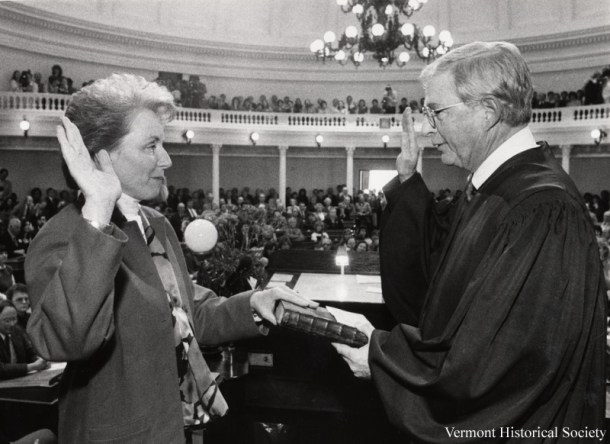
When Snelling stepped down eight years later, Kunin made history as Vermont’s first (and so far only) and the country’s fourth female governor. Her inauguration in 1985 celebrated that distinction.
“A lot of my friends came from around the country because they wanted to see a woman inaugurated as governor,” recalls Kunin, then 51 and now 83. “You do feel the auspiciousness of the moment. I felt I had a big responsibility. It was exciting more than anything else and, in a way, historic.”
Kunin, born in Switzerland, came to America with her mother and brother at age 6 during Hitler’s invasion of Europe in 1940. Her mother wasn’t alive on inauguration day, but her brother, Edgar May, led the legislative delegation that escorted her into a House chamber filled with family and friends.
“When I raised my right hand to take the oath on January 10, 1985,” Kunin writes in her 1994 autobiography “Living a Political Life,” “my eyes were riveted on the ruddy-faced, black-robed, visibly nervous man standing three feet in front of me: the chief justice of the Vermont Supreme Court, the Honorable Frederic W. Allen. He did not read the oath of office, but recited it from memory. Midway he abandoned the printed text and improvised. After each pause, I repeated whatever he said. The words were familiar, but the order was not. He was moving in circles, instead of in a straight line. At last, he caught the last sentence: ‘So help me God.’ I repeated, ‘So help me God’ with enormous relief. Had anyone noticed our digression? No one had.
“It was our portrait, not our words, that held the public’s attention,” Kunin continues in her book. “The two of us with our hands raised, he robed in black, I dressed in white, had created a startling image: gubernatorial power was being transferred to a woman. I was the same, and I was different. This had always happened, and it had never happened. Tradition was being continued, and it was being broken.”
Howard Dean: ‘A hard time’
Howard Dean didn’t have a two-month transition period before he took his oath. The Burlington doctor was conducting a physical when he learned, as lieutenant governor, he would be taking over.
After Kunin, Snelling had come out of political retirement for another inaugural in 1991. But Dean had no time to prepare to succeed him when, at age 42, he raised his right hand just hours after the 64-year-old Republican died of cardiac arrest Aug. 14 that year.
Dean, eschewing the traditional trappings of an inauguration, was sworn in as seemingly everyone else was on summer vacation.
“I went back and finished the physical,” Dean, now 68, would go on to tell a reporter covering his 2004 presidential campaign. “I figured that, later, I’d have a hard time fitting it in.”
James Douglas: ‘Graduate of this House’
When Republican James Douglas was sworn in for the first of four terms in 2003, he looked past his printed speech to the crowded House chamber around him.

“I took it all in, never having imagined that I might someday be standing there before the people of Vermont to assume such a tremendous responsibility,” Douglas writes in his 2014 autobiography, “The Vermont Way.” “My confidence, though, was buoyed by the realization that I had been preparing for this moment for many years. From the podium I looked down at seat 125, where I had first sat as a legislator 30 years before.”
Douglas, then 51 and now 65, went on to note that in his address.
“I am a graduate of this House,” he began. “Thirty years ago this week I took my seat as a representative from Middlebury. America was in the midst of a long and divisive war, and a presidency was crumbling under the weight of scandal inspired by politics run awry. But here, tucked among the rolling hills of Vermont, under this dome, men and women of goodwill met, and progress triumphed over partisanship. I pledge to you that I will carry on the Vermont tradition of civic virtue. I will be a willing listener and a reasonable partner. My intentions will be sincere, my word will be my bond, and while we may not always agree on approach, our goals are shared.”
Peter Shumlin: A different view
When Democrat Peter Shumlin delivered his first inaugural address in 2011, he faced a unique challenge reading it.
It wasn’t just because Shumlin is one of an estimated 15 percent of Americans — including fellow Govs. Dannel Malloy of Connecticut and John Hickenlooper of Colorado — with dyslexia.
“I remember well in second grade being called into the principal’s office with my parents to have them be told what I already knew, but hoped beyond hope that they would never find out,” Shumlin, then 54 and now 60, said in his speech. “That with all the good efforts of my teachers they could not teach me how to read; that the prospects of my being a successful student and going on to college were unlikely.”
Then one instructor — the late Claire Ogelsby, subject of the 2000 documentary “The World in Claire’s Classroom” — “slowly and creatively” taught him to read.
“What I remember best about Claire,” Shumlin said in his speech, “was no matter how difficult the challenge, no matter how innovative she had to be or how hard she had to work, she never gave up on me, and therefore neither did I.”
The governor’s teleprompter was a different story — it stopped before he started, forcing him to turn to a paper printout.
Scott hopes to have an easier time when he offers his inaugural address after taking the oath of office Thursday at 1:30 p.m. He’s expected to be surrounded by several predecessors offering bipartisan support — and sympathy.
“I think people feel the inauguration is there to give the governor a good start,” Kunin says. “You recognize you can’t do this alone. You need all that goodwill from the Legislature, friends, family and staff — because there are tougher times ahead.”
