


Those are the views of the next leader of the Vermont Senate, Tim Ashe, a Chittenden County Democrat/Progressive who will succeed Sen. John Campbell, a moderate Windsor County Democrat who held the Senate president pro tempore position since 2011. Campbell decided not to seek re-election to the Senate in November.
In this edition of Digger Dialogue, Ashe, who just won his fifth term, discussed some of his priorities, some of the challenges, and the excitement of winning the top leadership post in the 30-member Senate.
Ashe was the top vote-getter of the six Chittenden County senators elected nearly two weeks ago. After the general election, his fellow Democratic senators selected Ashe as their leader. Sen. Claire Ayer, an Addison County Democrat, dropped her challenge at the last minute. Because Democrats have an overwhelming majority, winning the support of the caucus was essentially the race. The vote in January by the full Senate is expected to be a formality.
“On a personal level, it’s hugely exciting,” Ashe said in a 30-minute interview at the Hilton in Burlington, where had just finished moderating a panel discussion at a statewide housing conference. The 39-year-old Ashe (40 next month) said he had “the same bounce in my step” as when he entered the Senate in 2009 and had “an insatiable appetite for information.”
Among the public policy challenges he wants to take on is trying to reduce poverty. He’s also outraged by medical costs he said are out of control, a “blob” with an unending appetite. On poverty, Ashe said he wanted to “step back and take a look at the myriad of programs” and see what’s working and what’s not. He also said poverty is inextricably tied to the opiate addiction epidemic.
On a political level, Ashe pushed back on the idea that the Senate was shifting to the left with his selection as president and Progressive/Democrat David Zuckerman’s election to the lieutenant governor’s job. He said any move left would be “more subtle” and the result of the new senators replacing ones not as liberal or progressive.
Ashe also strongly defended the selection of Sen. Dick Mazza, who represents the Grand Isle district, for the third position on a panel that determines Senate committee assignments and selects conference committee members at the end of the session. Ashe described Mazza as a “cooling agent” who recenters the Senate when tempers flare or legislation is moved along too quickly.
Mazza, a senator since 1985, is often “the adult in the room when it doesn’t seem like anyone is acting like one,” said Ashe.
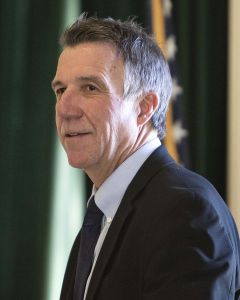
Ashe has chaired the Finance Committee the last several years. He said ideas proposed by the Scott administration will get closer scrutiny than Minter’s probably would have for the same reasons, he said, that some of Gov. Peter Shumlin’s proposals went through without sufficient vetting.
When Ashe was first elected, Republican Jim Douglas was governor.
The Democrat-majority Legislature would “kick the tires quite sufficiently and fine tooth comb every word” in Douglas’ proposals. “I’m not sure that all the legislators in the majority had the same scrutiny when they received proposals from the Shumlin administration,” he said.
Ashe called a certain skepticism “a natural function of a contrary political party.”
And, he said, that natural tension may help convince voters that legislation was thoroughly reviewed.
If Minter had won, Ashe said, he would have felt the need to review her proposals even more closely.
“I would have wanted to make sure that we were proving to the people that there was no rubber stamp in the Vermont Senate, and that’s a matter of personal pride. I try to give my friends a harder time than I give my opponents. No quarter for even your friends, and sometimes it creates awkward situations, but that’s the way you guarantee the people that they can have confidence that you’ve really done your work,” he said.
Ashe saved some of his harshest words for the $6 billion Vermont medical industry, which he said had “an insatiable appetite to spend money” and was full of waste. A new deal with the federal government appeared to be “giving (health care providers and hospitals) the keys and telling them to figure it out” and was focused on limiting future annual increases in costs while “baking in” current inefficiencies.
On the presidential race, Ashe noted that Hillary Clinton was a candidate with baggage and that she received millions fewer votes than President Barack Obama when he won re-election in 2012. Those votes, he said, had they been spread around, could have made the difference between victory and defeat. Trump’s total vote count is only slightly ahead of Mitt Romney’s in 2012.
The outcome, Ashe said, was not what he wanted. And whether it’s health care reform or environmental policy, Ashe conceded the state and the Legislature will have to largely react to any changes at the federal level. On health care reform, he said that “not only could the rug be pulled out from under us but the foundation too” if the Affordable Care Act is repealed without a sufficient replacement.

