


Only through fevered political maneuvering, including the alleged buying of a single crucial vote, did Martin Chittenden win election. In doing so, he finally managed to defeat his three-time rival for the governor’s office, Jonas Galusha. To make matters more awkward, Galusha happened to be Chittenden’s former brother-in-law.
But this was more than a dispute between two men; it was a battle between two parties, the Federalists and the Democratic-Republicans, who called themselves Republicans for short. They shouldn’t be confused with today’s party of the same name.
The Federalists and these earlier Republicans fought over whose vision would shape the future of the United States. In a way, the clash between Chittenden and Galusha was a continuation of the battle between John Adams, a Federalist, and Thomas Jefferson, a Republican, which had led to the disputed presidential election of 1800. The job of settling that election fell to Congress, which took 36 ballots before deciding in Jefferson’s favor.
Thirteen years had done nothing to lessen tensions, and the issues remained largely the same. The parties disagreed on virtually every important question of the day.
Federalists, including Chittenden, wanted a strong central government; Republicans, including Galusha, wanted more power to reside at the state and local level. Federalists believed commerce would be the backbone of the new country’s economy and promoted federally funded infrastructure projects to boost the economy; Republicans believed the nation should rely on farmers to create a virtuous society and opposed publicly funded projects, which they thought would benefit the few at the expense of the many.
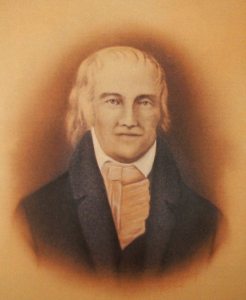
Against that backdrop, Galusha had defeated Chittenden the first two times the men faced each other for governor. In their first contest, in 1811, Galusha had beaten Chittenden by a little over 2,000 votes, or about 10 percent, an easy victory. Governor’s terms were then only one year, so the following year Chittenden again challenged Galusha, and lost by a similar margin.
Then came the election of 1813. Things were different in Vermont. The War of 1812 had erupted and the state braced for a possible British invasion. Early American losses unnerved people and may have won Chittenden some votes. Still, the initial count gave Galusha a slim majority, with just over 50 percent of the total, about 500 votes more than Chittenden.
But the election still had to be certified by the state canvassing committee, which would be made up of members of the newly elected Legislature. Federalists held a four-vote advantage in the House and narrowly managed to elect Daniel Chipman, one of their own, as speaker. It was Chipman’s job to appoint the canvassing committee.
Chipman made a partisan decision that would ultimately benefit his fellow Federalist Chittenden and muscle Galusha out of office.
Though the Legislature was almost equally divided between Federalists and Republicans, Chipman awarded Federalists 28 of the 39 committee positions. These Federalists refused to ratify the popular vote tally, noting possible voting irregularities in Colchester, which had gone overwhelmingly to Galusha.
It seems a Maj. John McNeil had marched about 200 of his troops from Burlington, which was then an armed city, to Colchester to vote. McNeil supported the war cause and therefore backed the Republicans. The canvassing committee argued that many of McNeil’s men might not have been Vermonters and were therefore ineligible to vote. Committee members also said they had heard reports McNeil had bribed the men with liquor and promised to punish anyone who voted for Chittenden.
Rather than sort out whether anyone had voted illegally in Colchester, the committee voided all votes cast in the town. That still left Galusha with more votes that Chittenden, but he no longer had the 50 percent needed to win outright. Under the state constitution, since neither candidate now had a majority, the Legislature would pick the winner.
The purging of the Colchester vote also meant that three Republican members of the Governor’s Council, the precursor of today’s state Senate, lost their seats to Federalists. Those seats were crucial. The Council and House would together select the next governor.
Repeated votes came to the same conclusion: 112 votes for each candidate. Then, on a subsequent ballot, a vote changed, or rather disappeared. The tally came to 112-111, in favor of Chittenden. As Democrats celebrated, Republicans cried foul and quickly collected signatures from 112 legislators who claimed they had voted for Galusha.
What had happened to the missing vote? Some Republicans pointed to Josiah Dunham, who as clerk of the House was the official vote counter. Dunham was a Federalist who, some noted, dressed in shirts with large ruffled cuffs, where he could easily have concealed the missing ballot.
Federalists countered that Republicans had tried to buy the vote of Carpus Clark, a Republican representative from Worcester. Clark had recently sold his struggling farm to a prominent Republican, they said, suggesting the buyer had overpaid in hopes of securing Clark’s loyalty.
Clark himself pointed the finger at Federalists. He said two leading Federalists had tried to buy his support under the guise of hiring him to haul goods to Boston. They promised to pay him handsomely because the delivery was urgent, so urgent he would have to leave immediately and miss the crucial vote. Clark rejected the offer.
Both parties were furious with Clark. But we don’t know why. Were they angry he had attempted to sell his vote, or that perhaps he had agreed not to vote at all? Or was it merely that by disclosing the offers he had embarrassed both parties? Whatever the reasoning, the House voted to expel him.
Soon afterward, Clark helped found the town of Burlington, Ohio, named after the one in Vermont. Somehow, his detractors claimed, Clark suddenly had enough money to buy a prime parcel in Ohio.
In the long run, Chittenden may have regretted that Chipman and others worked so hard to elect him. He served two years in office during extremely rancorous times, having been reinstalled in office by the Legislature in 1814 after another razor’s edge race against Galusha.
As a Federalist, and therefore pro-British, Chittenden was in an awkward position, since the nation was now at war with Britain. He tried to recall Vermont militia troops stationed in Plattsburgh, New York, defending against invasion. He argued that the troops’ role was to serve the state’s interests, not the nation’s. The troops refused to return.
American victory in the War of 1812 was a boon to Republicans, who had championed the fight, and a disaster for Federalists, who had so bitterly opposed it. New England Federalists were discovered to have been secretly discussing a separate peace with Britain and seceding from the Union. The national party soon dissolved, and with it any chance of Chittenden remaining in office. He was Vermont’s last Federalist governor.
Galusha, who had already served four terms as governor before being ousted by the Federalists, defeated Chittenden again in 1815. Chittenden got the message and stopped running for governor. With only token opposition, Galusha went on to win another four elections. He won each handily, taking as much as 95 percent of the votes, and keeping the decision out of the hands of the Legislature.

