

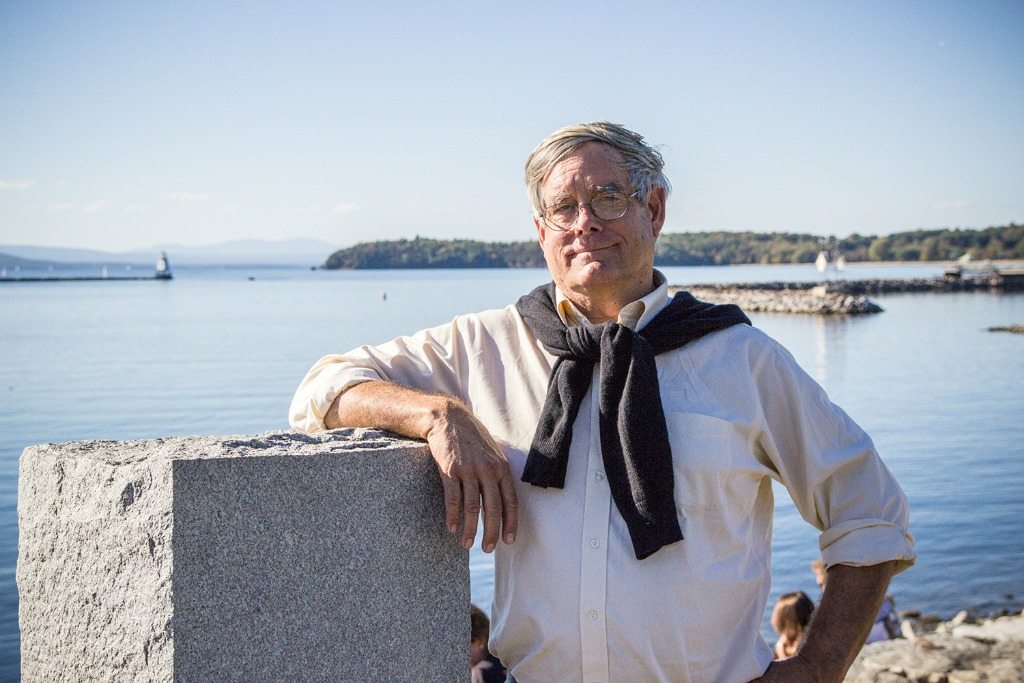
BOB KLEIN ON THE CULTURAL AND ENVIRONMENTAL
TRADEOFFS OF OUR ENERGY CHOICES
(Editor’s note: The following comes from the recent Vermont Folklife Center exhibit, Portraits in Action: Pioneers in Renewable Energy, Environmental Conservation, and Land Use Planning. For more, visit their website.)
[B]ob Klein, the first director of Vermont Chapter of the Nature Conservancy, makes an argument for thinking big and stretching beyond our comfort collective zone—listen below—then read his response to the question: What will bring us to the next level in meeting the energy and environmental challenges we are facing today?
What will bring us to the next level in meeting the energy and environmental challenges we are facing today?
Whatever energy sources we utilize in Vermont inevitably will have cultural and environmental consequences. Whether we like it or not, with energy development there’s no free lunch. There have always been tradeoffs. Having discovered that the environmental cost of burning fossil fuel is unacceptable, we’ll transition to other energy sources, and make new tradeoffs over the decades to come.
Meeting “the next level of environmental and energy challenges” should involve confronting these tradeoffs consciously. There’s room to decide what impacts we’re willing to accept. We can weigh the consequences of certain energy choices against things we value – local control, scenery and open space, prime ag soils, natural areas, and recreational access to land, for example. Some energy choices could even have an impact on Vermont’s rural character itself.
We may be facing a climate emergency, but this need not lead to a suspension of the rules. We do not have to leave the adoption and siting of alternative energy sources to chance. Like other kinds of development, state, regional, and local planning can steer renewable energy installations away from other things that we value. Geographic Information Systems and resource mapping tools have never been more widely available. We just need to use these tools, together with an enabling policy framework, to meet the challenges before us.
Bob Klein
First director, Nature Conservancy Vermont Chapter
◊ ◊ ◊ ◊ ◊ ◊ ◊ ◊
Portraits in Action: Pioneers in Renewable Energy, Environmental Conservation, and Land Use Planning brings together a diverse cross section of twenty-five pioneers, activists, and leaders in renewable energy, environmental conservation, and land use planning, and invites them to speak to the issues at hand. It is both an oral history and a call to action.
The Vermont Folklife Center’s mission is to broaden, strengthen, and deepen our understanding of Vermont and the surrounding region; to assure a repository for our collective cultural memory; and to strengthen communities by building connections among the diverse peoples of Vermont. For more, visit us.
