

[V]ERNON — To get the most out of his sprawling dairy farm near the Massachusetts border, Jeff Dunklee knows his cows have to be comfortable and his equipment has to be clean.
Lately, to make those tasks easier, he’s turning to a different resource: the copious amount of manure produced by more than 500 cattle.
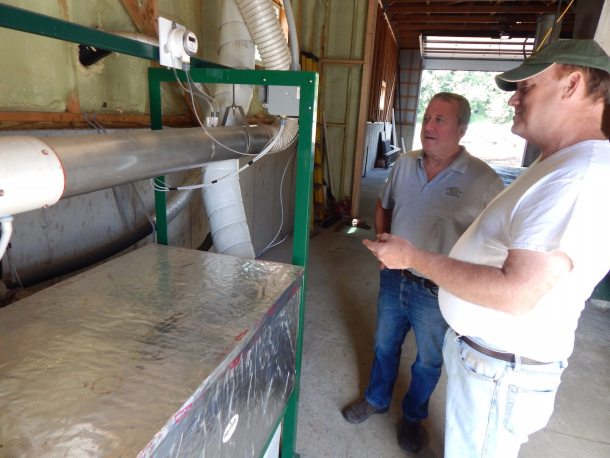
First came a new heavy-duty composting system that allows Vern-Mont Farm to transform cow dung into cow bedding. Next came an accompanying system that captures and repurposes heat generated by the farm’s constantly rotating compost drum to ensure a steady supply of hot water.
The latter system is billed by Enosburg Falls-based Agrilab Technologies Inc. as the first of its kind. But one of the ideas behind it — a New England farmer’s frugality — is not so novel.
“You just kind of hate to see energy dissipating when there’s some potential method of recapturing it and saving money,” Dunklee said.
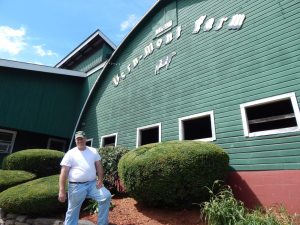
Dunklee co-owns the 850-acre Vern-Mont Farm with his father, Alfred. The Dunklees have deep roots in Vernon, but both father and son are searching for ways to modernize the farm, conserve energy and save money.
That’s especially important in an era of declining milk prices. “As margins become increasingly tighter, you have to explore efficiencies,” Jeff Dunklee said.
It turns out that a neighbor of Vern-Mont Farm, Bob Spencer, is well-suited to help find those efficiencies. He is executive director of Windham Solid Waste Management District and has a background in the technical aspects of large-scale composting.
Spencer — acting as a neighbor, rather than in any official role — coordinated a small pilot project utilizing a manure composting drum at Vern-Mont Farm eight years ago. The idea behind a mechanized rotating drum is that it processes waste and kills pathogens much faster than a traditional composting pile can, Spencer said.
“We said, ‘Yeah, we could do it,’” Spencer recalled of the 2008 test run. “But there weren’t that many installations in the country at that time.”
Fast-forward to 2015, when the Dunklees procured a large rotating drum — housed in a specially constructed building — that can process manure produced by hundreds of cows spread out among their three barns.
Excess liquid is siphoned off before manure is composted in the drum, where temperatures average about 150 degrees. The end product is a material that can be used as bedding for the herd.

“This is not manure (anymore),” Spencer said. “It’s actually fiber from the cow’s digestive tract. It’s the corn and the silage. The manure itself has been consumed by the microbes in the drum.”
That’s no small thing for Jeff Dunklee’s bottom line, because he had been buying about 10,000 cubic yards of sawdust annually to serve as bedding. “We use a lot of bedding because we want our cows to be comfortable and clean,” he said. “But it’s expensive to keep using the quantity that we do.”
The drum-composting project has environmental benefits, as well. For instance, because solids are removed from manure for composting, there is less chance for nutrient runoff pollution when the remaining liquid is spread on — and quickly absorbed into — farm fields for fertilization.
“It’s just one way to help farms have an economic reason to improve the watershed,” said Gaelan Brown, vice president of sales and marketing at Agrilab Technologies.
Agrilab and Vern-Mont Farm are based in opposite corners of Vermont. But they’ve paired up to take the Dunklees’ large-scale composting operation a step further by harnessing its exhaust, which is used to heat water.

“We use a lot of hot water on this farm for cleaning purposes. Cleanliness is really important for the product we’re producing,” Jeff Dunklee said. “We use a lot of propane.”
These days, he’s using less of that fossil fuel as the newly installed system steadily pumps hot water out of the manure composting building. “That’s how it pays for itself: the reduction in expense for fuel,” he said.
The concept of recycling cow manure is not new. Anaerobic digesters produce methane, which can be used as a fuel to produce heat and electricity, as evidenced by Green Mountain Power’s “Cow Power” program.
The industry group Renewable Energy Vermont says the state has more digesters per dairy farm than any other.
But composting, unlike the anaerobic digesters, uses oxygen and produces heat as part of the microbial breakdown of manure. Hence the heat source for Vern-Mont Farm’s hot water, which averaged 134 degrees during Agrilab’s testing last month.
Agrilab has done compost heat recovery projects at a few other farms, but Brown said this is the first such commercial-scale system that works with a composting drum like the one at the Dunklee farm.
As he toured the farm and took photos of the new composting and hot water systems on a recent morning, Spencer predicted they won’t be unique for long.
“I think this is going to be more and more widely accepted,” he said.
