

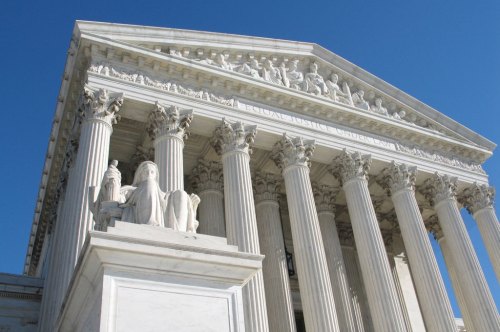
[T]he U.S. Supreme Court decided Tuesday against the state of Vermont in a landmark case regarding health insurance claims data, dealing a blow to states’ power to enforce health care reform.
The court decided 6-2 in favor of a private company in the case Gobeille v. Liberty Mutual Insurance Co., which the Vermont attorney general’s office argued before the justices in December on behalf of the Green Mountain Care Board.

Chief Justice John Roberts joined Clarence Thomas, Anthony Kennedy, Stephen Breyer, Samuel Alito and Elena Kagan in the majority. Justices Ruth Bader Ginsburg and Sonia Sotomayor dissented. Justice Antonin Scalia, who died in February, was not referenced in the decision.
The case dealt with a simple question: Could Vermont force a private insurance company, Blue Cross Blue Shield of Massachusetts, to turn over health insurance claims data for a plan it administered on behalf of Liberty Mutual, which pays administrative fees to the company as part of a self-insurance plan covering Liberty Mutual’s employees?
Vermont subpoenaed the information back in 2012. Liberty Mutual then sued in U.S. District Court in Burlington, saying Vermont was imposing an unreasonable burden and that the state was powerless to force the company to hand over data because of the federal Employee Retirement Income Security Act, or ERISA, which governs self-insured employee benefits plans.
The District Court decided in favor of Vermont. Liberty Mutual then appealed to the 2nd Circuit Court of Appeals in New York City, which ruled in favor of the insurance company. Vermont appealed to the U.S. Supreme Court and made its oral arguments in December.
“ERISA’s express pre-emption clause (invalidates) the Vermont reporting statute as applied to ERISA plans,” the Supreme Court’s decision says. “The state statute imposes duties that are inconsistent with the central design of ERISA, which is to provide a single uniform national scheme for the administration of ERISA plans without interference from laws of the several States.”
Al Gobeille, who brought the case, is the chair of the Green Mountain Care Board, the state’s regulatory agency that oversees and studies a claims database called the Vermont Healthcare Claims Uniform Reporting and Evaluation System, or VHCURES. In a general sense, state law requires insurance companies to submit data to the reporting system.
Gobeille said the decision “could be a blow” to the state’s effort to collect this data and analyze it to bring down health care costs. He said self-insured companies account for the largest number of Vermonters who pay for doctor visits with commercial insurance.
Gobeille said many ERISA companies already submit data to VHCURES.
“Any insurer can still submit,” he said. “We hope they will, and we would ask that they voluntarily submit, which typically people want to work with the state and work for the common good, so hopefully that continues.”
He also said the state might have another avenue through the federal government to force ERISA companies to comply.
“I think that the justices gave us clarity,” he said. “They said, ‘No, you can’t do this this way, but the (U.S.) secretary of labor can do this and should do this and should work with the states to figure out how to do it.’”
Gobeille cited the 18 states that filed friend-of-the-court briefs in support of Vermont’s position. He said the states that want to maintain similar databases can now come together and ask the U.S. labor secretary to enforce health care claims data reporting for ERISA companies.
Darcie Johnston, the executive director of Vermonters for Health Care Freedom, said the organization supports the Supreme Court’s ruling. Her group was one of several that filed friend-of-the-court briefs.
“We just don’t know why or when or who appointed the state to have the right to access medical claims,” Johnston said. “Just because the state wants this data doesn’t mean the state is entitled to this data, and it doesn’t mean that people participating in these ERISA plans don’t deserve to be protected.”
“We think it’s an overreach,” she said. “They’re trying to determine through this data how to control health care spending. We don’t think that’s in the best interest of the people who are participating in these ERISA plans, and if they are, then Congress can change the law.”
Johnston predicted the U.S. Department of Labor likely wouldn’t be able to change the law to mandate this type of data reporting. “It’s worse than a Hail Mary pass,” she said. “It’s not going to happen anytime soon.”

