

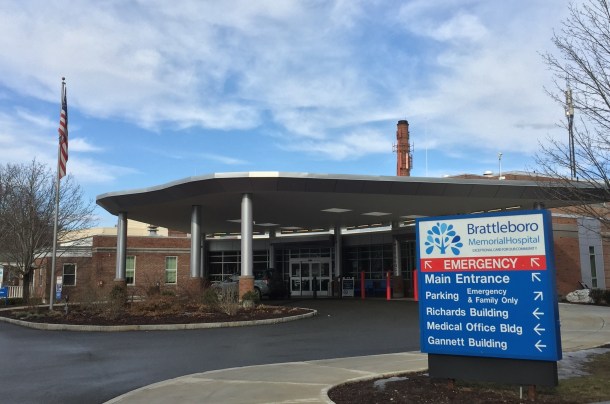
[B]RATTLEBORO – There are four primary vital signs – temperature, pulse, respiration and blood pressure – traditionally monitored by doctors and nurses.
Dr. Kathleen McGraw says a fifth factor – pain – has made its way onto that list over the past decade or so. “The expectation is really out there that patients will have their pain addressed,” said McGraw, Brattleboro Memorial Hospital’s chief medical officer. “And our most powerful pain medications are opiates.”
But with Vermont in the midst of an opiate addiction crisis, hospital administrators say they’re taking careful steps to combat medication abuse while still treating pain. Those steps include additional education for staff; better communication with patients; and more interaction with outside entities that can offer assistance.
“It’s put us in a situation of really trying to adequately address (pain) without over-addressing it,” McGraw said.
In short, the opiate problem has become a primary preoccupation at this 61-bed hospital that serves patients in southeastern Vermont and beyond.
“We talk about it every single day,” McGraw said. “It’s a huge impact on our system. We wrestle with it from a variety of different angles.”
State officials are wrestling with myriad problems stemming from rampant abuse of heroin and prescribed opiates like oxycodone. As the justice system deals with drug-fueled crime and first responders see an increasing number of overdoses, the state has been handing out free samples of an overdose-reversal drug and Gov. Peter Shumlin has been pushing to get more addicts into treatment – though there can be long waits for that help.

At hospitals like Brattleboro Memorial, administrators and doctors are rethinking their approach.
“I think what you’re seeing is the pendulum swinging (away) from total focus on pain control equating to over-prescription of opioids,” said Steve Gordon, BMH president and chief executive officer. “Now it’s swinging back to, ‘We’ve got to be a lot more conscious about this.’”
One way to do that is better educate medical staff working directly with patients on how best to treat pain, McGraw says, “without causing more opiate issues.”
There has been a special emphasis, with assistance from Brattleboro Retreat staff, on pain management for those who use Suboxone, a drug used in opiate addiction treatment. “Treating pain for patients who are on Suboxone is a very, very tricky business,” McGraw said.
That’s because the pharmacology of Suboxone – and the way it interacts with a patient’s opiate receptors – means that “an individual’s response to other opiates is unpredictable when they are taking Suboxone,” McGraw said.
Staff members must weigh such issues on a daily basis, particularly when patients walk into the emergency room seeking pain relief. There, the problem can be “trying to sort out who is asking for pain medication because they’re in pain, and who is asking for pain medication because of dependence issues, then trying to figure out how to get them the help they need,” McGraw said.
Identifying potential problems is made somewhat easier by the Vermont Prescription Monitoring System, which the state Department of Health launched in 2009.
Pharmacists are required when filling prescriptions for certain drugs to submit the patient’s name, the type and quantity of the drug, the date and the name of the prescriber. Drugs that must be reported fall within schedules II, III and IV of the federal government’s controlled-substance law; painkillers like hydrocodone and oxycodone are Schedule II drugs.
Using an extreme example, McGraw said the idea is to “look up and see whether patients have been trying to get pain medication prescriptions from 27 doctors in three counties – that kind of thing. It happens.”
Gordon said Vermont State Police representatives have visited the hospital “to encourage the physicians to query that system with new patients.”
Hospital leaders have been careful, though, to not adopt a one-size-fits-all approach. McGraw echoes other Vermont medical administrators in expressing concerns about Shumlin’s recent proposal to limit prescriptions after “minor procedures” to no more than 10 pills.

“We’re also looking at reasonable limits for more major procedures that provide pain relief without filling up our medicine cabinets with unused opiates,” Shumlin said in his State of the State address last month.
McGraw is leery of uniform standards.
“People’s situations are very, very different, and it actually takes time to tease out how to best treat a patient,” McGraw said. “One individual might do fine with five (pills), and somebody else might need 25. You’re not going to be able to tell that in advance of really exploring the situation with the patient – having good communication.”
But sometimes, there’s little to no gray area when judging the impact of opiates. One prime example is the number of opiate-dependent mothers giving birth to opiate-dependent babies: While the hospital did not release statistics, McGraw said such cases “have really increased over the past two years or so.”
“That’s a big concern,” McGraw said. “A number of these (mothers) haven’t had access to prenatal care, and so we really have to scramble – all hands on deck – on how to address both these patients’ issues around opiate addiction as well as their newborn infants.”
It’s a problem that hospital staff don’t have to deal with alone, as those cases also involve intervention by the state Department for Children and Families. But from a medical standpoint, hospital administrators “are working hard to ensure that we have the staffing and the expertise needed to treat these patients,” McGraw said.
“We expect that we will continue to see increased numbers while the incidence of opiate use and misuse continues to rise,” she added.

