


This story by Danielle M. Crosier was first published in the Bennington Banner on Sept. 15, 2026.
SUNDERLAND — On a quiet stretch of the Batten Kill River, located between Arlington and Manchester, conservationists are working to help the river remember how it once moved, how it flooded, and how it cooled itself. The Sunderland River Project, led in part by Trout Unlimited’s Jacob Fetterman, aims to restore a damaged floodplain, stabilize eroding banks, and bring back a more beneficial habitat for trout and other wildlife.
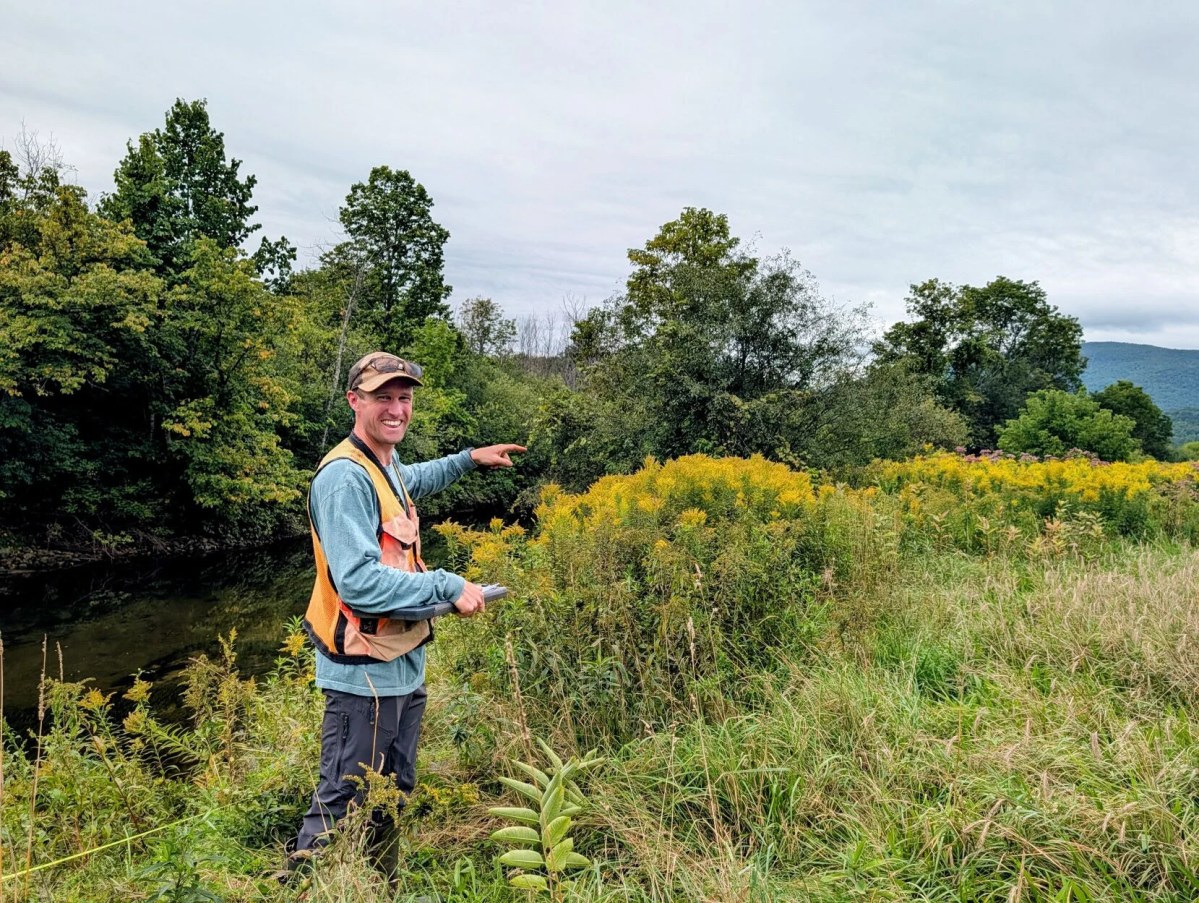
On a warm morning in early fall, and standing at the edge of the north bank, Fetterman described a river that has been constrained for decades by agriculture, as well as the practice of mowing right up to the water’s edge.
The result is a sheer, unstable drop and a river that runs too straight and too warm to support the kinds of fish and floodplain life that it once held.
Along portions of this stretch of the river, the north bank is an eight‑foot drop to a channel that’s about three feet deep – with the river “cut in, left a little bit high” where the bank has repeatedly collapsed and eroded.
On the opposite bank, the south bank, the Batten Kill still has “pretty good floodplain access,” allowing water to spread out during higher flows and recede back into its channel during drier events. That natural access helps mitigate downstream flooding.
The goal on the north side is to recreate some of that function – once again allowing the river to spill out, to slow down, and to rebuild its own richly populated habitat.
A river cut too deep and running too straight
Beginning in the 1990s, the Batten Kill River began experiencing a major decline in wild trout populations due to human-induced habitat loss, rising water temperatures, and other contributing factors.
Recent efforts by groups like Trout Unlimited and the Battenkill Conservancy, both of which have launched relatively aggressive restoration projects, have established natural wood and rock structures, stabilized eroding banks, ensured that the river can properly aerate, reestablished more natural floodplains, and created narrowed channels that cool the water.
These efforts have measurably increased the populations of brown and brook trout.
Explaining that, in this reach, the Batten Kill has been forced into a shape that serves neither people nor wildlife particularly well, Fetterman pointed to the drawbacks of the current channel. It runs straight, relatively deep, and is slow‑moving; it is largely devoid of woody debris that would normally break up the flow; and it is unshaded by trees, which allows the water to warm.
That combination is difficult on cold‑water species like trout. Fetterman notes that in this section, you might see an occasional trout move through, but would most likely not see fish “holding” in place to feed and rest the way they historically did in the past.
Without structure, cooler water, and varied depths, the river becomes a long uniform run rather than a string of riffles, pools, and cool shady hiding spots.
The bank itself is evidence of years of stress. The field above was rather consistently mowed to within about four feet of the edge, removing deep‑rooted trees that could hold the soil together. As floods hit this unnaturally steep and unvegetated face, “massive amounts of sediment” began to slough off the bank and into the river.
The river has been trying to correct that by cutting and collapsing but, without room and without rooted vegetation, each correction simply results in greater damage.
Rebuilding the floodplain and grading back the bank
The heart of the Sunderland River Project is a careful reshaping of the north bank so that the river can reconnect with its floodplain.
Fetterman describes a phased cut where an excavator will be brought in to taper the bank. The new slope will run from the current water elevation back about 10 feet on a two‑to‑one slope, softening the eight‑foot drop. Beyond that, workers will create a roughly 20‑foot “bankfull bench” – a flat or gently sloped terrace at the level of the river’s typical annual high flow.
“Bankfull” flows, Fetterman explained, are those regular high‑water events that do most of the work of forming and maintaining the channel. Larger floods do occur, but it’s that recurring bankfull stage that shapes the river’s curves, bars, and banks over time.
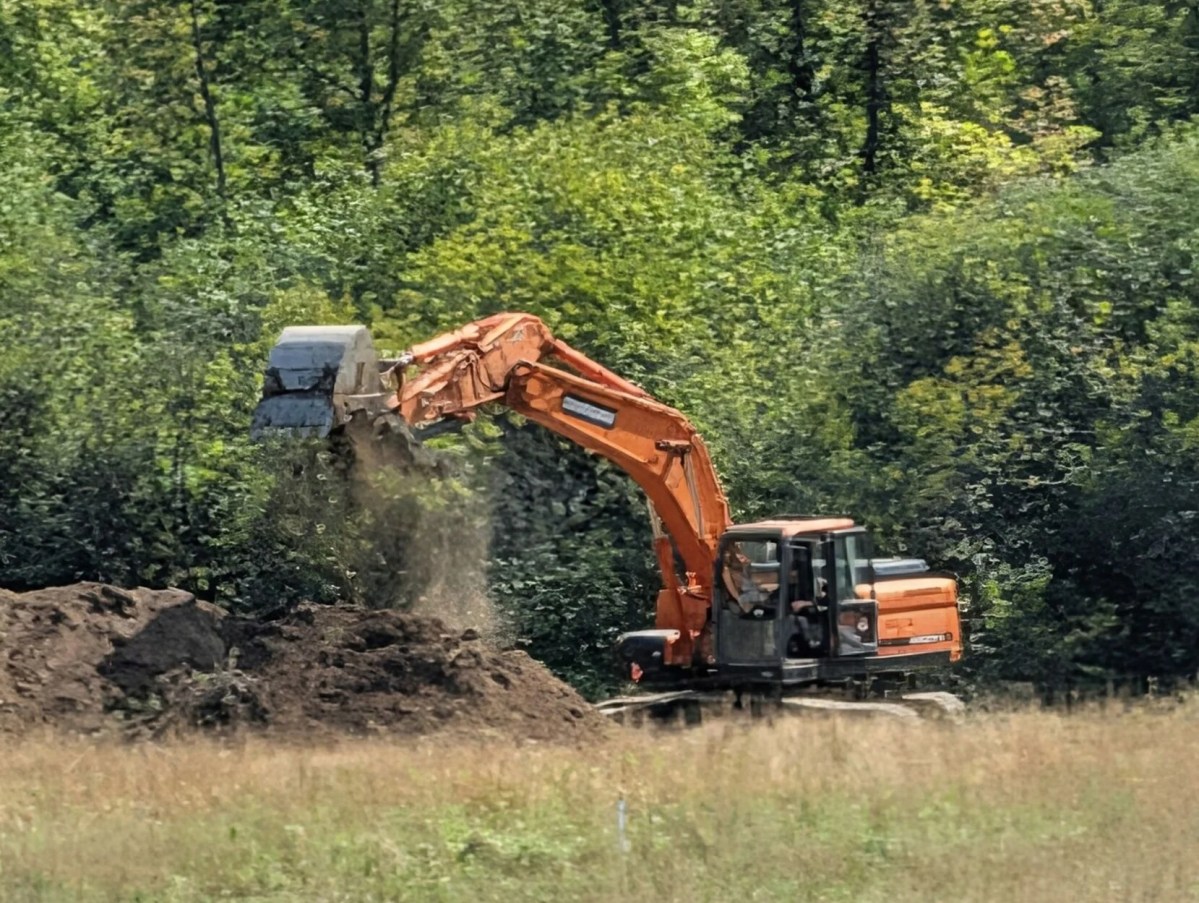
By giving the Batten Kill a bench at bankfull level, the project allows water to spread out horizontally instead of just cutting down vertically. When flows rise, the water will be better able to move across this new surface. The results will be a slower velocity and the dropping of sediment – and the river will once again begin to build a healthier floodplain rather than simply scouring a deeper trench.
Fetterman is clear that the river will always have the final say. The project’s role is to set up conditions – gradual slopes, deep roots, room to move – to ensure that, over years and decades, the channel can shift in a way that is safer for downstream communities and more supportive of aquatic life.
Planting shade, structure, and stability
Regrading alone would leave the soil highly vulnerable to erosion. To stabilize it, the project team is moving quickly to establish vegetation.
Immediately after excavation, the newly shaped surfaces will be seeded and mulched with a mix of grasses, wildflowers, and wetland species and designed to form a sod layer and early root network that will hold the soil in place. Next, the group will help to establish a diverse planting of trees and shrubs this fall. Fetterman listed species that include red osier dogwood, willows (such as native pussy willow), sycamore, cottonwood, black cherry, river birch, maples, and oaks.
These plantings will initially extend just 30–40 feet back from the river’s edge, creating a corridor of riparian vegetation. Ducks Unlimited will later extend that planting an additional 160 feet into the field, for a total of roughly 200 feet of restored buffer.
This living edge is designed to serve multiple roles – specifically to provide shade, structure, stability, and habitat.
Overhanging branches will help to provide shade and will in turn cool the water during the summer months, a critical factor for trout establishment. Fallen limbs and trees will create the woody debris that slows the velocity of the current, help to establish and form pools, and protect fish. Deep roots will bind soil and slow erosion, so that flooding events remove less sediment. Shrubs and trees will support insects, birds, amphibians, and mammals in the riparian zone.
Over time, those plantings will turn what is now an exposed, collapsing edge into a layered riverside forest that both protects the bank and enriches the river.
Ducks Unlimited, Trout Unlimited, and a coalition of interested partners
The Sunderland River Project emerged when Ducks Unlimited purchased the former agricultural field with the explicit intent of restoring wetland habitat. That acquisition opened possibilities beyond crop production – a mosaic of wetlands, riparian forest, and an improved river corridor.
Recognizing the Batten Kill as a major cold-water resource, Trout Unlimited joined as a partner to focus on the in-river and tributary components. The site also includes Tanner Brook, a cold-water tributary that flows in through the woods. Tanner Brook has also become a key part of the work.
The overall project has drawn in a broad coalition that includes the Bennington County Conservation District, the Batten Kill Watershed Alliance, the Vermont Department of Fish and Wildlife, the U.S. Army Corps of Engineers, the Vermont Department of Environmental Conservation (DEC), and Watersheds United Vermont (which administers the grant funding).
Funding comes through the Vermont DEC Clean Water Project program, which supports efforts to improve water quality, reduce erosion, and restore natural processes in rivers and wetlands statewide.
As a part of “permitting and due diligence,” Fetterman also noted that an archaeological study was completed along the strip to be excavated, ensuring that no significant historic resources would be disturbed.
Mimicking the effect of beavers in Tanner Brook
While excavators reshape the Batten Kill’s north bank, a quieter form of engineering will unfold in the Tanner Brook tributary. In Tanner Brook, crews plan to install approximately ten Beaver Dam Analogs (BDAs) over about a half‑mile stretch.
BDAs are human‑built structures that mimic natural beaver dams. Fetterman described them as rows of wooden stakes driven across the channel, perpendicular to the flow of the water. These stakes are then interwoven with branches and plant material, much like a beaver will weave a lattice of sticks.
The low leaky dams are intended to raise water levels slightly and slow the current, spread water out over the floodplain, reconnect side channels and wetlands, and create deeper pools and varied habitat for trout and other species.
In winter, trout seek out deeper, somewhat warmer water – “warmer” in a relative sense, in comparison with the shallow fast‑flowing sections that can freeze more solidly. By building pools and improving groundwater interactions, BDAs can provide fish with more options, enabling them to endure the more harsh winter conditions.
Fetterman noted that BDAs are well suited to small tributaries like Tanner Brook, where flows are lower and structures can persist.
In the mainstem Batten Kill, however, the larger forces at work would likely blow out such small dams in a single high‑water event – so the river restoration there relies instead on felled large trees that are placed along the margins to form cover and complexity within the flow.
Letting the river do the work
Taken together, the bank grading, the floodplain reconnection, the riparian planting, and the beaver-mimicking structures, form a single philosophy – give water more space and better tools, and then step back and allow the river to adapt.
Fetterman emphasized that some erosion in the early years will be expected. Spring run‑off, for example, will test the new slopes and the vegetation. The river will nibble at the edges, deposit gravel and sand where it slows, and carve pockets where woody material deflects the flow.
The project team is not trying to force the Batten Kill into a fixed design. Instead, they are restoring the ingredients – the room, the shade, the roots, the wood, and the wetlands – so that the natural processes can rebuild a more resilient system.
In the long term, that will translate to reduced impacts downstream during flood events, as floodwaters have space to spread and slow. It also translates to cleaner water, with less sediment and nutrient-laden runoff entering the channel.
Additionally, there will be a healthier trout habitat – with cooler temperatures, deeper pools, and sheltering structures. And, richer wetlands and riparian corridors will develop – supporting birds, amphibians, invertebrates, and plants.
For the communities along this stretch of the Batten Kill, the Sunderland River Project is both “practical infrastructure” and “ecological healing.”
It recognizes that a river is not just the water between its banks, but it is also the floodplain, the wetlands, the forests, and that tributaries that breathe with it.
In Fetterman’s work – and in the partnerships behind this effort – there is an understanding that restoring a river is less about imposing a new shape and more about giving it back the space and the conditions it needs to remember its own shape and path.
Implementation timeline
According to Fetterman, construction on the regrading and floodplain work should soon begin nearing its conclusion. The tree and shrub planting will follow at a later date in the fall.
The Ducks Unlimited wetland restoration will continue into next summer, extending the vegetated buffer and expanding habitat in the field beyond the newly graded bank.
As the machinery leaves and the first roots take hold, the Batten Kill and Tanner Brook will begin – slowly and quietly – to rewrite their own courses, guided by the work of partners intent on helping these rivers function once again as healthy rivers must.
