

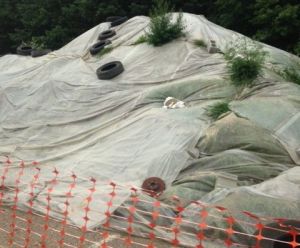
The city has a plan to remove the soil during the upcoming winter months. Federal officials will use the consultant’s data to decide if they will intervene, which will determine the range of options the city has for disposing of the dirt.
The soil was excavated from Waterfront Park during construction of the bike path in 2014, and has since been stored three miles away in the Leddy Park parking lot.
City officials say the 2,500 cubic yards of dirt piled in the parking lot have been properly maintained and doesn’t pose a threat to public health, but residents have said initial communication that the piles were contaminated was poor.
Preliminary testing of the stockpiled soils last year showed the largest of four piles contained polychlorinated biphenyls (PCB) levels exceeding the state’s limits as set by the Agency of Natural Resources. PCBs are classified as carcinogenic by the International Agency for Research on Cancer. Prior to that, the city was not aware that PCBs were in the soil beneath Waterfront Park.
The discovery is significant because PCBs fall under the jurisdiction of the federal Environmental Protection Agency.
The city has long known that the soil beneath Waterfront Park, which was once a railyard, had other contaminants. A state investigation in 1992 found that to be the case, and the consultant overseeing construction of the bike path found evidence of contamination as well.
That initial testing also revealed that lead, arsenic and total petroleum hydrocarbons (PAHs), some types of which are also carcinogenic, were found in other piles at Leddy Park.
City and state officials have agreed to a timeline for removal that includes a decision about what to do with the soil by Dec. 15 and execution of that plan during the winter of 2016. That timeline was shared with residents at a September public meeting.
Burlington hired the Johnson Company in September to do additional testing on the stockpiled soil and the soil at Waterfront Park at the request of the state Department of Environmental Conservation and the federal Environmental Protection Agency. The city paid the environmental firm $47,360 for its work, according to city officials.
Because PCB contamination falls under federal jurisdiction, the EPA requested the city collect better data on what contaminants are in the soil to allow the agency to decide whether it will take charge of its removal.
The EPA’s decision will be “key” in determining what happens to the soil next, according to Hugo Martinez-Cazon, a hazardous site manager for DEC. Martinez-Cazon said it’s too early to speculate on what EPA officials will decide. The Johnson Company’s draft report was released last week. State officials are still reviewing its results to confirm their accuracy, he said.
Kim Tisa, PCB regional coordinator for the EPA, said Wednesday that the agency has begun its review of the new data, but that process is not complete.
If the EPA steps in, the soil will likely need to be trucked to Coventry for safe disposal in the state’s only landfill, which city officials have estimated would cost $300,000.
If the EPA doesn’t get involved, the solution may be less complex and potentially less costly, and the city will have more options. One options would be to reuse the soil as a constituent of asphalt or concrete, something that has been done with soils containing low levels of PCBs in other projects nationally, Martinez-Cazon said.
The Johnson Company found PAH levels exceeding EPA and state Department of Health standards in 57 samples taken from all four dirt piles at Leddy Park. Five of the 57 samples contained lead in amounts that exceed federal and state thresholds. PCBs were found in all four piles, and in three of four piles, including the largest, they exceeded federal and state thresholds, according to a narrative summary of the report.
The report itself is several hundred pages of technical language and appendices showing lab results. It’s unclear from the draft narrative summary what the findings mean for the future of the stockpiled dirt.
Residents had expressed concern that runoff from the piles may be entering Lake Champlain, but officials say the runoff is being trapped by a vegetated swale at the foot of the Leddy Park parking lot. Hay bales to reduce runoff were added over the summer.
The Johnson Company reported “no visual or olfactory evidence of contamination” in the sediment of the swale, and laboratory tests found that PCBs were not detected at levels exceeding the Health Department’s threshold.
City and state officials will hold a public meeting Nov. 12 to discuss the draft report with residents. Officials said they should have more information about the future of the dirt piles at the meeting. They have not released a time and place for the event, but it will be posted to the Bike Path Rehabilitation website.
The Johnson Company also took soil samples from wells and groundwater at Waterfront Park to gather more information about PCB contamination at the former industrial site. PCBs were not previously a known contaminant there, according to Jesse Bridges, director of the Parks and Recreation Department.
Samples from the wells found at least one PAH in concentrations exceeding the federal and state thresholds. The well samples contained PCB levels above state thresholds in nine of 36 samples, and levels exceeding federal standards in four of 36 samples. The groundwater samples did not show PCBs in concentrations that exceed thresholds.
Those results could have implications for further construction at Waterfront Park. Bridges said Waterfront Park is largely complete, but further construction is on hold and the site could require additional testing before work continues.
The findings at Waterfront Park won’t impact construction of the bike path, Bridges said, but the city will continue to test soils as the path extends north.

