


[L]awmakers are considering stronger protections for whistleblowers in the state workforce.
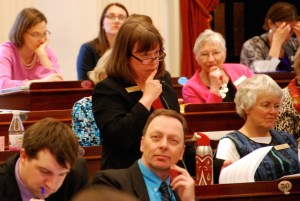
The House General, Housing and Military Affairs Committee took testimony last week about the laws Vermont has in place to protect whistleblowers.
The current law applies to anyone who reports suspicions of waste, fraud or abuse in public systems. However, the law has limitations, attorney Ted Hobson told the House General, Housing and Military Affairs Committee on Wednesday.
At the moment, a whistleblower is only protected if they take their complaint to a public body, such as the Legislature. If the whistleblower turns out to be incorrect in their suspicions, they could be left be without protection.
According to Hobson, that is a problem for Vermont.
“People misunderstand whistleblower rights when they think it’s to protect the whistleblower,” Hobson told the committee. “It’s really to protect the flow of information and to give people the ability to give you the information that you need to do your job.”
State Auditor Doug Hoffer has been an advocate for stronger protections for people who report perceived wrongdoing in public agencies. Last year, at his prompting, the Legislature passed a law strengthening confidentiality guarantees for whistleblowers.
Hoffer said that whistleblower protections are “critical.” He’s in the early phases of an audit relating to contracts and grants in the Agency of Education that he said is the direct result of a whistleblower’s information.
“You don’t have to believe that state government is a bad actor,” Hoffer said. “In any organization of 8,000 people there is the possibility of a bad actor.”
Many state employees are not aware of the extent of current law.
A July 2013 survey found that about half of Vermont State Employees’ Association members did not know that Vermont has whistleblowing protections in place, according to VSEA legislative director Ben Palkowski.
“Our members, as well as the public, the administration and the Legislature, they want to have a government that operates as best as possible,” Palkowski said. “I think we should incentivize, or at least remove the disincentives, for state employees to come forward when they can pinpoint areas of waste, fraud and abuse.”
In the same survey, three-quarters of VSEA members said they would be more likely to come forward with allegations if the state had additional protections.
Tom Cheney, policy chief for the Department of Human Resources, said that the department has been in communication with the VSEA for some time about improving whistleblower protections. Revising the state law could be an opportunity to bring Vermont in line with federal statutes, he said.
“We want to make sure we have strong whistleblower protections,” Cheney said.
DHR and the VSEA drafted language that would strengthen protections for employees if they act on something they suspect to be illegal, even if they turn out to be incorrect. It would also require that whistleblower protections be made more explicit to state employees.
Rep. Helen Head, D-South Burlington, chair of the General, Housing and Military Affairs Committee, said that she was prompted to take up the issue based on Hoffer’s concerns and the recent revelation about overtime pay at the Department of Liquor Control, as reported by the Burlington Free Press.
The committee likely will not take up any legislation until the 2016 session. She said they will consider the DHR draft language, and will weigh whether Vermont should have whistleblower protections for the private sector as well.
