

[A] spending cap added to the House Education Committee’s “big bill,” at the eleventh hour is drawing intense criticism.
H.361 is designed to put the brakes on rising school budgets. The legislation calls on school districts across Vermont to merge into larger “integrated education systems” of at least 1,100 students.
The bill also calls for a short-term annual spending cap increase of 2 percent on local per pupil expenditures, for school systems to work to increase staff- and teacher-to-student ratios, and more. The cap would expire Dec. 31, 2018.
The bill will be scrutinized by the House Ways & Means Committee when the Legislature resumes Tuesday.
Lawmakers are responding to growing taxpayer unrest about rising education costs and property tax rates, combined with the realities of declining enrollments in the state’s public schools. The state’s education system has seen a loss of more than 21,000 students since 1997. Meanwhile, costs have increased by 30 percent over the past decade.
Both the House and the Senate are taking a hard look this year at the financial realities of a school system built for many more students than it is today serving.
Less than a week after the first draft of a bill was inked, education groups have already begun assailing the cap.
Stephen Dale, executive director of the Vermont School Boards Association, says the proposed solution blames “the entire issue on local boards by imposing a cap on school spending.”
The bill says any budget that exceeds the 2 percent cap will be considered “failed” and the district would not be allowed to borrow money for operating costs.
The VSBA says that would prevent schools from being able to borrow money in emergency situations that occur after a budget is passed, such as a leaking roof or the arrival of a special needs student.
“The ‘across-the-board’ caps would not take into account current per-pupil spending — affecting very frugal towns and higher spending towns equally, and being blind to special circumstances,” a VSBA statement reads.
The VSBA also complains that the bill “… does nothing to help districts manage their largest cost, the cost of personnel,” which includes salaries and benefits such as health insurance.
Ken Page, executive director of the Vermont Principals’ Association, said the cap would not work as lawmakers predict.
“Caps are a one-size-fits-all solution to the problem. It says to local school boards: ‘We are imposing this upon you because we believe that you are unable to reduce budgets yourselves,’” Page said. “I reject the notion that legislators feel they must wrestle authority from local boards who know their schools, know their communities’ priorities and know their own abilities to right-size their schools better than any legislator in Montpelier.”

Jeffrey Francis, executive director of the Vermont Superintendents Association, said the bill addresses some issues of cost containment but will have unintended consequences.
“The (cap) proposal … would provide districts that are currently spending more a greater increase in their budgets than those districts with lower per pupil spending. This is, and will be recognized, as inequitable.”
Steven Jeffrey, executive director of the Vermont League of Cities and Towns, said the bill misses the mark on property tax reform.
The bill does not shift the “over-reliance on the property tax to fund education. It really doesn’t get to the heart of it,” Jeffrey said.
When the VLCT board convenes next week, the spending cap will be on the agenda, Jeffrey said.
Whether the VLCT should support that step because of its potential to mitigate property taxes is on one side of the question, but on the other, the cap provision “calls into question what the state’s role is in determining what local budgets are going to spend.”
A spokesman for the Vermont National Education Association was even more critical of the cap.
“First of all, we think it’s a dumb way to address school spending, and number two, the fact that the Legislature would invalidate a vote of the people is appalling, and is not something we usually see in a democracy, so that’s troubling,” Darren Allen said of the cap.
Allen said that wherever spending caps have been imposed in public education, that step has led to “an erosion of the quality of education,” pointing to California as an example.
“We’re looking at it with one eye,” Allen said, “what it’s going to do for kids and communities? As long as that spending cap is in there, it’s a nonstarter for us,” he said.
A spending cap, said Allen, “is outrageously dumb and, we suspect, unconstitutional.”
Other views
Nearly 100 proposals were submitted to Speaker of the House Shap Smith, D-Morrisville, on education finance and reform.
Those proposals all made it to the door of the House Education Committee, where many were presented, and all were discussed.
Campaign For Vermont is one of the groups that brought a proposal to the Legislature.
“Generally speaking, H.361 missed the mark,” executive director Cyrus Patten said this week.
“Vermonters asked for property tax relief, and this bill will offer them little,” Patten said. “We need to create economies of scale by consolidating supervisory unions into regional educational administrative districts (READs) that would control education spending and implement collaboration among districts.”
Patten said the cap is “a clumsy effort at addressing property taxes” that indiscriminately punishes schools that have kept costs down.
“When communities that abide by the will of Montpelier get lower taxes without reducing expenditures and others get higher taxes without spending more, as is the precise intent and impact of this bill, you are setting the stage for a constitutional challenge,” warned Heidi Spear, founder of the citizen-led Accountable Education Funding Working Group. “Either they aren’t thinking — or they think we aren’t going to hold them accountable,” she said.
Vermonters for Schools and Community filed comments on H.361 section-by-section, noting which they agree with and disagree with.
The group opposes mandated consolidation and objects to the stricter provisions and restrictions for schools qualifying for Small Schools Grants.
“These important supports have helped to level the playing field for smaller schools, allowing them to continue to offer students in smaller communities access to a strong educational program,” the group’s position, released Wednesday, states.
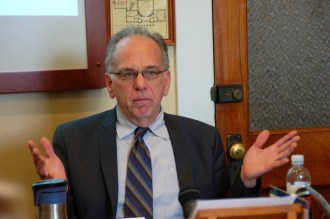
Paul Cillo, president of the Public Assets Institute, also criticized the cap and said lawmakers rushed to get a bill out before town meeting.
A spending cap “rewards high per-pupil spending districts and punishes lower spenders,” said Cillo. “That makes no sense. Considering that school budgets that passed on Town Meeting this year are showing growth of less than 3 percent, there is really no need for a cap like this.”

