


Editor’s note: Jon Margolis is VTDigger’s political columnist.
Here’s a simple plan for saving Lake Champlain: get rid of dairy farming.
Remember, that said a simple plan, not an easy one. Any plan that can be described in five words is simple.
Sadly, like most very simple ideas, this is a very bad one. To begin with, the farmers are not the villains of the Lake Champlain saga, or at least no more than anyone else is. With a few exceptions (there are always a few exceptions) dairy farmers have played by the rules and done what was asked of them. Many have done quite a bit more.
Besides, if the farms were abandoned, much of that acreage would be converted to roads, houses, shopping malls and the like, from which flows the phosphate pollution that is ruining the lake just like the phosphate pollution from cattle and crop.
Not to mention that getting rid of dairy farms is and ought to be politically impossible. Josef Stalin forced millions of independent farmers off their land. Free and decent societies do not (though they might consider eliminating the subsidies).
But there is a method in the madness of starting out with this outrageous proposal. Two methods, actually. The first is to get the Lake Champlain discussion away from the scientific jargon (though not away from the science) of TMDL’s and AAPs and phosphorus mass balance models and from the political back-and-forthing which dominates (obscures) the day-to-day political debate over the lake.
The second is to point out how dismal the lake’s prospects are. Even were it to be entirely implemented (and it is already running into opposition), Gov. Peter Shumlin’s $6.7 million plan to clean up Champlain might be too little, too late.
Perhaps not for the whole lake. No matter how well or poorly human beings control what flows into it, there will be 490 square miles of fresh water between Vermont, New York State, and Quebec. Most of it will remain delightful to sail on and full of lake trout and other sport fish to catch (unless they are displaced by Asian carp and other invaders from the Great Lakes or elsewhere, but that’s a completely different subject).
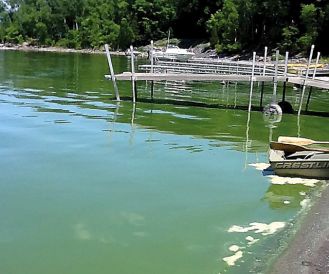
But for some bays and inlets, even extreme measures may not reverse the phosphorus infiltration that has turned parts of the lake into fields of blue-green algae.
Because when all the scientific jargon and political back-and-forthing are done, though “Vermont has taken many important actions” to reduce phosphorus pollution in the lake, “phosphorus levels … are above the allowable standards,” according to an Environmental Protection Agency document of last year.
As bureaucratic documents tend to do, this one might have skirted an unpleasant truth. As the Lake Champlain Committee sees it, despite all those “important actions” and the millions of dollars they entailed, “the amount of phosphorus in the lake has not changed in most places and appears to be increasing in some lake segments.”
A chart in that same EPA document reported that in order to restore Missisquoi Bay to ecological health, the phosphorus inflow would have to be reduced by 75 percent. Under the column in the chart assessing whether such a reduction is “achievable,” there is a question mark.
In a 2013 presentation, reports James Ehlers, the executive director of Lake Champlain International, Department of Environmental Conservation scientists reported that even if the flow of phosphorus into Missisquoi Bay were reduced by 75 percent, the state “might see progress (in reversing growth of the Bay’s algae) in 10 years.”
And the plan before the Legislature now would not come close to reducing the phosphorus flow by 75 percent.
That’s why even some of those trying hardest to save the lake sometimes wonder whether they can prevail.
Failure is “a very real possibility,” said Kim Greenwood, the water program director and staff scientist for the Vermont Natural Resources Council. “Even with the most sincere plans, we may not reach our goals.”
Chris Kilian of the Conservation Law Foundation, the outfit that has sued the state to try to force it to comply with EPA standards, acknowledged that it was, “not at all likely the proposals being put forward right now by the governor are going to result in clean water in the lake.”
David Mears, the commissioner of the Department of Environmental Conservation, is the official trying to put those “sincere plans” into effect, and who therefore would be unlikely to think the entire effort is for naught.
And he doesn’t.
“We don’t have a choice but to save the lake,” he said.
But he acknowledged that what the state is now proposing might not have much impact on some portions of it, at least for decades.
“The question shouldn’t just be about those portions of the lake,” he said, but “about rest of lake, too, to make sure the remaining sections don’t get worse.”
Mears pointed out that the measures the state is proposing can have beneficial impacts even if they do not reverse the growth of blue-green algae in some bays. Cleaning up the Missisquoi River and its many tributaries will, at the very least clean up the river and its many tributaries, a worthwhile outcome even if Missisquoi Bay remains choked with algae.
The problem is that while everyone wants to save the lake, the organized constituencies – farmers, developers, towns – seem always reluctant to pay much of a price in order to do so. One of the proposals Shumlin put forth during his inaugural address was to impose a “fee on agricultural fertilizers, because these products contribute to water pollution.”
But the fee proposal, which would raise $1 million, has already run into opposition from farmers. So has the Shumlin administration’s plan to assess new fees on municipalities to raise $1.5 million to help finance clean water programs.
“Local governments are committed to doing their part to clean up the waters of the state,” noted the Vermont League of Cities and Towns. But then it listed the potential fees in the administration proposal and asked, “Do you sense something wrong with this picture?”

Responsively, the League proposed alternative financing, including another increase in the gasoline tax. Arguably a good idea except the Legislature just raised the gasoline tax last year and would be reluctant to do so again this soon.
Both the farmers and the municipal officials may have good arguments. But their reactions recall the wisdom of the late Sen. Russell Long of Louisiana, the longtime chairman of the Senate Finance Committee, who noted that the common reaction to any suggested tax increase was “don’t tax you, don’t tax me, tax that fellow behind the tree.”
Shumlin plays this game, too. In his inaugural address he said his plan, would avoid the “more costly” proposals of the EPA, including requirements to improve or add to the state’s wastewater treatment plant capacity. The governor wants to avoid that, because it’s expensive, and the cost is borne by taxpayers and water and sewer rate payers.
Shumlin argues that upgrading the plants is not necessary because wastewater plant emissions contribute only 3 percent of the lake’s phosphorus. Lakewide, that may be accurate (though not all experts agree). In Burlington Bay and parts of the southern half of the lake, it is not accurate.
Besides, the governor is fighting a losing battle. As Sen. Long’s uncle, Gov. Earl Long, told arch-segregationist Leander Perez who bragged his county’s schools would never integrate, “Forget it, Leander. Da Feds got da A-bomb.”
Also the Supreme Law of the Land clause of the Constitution. Mears agreed that at some point Vermont “will have to agree to some level of phosphorus control in our sewage treatment plants.”
Chris Kilian remembered that a decade ago the Legislature passed a law limiting new tie-ins to the wastewater treatment plants, only to repeal it a year later, before it took effect, under strong pressure from developers.
The developers wanted what everyone wants – farmers, town officials, taxpayers and homeowners: more government subsidies (while denying that they are subsidies) at no extra cost, or at least with no extra cost to themselves, only to that fellow behind the tree.
In this sense, nature is like government. Everyone wants to use it – which is another way of saying abuse it – and have either someone else or maybe no one pay the price of protecting or restoring it.
Neither the farmers nor the developers nor the town officials nor the taxpayers are the villains here, unless they all are. What has always ailed Lake Champlain continues to ail it. Saving it is no interest group’s priority, except for the environmentalists, and they are outgunned. They all want to save it, but first and foremost farmers and developers want to hold down their costs, as do town officials because their constituents don’t want higher taxes.
It’s the American way.

