

High school students lobbied lawmakers to cut the state’s investments in fossil fuels at the Statehouse on Thursday.
Dozens of high school students testified before lawmakers to voice their concerns about climate change.
Isabelle Francke, a 14-year-old from Montpelier High School who teaches second-graders about renewable energy, testified before the Senate Government Operations Committee. She said the state is not doing enough to stop carbon emissions.
“That’s why I need my leaders to divest from fossil fuel companies and help me,” Francke said.
The committee is drafting a bill, S.28, that would require the state’s pension managers to divest retirement holdings from the world’s 200 largest publicly traded fossil fuel companies by 2020. There is a similar bill in the House and a resolution.
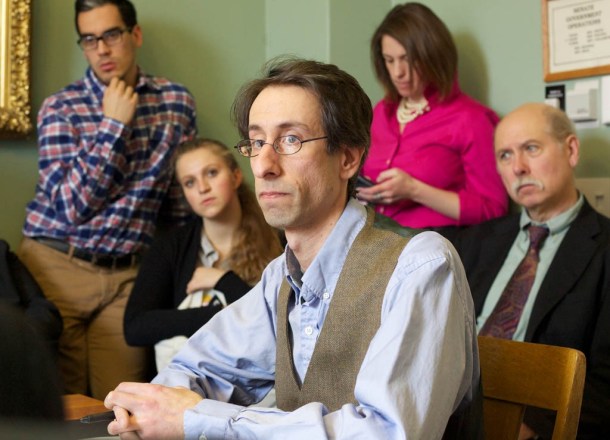
State Treasurer Beth Pearce opposes the divestment proposals because she says the strategy would harm the fund that 48,000 Vermont retirees depend upon.
“From my perspective, as a fiduciary, we have a responsibility to those individuals,” Pearce said. “We can still address climate change through constructive engagement.”
The Vermont Pension Investment Committee (VPIC) has about $109 million invested in oil, gas and coal companies. The committee’s total investments as of June 2014 were more than $4 billion.
If Vermont divested all its fossil fuel pension holdings, it would pay $1.8 million in transaction costs and lose $8.8 million annually in returns, according to a 2013 report by NEPC, a Boston-based investment consulting firm.
Eric Becker, the chief investment officer for Clean Yield Asset Management, a B Corp certified investment firm, said many of the assumptions in the NEPC report are flawed.
NEPC didn’t take into account potential regulations on the fossil fuel industry designed to curb greenhouse gas emissions, Becker said. As a result, the cost to divest would be less than what the company reported.
He cited a 2012 report by the International Energy Administration that says no more than one-third of fossil fuel reserves can be consumed prior to 2050 in order for global climate temperature increases to stay below the 2 degree Celsius goal. Wide deployment of carbon capture and storage technology could mitigate temperature increases, he said.
Pearce wants to leverage the state’s role as a shareholder to change the business practices of fossil fuel companies. She said if the state gives up its “seat at the table,” someone else who does not value the environment may take it.
Vermont was a founding member of the Investor Network on Climate Risk, a group of activist investors. Last month, oil giant Royal Dutch Shell supported a resolution by the group to disclose any business risks associated with reducing greenhouse gas emissions.
But Becker said the state could remain engaged through the Investor Network on Climate Risk without investments, though the state would not be able to file shareholder resolutions. He also said shareholder engagement is a “woefully inadequate tool.”
“Shareholder engagement is bound to fail when the goal is to change the core business of the corporations, and that is the case with fossil fuel companies. To maintain a livable planet, fossil fuel companies need to be put out of business,” he said.
Matt Patsky, a partner in the Boston-based investment firm Trillium Investments, which has $2.2 billion under management, said he advises many of his clients on the risks of fossil fuel investments.
He said more than half of his assets are fossil fuel free, which is one of the fastest-growing parts of his business. He said he encourages his clients to divest from coal and phase out investments in oil and gas companies.
Trillium Investments is managing Goddard College’s endowment assets. Goddard, like Sterling College and Green Mountain College, have divested endowment assets from fossil fuel companies.
According to Sterling College’s finance director, the college’s divestment grew a total of 17 percent in the 18 months prior to divestment — between December 2011 to June 2013. The fund grew 25 percent during the 18 months after divestment — June 2013 to December 2014.
The advocacy group 350 Vermont organized the student testimony. Many of the students were shuttled to the Statehouse by teachers from nearly a dozen schools, including Twinfield Union School in Marshfield, U-32 High School in East Montpelier, Montpelier High School, Vermont Commons School in South Burlington and Burr and Burton Academy in Manchester.
During the climate caucus, lawmakers asked the students to continue to advocate through social media forums. Another cautioned that the Internet relies data centers that are among the largest electricity consumers in the United States.

