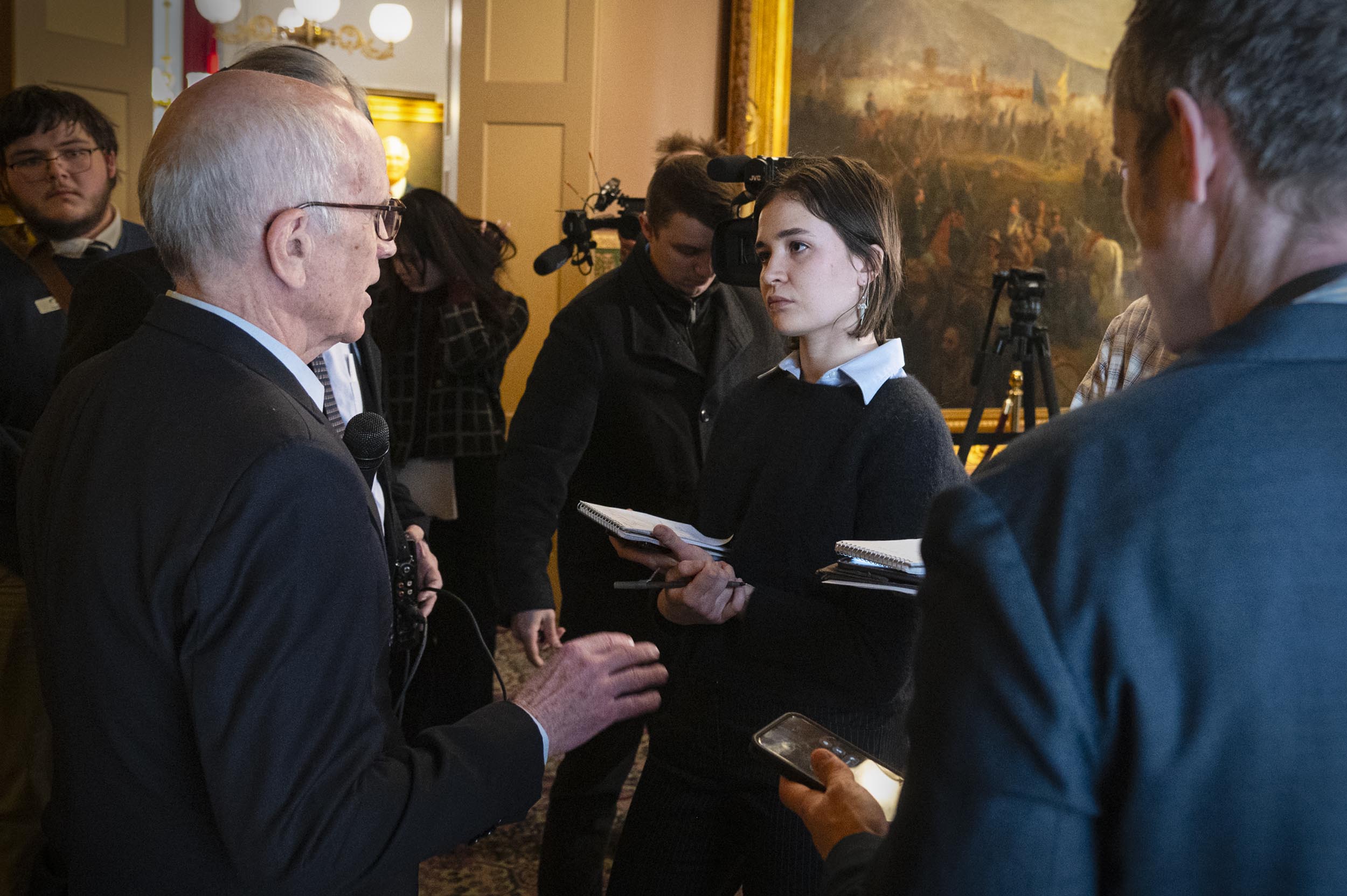
Vermont has changed its vendor management structure in the wake of its frustrating experience with technology giant CGI, state officials say.
The changes are meant to strengthen the management of large-scale IT projects as the state overhauls its human services infrastructure in the next five years.
Vermont will need to sign a new contract with Optum early next year to complete its health insurance exchange, which still doesn’t work for small businesses and does not have a way for people to change coverage online.
Optum stepped in when the state became dissatisfied with CGI’s performance developing the Vermont Health Connect system.
The change necessitated an in-depth transfer of knowledge and information between the two tech companies, and Lawrence Miller, chief of health care reform, said the state plans to stick with Optum to avoid another transition.
The state will also hire contractors to revamp its Medicaid system and build an integrated system for tracking clients’ eligibility across the agency’s spectrum of services.The combined projects, known as the Health and Human Services Enterprise (HSE), will cost an estimated $420 million.
Since the current AHS systems are outdated — some close to three decades old — and the state pumps about $3.4 billion in state and federal money through the agency each year, the overhaul is necessary and overdue, Miller said.

“I think we’ve made the adjustments that need to be made for Vermont Health Connect to hold vendors accountable, hold ourselves accountable — which is equally important — and to translate those lessons learned across the rest of the (HSE),” Miller said.
The day-to-day management of Vermont Health Connect has been shifted from a team of policy experts to a group with “extensive 25-plus-year backgrounds” in project management, Miller said.
Harry Chen, the agency’s interim secretary, is now chair of the HSE steering committee, Stephanie Beck is now its director and, most recently, the state hired a project manager to oversee business practices across the HSE.
The agency has brought “many of the oversight positions” in-house, including some vendor management positions, rather than relying on consultants, Miller said. Those resources will be shared across all the HSE projects instead of having them siloed within specific projects, he said.
Negotiating with powerful and risk-averse vendors
The state signed its contract with Optum under less than ideal circumstances, according to Assistant Attorney General Jaye Pershing Johnson.
Johnson is tasked with getting state agencies and departments, her clients, the best deal with vendors in an industry that she said is “extremely risk-averse.”
She compared Optum to a “white knight” riding in to save the state’s ailing exchange in June, after having done the same for other states and the federal government.
The state agreed to a time-and-materials contract, or one that pays retroactively for work as it is completed.
In general, the state avoids time-and-materials contracts, which are more difficult to manage, in favor of those that pay for performance. When the state signs a time-and-materials contract, it’s typically because that is all the vendor would accept, she said.
 Optum’s contract, worth a maximum of $29 million, was built upon a smaller consulting contract and became a time-and-materials agreement so that Optum could investigate what the state needed for a smooth open enrollment period, which began Saturday, and craft the scope of work to fit those needs.
But time-and-materials contracts are more difficult to enforce if the vendor doesn’t deliver, and therefore state oversight will be the state’s best tool to hold Optum to account, Johnson said.
Clearly outlining the work also helps, and the state was able to include in the contract “performance hurdles” that define its expectations. The contract does not include liquidated damages, which would allow the state to recoup money paid to Optum should there be disagreement over what was delivered.
“We theoretically don’t pay for any phase until the outcome is accepted by the state,” she said. The state is able to place retainers on payments, so when a project launches the state holds back some of the money.
“Then when you do go live, you keep (the vendor) around to make sure they follow through,” Johnson said.
The state is planning to sign a new contract with Optum in January for the remaining elements of Vermont Health Connect, Johnson said, and it’s unlikely to accept another time-and-materials contract.
Nationally, it has been hard for states to get vendors to accept risk as part of exchange contracts.
A recent report from PoliticoPro captures that struggle:
“Exchanges are complex systems that interface with Medicaid agencies and numerous federal and state departments. Because of that high degree of complexity, companies ‘won’t do this development assuming financial risk,’ (Dan) Mendelson, (chief executive of consulting firm Avalere Health) said. ‘If these systems existed in isolation, it would be a lot easier to structure performance contracts.’
“’The contracts generally don’t allow states to not pay a vendor because an exchange didn’t work,’ he said. And it isn’t clear suing would produce a better outcome for states, so most of the work has been done out of court.”
Settling with CGI
Vermont settled with CGI, agreeing to pay $67 million of an $83 million contract, despite a report from Optum that said CGI left incomplete “several critical functional requirements” it was hired to build.
That settlement notes that “a number of contract disputes have arisen…regarding rights and obligations under the (contract),” but it precludes claims from being brought that pertain to disputes predating the Aug. 1 agreement.
It does allow for claims relating to the transition away from CGI, which contained roughly $10 million worth of services, but everything else must be left in the past.
 CGI continues to provide hosting services for the exchange, and a provision of the settlement has forced Vermont to pay an additional $75,000 per month for those services since Sept. 30 because a revised contract was not signed by that date.
Vermont hired the prominent Boston law firm Mintz, Levin, Cohn, Ferris, Glovsky and Popeo to assist the Attorney General in negotiations with CGI. The law firm has received more than $1 million in fees since 2012.
The state has not hired outside counsel to help it negotiate contracts with Optum.
Vermont is not alone in settling with vendors that were paid big money and didn’t deliver, or delivered a partial product, according to the PoliticoPro report.
Nevada paid Xerox $13.5 million for a site that was scrapped; Massachusetts paid CGI $59 million of an $89 million contract before switching to Optum; Maryland is working on a settlement with Nordian Healthcare Solutions, which it paid $55 million before electing to use software developed by Connecticut.
Perhaps the worst debacle is in Oregon, where the state paid Oracle Consulting $240 million for work on its exchange before electing to join the federal healthcare.gov exchange.
Only after the Oracle division sued the state for unpaid fees, did Oregon file a countersuit seeking to recoup some of its money.
It is true that contracting for exchange work, and large-scale IT projects more generally, is difficult, Johnson said. The vendors know the work is risky and clients have limited options, so they aggressively structure agreements to limit their own risk.
But the market is shifting and states and other large purchasers are beginning to push back, slowly gaining the leverage they need over an industry that is used to getting its way, Johnson said.