

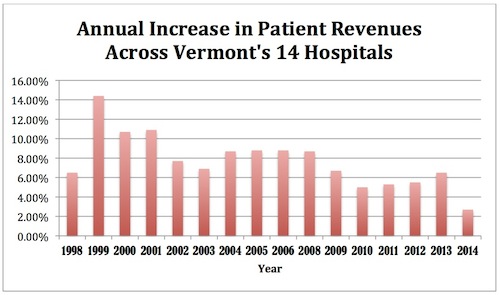
Vermont hospital budgets are rising at the slowest rate in more than a decade.
That does not mean that the cost of care for commercially insured Vermonters is rising at an equally slow pace.
The Green Mountain Care Board earlier this week approved the fiscal year 2014 budgets for all 14 of Vermont’s community hospitals. The average amount hospitals plan to raise from patients next year is going up 2.7 percent. That level of patient revenue inflation is the lowest recorded over a 16-year period, and it’s well below the average annual increase of 8.06 percent.
Meanwhile, commercially insured patients will pay a weighted average of 5.14 percent more at Vermont hospitals in 2014 than they did in 2013 for treatment and services. That growth rate is down from increases of 7.94 percent in 2013, 6.47 percent in 2012 and 5.45 percent in 2011.
Al Gobeille, chair of the Green Mountain Care Board, said one of the major drivers behind the reduction in patient revenues is a dip in hospital use. There are competing theories behind what is causing this decline in hospital use.
“Hospitals have seen inpatient surgeries drop, imaging and labs. Some of that, they believe, is due to health care reforms,” Gobeille said. “They used to bundle lab tests, and now they might say, ‘Do we really need to do all of these tests?’ It’s care protocols that can drive utilization.”
Aside from cutting out redundancies, many health care economists across the country believe the slow state of the economy has deterred people from seeking care or has made them more price-conscious, thus reducing rates of hospital use.
But Gobeille says that does not appear to be the case in Vermont. Individuals who are covered under federal programs are also accessing health care services at a lower rate.
“If you stretch it across all payers and look at Medicare, you’d expect lower utilization in other areas and Medicare up,” he said. “That’s not what we’re seeing. This is an across-the-board shift.”
Vermont’s lower patient revenue growth is in line with other national health care trends. As the Wall Street Journal reported this week, nationwide prices for medical care are growing at the slowest rate in half a century. Prices rose 1 percent from July 2012 to July of this year.
This week, the Centers for Medicare and Medicaid Services office of the actuary released findings that health care spending slowed from an increase of 6.2 percent in 2011 to 4.6 percent in 2012.
National health care spending, however, is expected to pick up in the next decade. As a share of gross domestic product, health care is expected to increase from 17.9 percent in 2012 to 20 percent of GDP by 2022.
Fletcher Allen and Vermont hospital costs
In early 2013, the Green Mountain Care Board reeled in the amount hospitals can raise in revenue from patients. The board, which is in its second year of regulating hospital budgets, capped patient revenue growth rate at 3 percent for 2014, 2015 and 2016.
The board is allowing an extra 1 percent rise in 2014 for expenses related to health care reform, such as setting up preventive care systems and shifting to more progressive budget models. The 1 percent cushion brings the maximum net patient revenue cap to 4 percent.
That means, on average, that the 2.7 percent rise in net patient revenues met the board’s goal. But, on paper, three of the hospitals were above the threshold, including the state’s largest hospital.
When Fletcher Allen Health Care submitted its more-than $1 billion budget earlier this year, the hospital overshot the 4 percent target with a net patient revenue hike of 4.8 percent, or more than $48 million. The hospital resubmitted its budget, and brought that growth rate down to 4.4 percent. That is a significant shift for the state’s overall health care system because Fletcher Allen patients pay about half of the state’s more-than $2 billion in revenues.
Of the increase at Fletcher Allen, 0.5 percent are revenues from three newly acquired practices in central Vermont that specialize in radiology, anesthesia and pathology. Since those revenues already existed, the board exempted them from Fletcher Allen’s budget as being net neutral items. This brought Fletcher Allen’s annual increase to below the board’s 4 percent cap.
“If they already existed, and you move them into a hospital, that net patient revenue is not new, and we’re trying to control new net patient revenue,” Gobeille said about regulating hospitals.
The board chair said that when the same fiscal move was applied to the budgets of Brattleboro Memorial Hospital and Northwestern Medical Center in St. Albans, they were under the cap, too. Brattleboro’s budget features a 5.92 percent increase on paper and Northwestern’s budget reflects a 5.04 percent increase.
To compare the patient revenues at each of the state’s hospitals and the rate increases that commercially insured patients will be responsible for next year, scroll over the two graphs below.
Budgeted changes in net patient revenues at Vermont hospitals

