

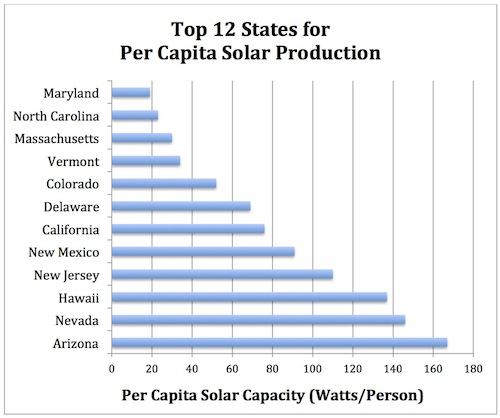
A new report from the nonprofit Environment America shows Vermont is leading New England in solar proliferation on a per-person basis.
Over the past decade, solar photovoltaic capacity in the United States has increased almost 140-fold, to more than 7,200 megawatts at the end of 2012. And the document says Vermont has played a key role in that expansion.
The report, titled “Lighting the Way: What We Can Learn from America’s Top 12 Solar States,” places Vermont in the “dazzling dozen.” While these 12 states account for 28 percent of the country’s population, they hold 85 percent of the nation’s solar energy capacity.
“Vermont is putting solar power to work and is leading the way to a clean energy future that tackles the threat of climate change while growing jobs and the economy,” Gov. Peter Shumlin said in a statement sent out by the Vermont Public Interest Research Group, which distributed the report.
“We have more than doubled our solar energy in the last two and a half years, but we know our work is not done,” Shumlin continued. “We plan to keep Vermont at the forefront of this energy revolution.”

Vermont ranks ninth in the nation for solar electricity capacity per capita at 34 watts per person, surpassing 10th-ranked Massachusetts, with 30 watts per person. First-ranked Arizona has 167 watts of solar power per person, and fourth-ranked New Jersey has 110 watts per person. Vermont also ranked seventh in per capita for photovoltaic capacity installed in 2012, with 26 watts per person.
Vermont drops out of the top 12 when looking at total solar capacity. At the end of 2012, California ranked first in the country for total solar capacity, with 2,901 megawatts. Massachusetts placed seventh, with 198 megawatts, while Vermont was 21st, with 21 megawatts.
Over the past decade, the cost of photovoltaic installations across the country has roughly halved, according to the report. From 2010 to the end of 2011, the cost of solar installations decreased by 20 percent. In 2012, the cost dropped by 27 percent.
As the cost of solar installations has fallen, the report shows that solar industry jobs have risen. In 2012, more than 119,000 U.S. workers were employed by the solar industry, marking a 13 percent uptick from the prior year.
The report explains that the leading driver of solar proliferation is not the degree of sunlight, but rather public policy. One of the key policies touted by the report is net metering, which requires utilities to credit small solar producers for the power they generate on the grid. While the report champions a net metering policy that credits at the retail rate of power, Vermont’s policy calls for a 20-cent per-kilowatt-hour (kWh) credit, which is above many utilities’ retail rate of power.
Since a new net metering law went into effect in 2011, which expanded the policy, Vermont has seen a large increase in solar net metering applications, from 358 in 2011 to 603 for the first 11 months of 2012.
The state’s net metering policy recently emerged as a topic of debate among utilities and developers.
A utility no longer has to accept applications for net metering systems when the capacity of a utility’s total net metering customers surpasses 4 percent of its peak demand from the previous year, or from 1996, whichever is greater. Three utilities — Vermont Electric Cooperative, Washington Electric Cooperative and Hardwick Electric Department — recently hit this cap, and officials from the utilities have voiced concern that the state’s net metering policy is shifting utilities’ costs onto other customers, who don’t have solar systems.
Net metering customers can use credits to pay off fixed-cost charges to reduce their monthly utility bill to nothing. Regardless of how much power a customer uses, a utility must have infrastructure, such as poles and lines, in place to supply customer needs. Officials at the three utilities have voiced support for limiting the application of net metering credits to kWh charges so that customers cannot zero out a utility’s fixed-cost.
Ben Walsh, clean energy advocate for VPIRG, says the state’s net metering policy has helped drive Vermont’s solar success. Rather than changing it, he said, the state should be doing more to encourage solar growth.
VPIRG rolled out three policy initiatives Tuesday in conjunction with the report. The organization called for:
• Doing away with the 4 percent cap that allows utilities to stop accepting net metering systems.
• Expanding the net metering law to include systems larger than 500 kW, which is the current maximum.
• Streamlining the permitting process for solar systems greater than 150 kW.
Although Vermont doesn’t have the availability of sunlight that states such as Arizona and California do, Walsh says Vermont has a lot of room for solar improvement. He points to Germany, with its 400 watts per capita of solar power and similar sunlight conditions, as a model for Vermont.
“Right now our job is to get as much renewable energy online as possible,” Walsh said. “The kinds of theoretical problems utilities are bringing up right now are just that: Theoretical. They are the kind of problems that will need to be dealt with at some point, but they are very minor.”
David Hallquist is CEO of the state’s second largest utility, Vermont Electric Cooperative. He said the problems of cost-shifting and intermittent power generation for a grid with 24-hour demands are not theoretical, but real.
“That comes from a highly misinformed source about the electrical grid,” Hallquist said about Walsh’s comment, pointing to a recent study published by Carnegie Mellon University researchers about the variability of renewable energy resources.
“The (Carnegie Mellon study) reaffirms VEC’s long-standing position that without thought and electrical considerations, intermittent renewable generation can destabilize the grid,” Hallquist said. “VEC is not opposed to streamlining the (permitting) process, however we still will need to perform the interconnection study for larger projects.”
Gabrielle Stebbins, the director of the renewable energy trade organization Renewable Energy Vermont, said she’s pleased to see Vermont remain in the top 10 states for solar capacity, “as it has for at least five years.”
But it is time, she said, to examine how to take the solar success Vermont has had on the small generation front and apply it to large generators. This is necessary, she said, for Vermont to achieve the goal set out in the state’s Comprehensive Energy Plan of drawing 90 percent of its energy from renewable sources by 2050.

