

This week’s In This State is by Tom Slayton. In This State is a syndicated weekly column about Vermont’s innovators, people, ideas and places. Details are at http://www.maplecornermedia.com/inthisstate/.
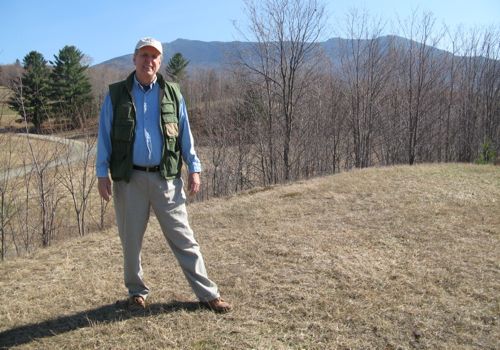
The Green Mountain Parkway has become a part of Vermont’s green myth, a fact that bothers contemporary historian Bruce Post and others.
A proposal in the 1930s for a high-altitude highway along the length of the Green Mountains was among the most contentious issues ever to face the state of Vermont. It was also one of the most complex.
It is those complexities that are being lost lately, Post believes. And that’s too bad, he says. Because to understand the contemporary threats facing Vermont’s mountains, it’s essential to understand the Green Mountain Parkway controversy.
The parkway was debated statewide for more than a year before it was voted down in a popular referendum on Town Meeting Day in March 1936, by a vote of 43,176 to 31,101. But there’s a lot more to the story than just that vote.
“There’s a lot of mythology about the parkway, and I find it a bit narrow,” Post says, noting that the parkway wasn’t simply an environmental battle, but a battle over many things – Depression-era jobs, federal government intervention in Vermont, and politics from the local town level all the way to the policies of President Franklin Delano Roosevelt.
Now semi-retired, Post was an aide to Sen. Robert T. Stafford and then-U.S. Rep. James M. Jeffords. He served as a policy adviser to Gov. Richard A. Snelling until Snelling’s death in 1991. He is a vigorous-looking man with thinning blond hair and an earnest manner, which becomes more animated when discussing Vermont’s mountains and the parkway proposal. He currently serves on the board of selectmen in Essex, where he lives, and is a member of the State Board of Libraries. His passion is Vermont history, especially the Green Mountain Parkway.
He began reading about the parkway some years ago in a book by another expert on the subject, University of Vermont professor Frank Bryan. As he had time, Post read further and began doing his own research. He was fascinated by traces of a native Vermont anti-Semitism that crept into the debate. because some Vermonters feared the parkway would bring Jewish vacationers to Vermont. Former U.S. Sen. George D. Aiken, who adeptly sidestepped the parkway controversy, hinted as much.
Post has prepared a computer slide presentation on the subject, which he showed recently at the University of Vermont’s Center for Research on Vermont. Professor Bryan also spoke that evening and presented his statistical analysis of both the legislative vote and the statewide referendum. Both votes, Bryan said, indicate that it was a contest of traditional Republicans versus Roosevelt New Deal Democrats – and the traditional Republicans won.
The myth, according to Post, is that in rejecting the parkway, Vermonters were voting to save their mountaintops. But the parkway issue is much more complex than a simple environmental battle over mountaintops. In fact, he believes, that negative vote on the parkway might have ultimately hastened their development.
“It’s been all downhill for our mountains ever since then,” he says.
He notes that when people today write or talk about the parkway, they usually describe it as “a ridge-top superhighway.” That’s wrong on both counts, he says.
Now look at Jay Peak more recently,” Post says, and pulls up a photo of a helicopter lowering construction materials onto the mountain. The Jay Peak ski area dynamited away some of those summit ledges to install a large tramhouse, which protrudes from the summit in a distinctive silhouette that can be seen for miles.
Maps of the proposed parkway route show that it would have been located mainly on the west flank of the Green Mountains, well below the ridgeline. And a superhighway? Modern interstate highway standards mandate a total highway width — including four lanes, shoulders and median strip — of over 100 feet.
Post produces a cross-section diagram of the proposed road and its mountainside surroundings drawn by landscape architects who helped plan the parkway in the 1930s. The diagram shows that the road as proposed would have been only 30 feet wide.
“The road by my house in Essex is 40 feet wide,” he says. “The parkway would have been no superhighway!”
Also, the diagram shows that the road would have been located within a wide greenway area that would have included hiking trails and bridle paths, with protected natural areas at regular intervals along the way. Perhaps most spectacularly, the road would have ended below the summit of Jay Peak in a large protected natural area, much like a national park. A mountainside hotel would have been part of the Jay Peak terminus of the parkway, but Post argues it would have been designed to fit into the natural contours of the land and vegetation of the forest, much like other national parks buildings of the time.
He shows a photo of the summit of Jay Peak in 1934. It is completely undeveloped, with some bare rock ledges poking above the surrounding forest.
“Now look at Jay Peak more recently,” Post says, and pulls up a photo of a helicopter lowering construction materials onto the mountain. The Jay Peak ski area dynamited away some of those summit ledges to install a large tramhouse, which protrudes from the summit in a distinctive silhouette that can be seen for miles. The mountain has ski trails and glades cut into its forested sides, and its ski lifts, including the tramway, transport hundreds of skiers daily in the season.
That has been the fate of many Vermont mountains. The ski industry has been important for Vermont’s tourist economy, but, Post says, it has compromised the peace and tranquility of the mountain environment – in his view much more seriously that the Green Mountain Parkway would have.
“We need to learn to love our mountains again,” Post says. “We have writ ourselves so large that we have forgotten we are part of nature. We are nature!”
Jay Peak is emblematic, he says, of what has happened up and down the Green Mountains. And he wonders if in worrying about the “industrialization” of Vermont’s ridgelines with wind towers and other apparatus, we have ignored the suburbanization of the mountains’ flanks and environs.
He pulls up a 1930s photo of Big Pond, a mountain lake in Woodford, near Bennington. In that photo, the pond is ringed by trees and looks completely natural. “Now here’s Big Pond today,” he says. A contemporary aerial photo shows Big Pond completely surrounded by camps and houses.
There were fears expressed in the 1930s that the parkway would bring shabby development to Vermont, a “Coney Island” atmosphere, and the universally abhorred icon of the time — hot-dog stands. Post suggests that in many of today’s ski areas and associated towns, there’s plenty of examples of tasteless over-development – including, in Manchester (a town that vigorously opposed the parkway in the 1930s) lots of commercialism — and a hot dog cart.
“It’s almost as if we need a truth commission in this state to let us see how we really are,” Post says.
After the defeat of the Green Mountain Parkway in 1936, a later proposal would have established a Green Mountains National Park roughly from Mount Ellen in Warren north over Camel’s Hump, Mount Mansfield, Bolton Mountain and others. It would have preserved those mountains in their undeveloped state — no ski lifts or trails, no high-altitude vacation homes, no water parks or motorized recreation.
“I look at those mountains from near my home – Camel’s Hump, Bolton Mountain, Mount Mansfield,” Post muses. “I think, ‘That could have been a national park.’ And I’m sad.”
Post is continuing his research, finding new aspects of the parkway controversy, and pondering the complexity of the debate. He wants to find some way of expressing his vast amount of research but is uncertain whether it should be a book or a film or something else.
Noting that James Taylor, the visionary who founded the Green Mountain Club, was in favor of the parkway, even though the club opposed it, Post said that Taylor might have ultimately been right.
“The parkway was part of our initial engagement with modernity,” Post says. “Somebody needs to speak for James Taylor.”
Tom Slayton of Montpelier is editor emeritus of Vermont Life magazine. He is subbing for Bryan Pfeiffer this week.
