

Vermont legislative leaders and Douglas administration officials are dismayed that Entergy, the Louisiana-based corporation that owns and operates the Vermont Yankee nuclear power plant, didn’t find an eighth-inch hole in a pipe that leaked radioactive fluid on Friday after recent inspections by engineers and robots.
Lawmakers are alarmed by the newly-discovered leak and a recent test that showed a fish caught in the Connecticut River, which runs 30 feet from the plant, contained measurable levels of Strontium-90.
Vermont Senate President Pro Tem Peter Shumlin, House Speaker Shap Smith and Rep. Tony Klein held a press conference on Wednesday to announce they were sending a letter to the Department of Public Service demanding action. They said they want the state agency to require Entergy to move the plant’s pipes above ground or to make them accessible in underground concrete vaults for the remaining two years of the plant’s operation. (The 38-year-old plant is slated to close in 2012; Entergy’s efforts to relicense the plant for an additional 20 years were rebuffed by the Vermont Senate in February.)
Read the Letter to Commissioner O’Brien 6-2-10
An official with the Department of Public Service said yesterday the plant inspection did not include a routine pressure test of the pipe.
Stephen Wark, communications director for the Department of Public Service, said the department is concerned about the leak, and he called the failure to conduct the pressurized test “a big miss from our perspective.”
The department won’t say whether the steps the legislative leaders suggest should be taken; officials are waiting for the vertical audit report, an analysis of the reliability of the plant, according to Wark.
Shumlin, a Democratic candidate for governor, expressed outrage at what he regards as a slow reaction from state officials.
“I would ask you this question: If tritium, cobalt, cesium and other isotopes were leaking every week into Lake Champlain, would we have been as silent as we have been?” Shumlin said. (He explained that one of the original sites for the plant was on the shores of the big lake. That site, in Charlotte, was later proposed for a second nuclear plant, but in 1978 it was finally dropped). “I would say probably not. We spent $100 million to try to make the lake clean and clear. It’s been a priority for Republicans and Democrats. … Just imagine for a minute we were talking about yet another leak of cobalt or tritium (into Lake Champlain). Do you think we would remain so silent, so patient? I don’t think so.”
The most recent leak at Vermont Yankee came from a drain line used only when the plant is restarted. Larry Smith, spokesman for Entergy, said the leak, which occurred on Friday, lasted four hours, released about a gallon of liquid and contaminated a “one-foot radius of soil.” He said the incident posed no threat to public health or safety.
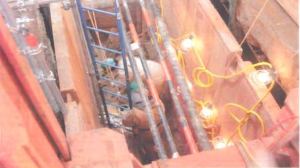
The pipe in question is located in the Advanced Off Gas System, the area that had been excavated for the March 25 repairs of the first two leaks, which have contaminated an extensive area of soil under buildings and on the plant compound located 30 feet from the Connecticut River.
Recently, a laboratory test found that a fish caught upstream had measurable levels of Strontium-90 in its system. SR-90 is a radioactive isotope that has similar chemical qualities to calcium and collects in the bones and teeth of humans and animals.
The Nuclear Regulatory Commission, which is responsible for plant safety, says there is no connection between the tritium contamination and the levels of SR-90 found in the fish. NRC spokesman Neil Sheehan blames the presence of SR-90 in the fish on nuclear fallout from the Chernobyl nuclear accident in the 1980s and nuclear weapons testing that occurred more than 50 years ago.
Legislative leaders blast what they call “the leak of the week”
Shumlin, Smith and Klein told reporters they were drafting a letter to David O’Brien, commissioner of the Department of Public Service, demanding that he “use all reasonable means to mandate” that Entergy retrofit the piping so that it is more accessible for inspections. The majority of piping at the plant is located approximately 15 feet below ground in concrete tunnels.
The letter cites Oyster Creek in New Jersey as an example of a plant that has taken steps to ensure inspectors have access to underground and buried piping.
“We are concerned about the length of time this current pipe has been leaking,” Smith and Shumlin wrote. “We are also concerned that there may be other potential leaks not discovered to date. The fact that the most recent leak was missed during the intense scrutiny of inspections of the Advanced Off Gas system is extremely disturbing. Entergy’s management of the reactor has repeatedly failed to demonstrate competence and has not exercised the necessary degree of administrative control and oversight.”
The cost to retrofit the piping would be roughly $10 million, according to Shumlin, based on estimates from Arnie Gundersen, who is a member of the Legislature’s Public Oversight Panel. That’s about what it cost Entergy to refuel the plant last month, Shumlin said.
“Why couldn’t you spend a similar amount to avoid a similar disaster?” Shumlin asked.
Smith said allowing leaks to continue in anticipation of decommissioning the plant isn’t sensible because it will be more costly to clean up contaminated soil than it will be to fix the pipes now.
“I think it’s a lot cheaper to prevent it from happening in the first place,” Smith said. “From my perspective, the economics say take care of it now, don’t take care of it later.”
Klein, chairman of the House Natural Resources and Energy Committee, who advocates shutting down the plant entirely, said it would take about three months to move the pipes above ground.
He compared the leaks of radioactive isotopes, including the worst offender — Strontium-90, which can persist in the environment for 28 years – with the Gulf Coast disaster.
“It may be the worst environmental disaster that has happened in Vermont,” Klein said. “We need to not turn a blind eye. This is dangerous, dangerous material (Strontium-90) and it is not something to just shrink away and say this is the daily course of business.”
Shumlin said the state is being incredibly laid back about the presence of radioactive isotopes on the Yankee site, some of which have contaminated the soil underneath buildings. “Entergy’s making the judgment well we’ll deal with that later,” Shumlin said.
“I sure wish we had a Public Service Department that was as diligent at protecting the public as we might wish because we may well regret our very lackluster response to allow radioactive isotopes to continue to move in the ground when another option might have been to say clean it up,” Shumlin said.
Department of Public Service takes wait-and-see approach
Stephen Wark, communications director for the Department of Public Service, questioned the rationale of requiring Entergy to invest in retrofitting pipes at the plant less than two years before the plant stops operating.
“It doesn’t make any sense to spend any money on retrofitting a plant that is closing,” Wark said. “Why not spend it on decommissioning?”
The department won’t say what steps should be taken; officials are waiting for the vertical audit report, an analysis of the reliability of the 38-year-old plant, Wark said. The vertical audit was sent back to Entergy after the leak was discovered, Wark said. The Public Oversight Panel is now reviewing it.
“It (the letter from Shumlin and Smith) is a request, that is really a function of an engineering study,” Wark said. “To just request this sort of — I wouldn’t call it remediation – to request this sort of engineering adaption would require engineers to take a look at it to see if it’s feasible because all these plants are different.”
When asked whether the department would push for that study, Wark called the question a “super hypothetical” because he hadn’t seen the letter from legislative leaders yet.
“We want all these systems to be readily accessible,” Wark said, “so we don’t have to keep going through this.” He wouldn’t be specific, however, about how that accessibility might be achieved, because he said the department not only doesn’t have the vertical audit in hand, it also is waiting for a “root-cause analysis,” the assessment of the original tritium leak which was discovered on Jan. 7.
Entergy’s analysis is currently under NRC review, according to Sheehan.
The next step would be a fully developed remediation plan.
Is Wark worried there could be more leaks? Yes, he said.
“The goal of these studies, and all these examinations that are being done by the engineering team, is to try to determine to what extent these go,” Wark said. “We haven’t even seen the root-cause analysis. So to prescribe and taking an action, we can’t go there yet. We may end up there.”
Wark said the state has limited authority over the plant because it doesn’t have jurisdiction over safety issues, the NRC does.
“The plant was running at 100 percent while it had the leak so it doesn’t affect the reliability, but does it affect safety,” Wark said. Since 2007, Vermont Yankee has been operating at 120 percent of capacity.
On the other hand, Wark was quick to chastise Entergy’s inspection process, and pointed to the lapse in the last inspection — during which Yankee employees failed to run a pressurized test on the piping system — as an example of Entergy’s questionable competence. He said, “We’re not happy about that at all.”
“Should these guys be running the plant?” Wark asked. “Maybe somebody else should be running the plant.”
Later in the interview, Wark remarked: “There’s no way we’re going to be apologists for Vermont Yankee.”
