


[G]ov. Peter Shumlin could have proposed a financing plan for single payer health care that cost $1 billion less than the one he presented to the public Dec. 17.
Instead, demoralized after a stunning near defeat in the General Election, Shumlin scrapped his long awaited, universal, publicly financed health care plan because he said it would shock Vermont’s fragile economy.
Shumlin has said abandoning the plan is the greatest disappointment of his political career. In remarks a week later, the governor said it was not a political decision.
But critics say that once Shumlin resolved to pull the plug, he cast the program in the most negative light possible because it was not politically viable in the context of his loss of popular support and against the backdrop of a lagging state economy.
Single payer, with the billions needed in revenue, may never have gotten anywhere in the Legislature. With the state facing a $100 million budget gap and anxiety about potential property tax reforms, the governor’s signature initiative faced an uphill battle in the Legislature, which this session has a larger contingent of Republicans who oppose the idea of a single payer program.
But critics say now Vermonters won’t know if single payer could have succeeded in 2015, because after Shumlin decided it wasn’t feasible, he found a way to mitigate the inevitable wave of political backlash and appease his main constituencies: liberal advocates, business leaders, providers, and teacher and state employee unions.
Shumlin had said he would present a menu of options to the Vermont Legislature in the two year run up to the announcement, but instead he presented one plan that Vermonters could not afford.
One of the alternative plans proposed by his health care reform team that was not considered in the final analysis was a much less expensive, $1.6 billion option, that would have offered a universal, publicly financed insurance plan with benefit levels on par with what is available to most Vermonters in the commercial insurance market today, according to documents provided by the Shumlin administration.
“I don’t know exactly when he made that decision, but once it was made, there is no question in my mind that Shumlin pivoted to his roots and his instincts, which are purely political,” said Hamilton Davis, a journalist and longtime observer of Vermont health reform.
“He hung everything he could on it and walked away.”
John Franco, a prominent Burlington attorney who has been involved health care reform for two decades, says that Shumlin purposely chose a plan that covered 94 percent of individuals’ health care costs. Proposing an overly expensive option, Franco says, was a political calculation.
“If you build an airplane out of lead, it’s not going to fly,” Franco said.
Shumlin has insisted it was not a political decision and that the documents he released would bear that out.
But buried on the 260th page of the appendices to his report released just before New Year’s Day, is a financing plan that might have been a reasonable starting point for going forward.
This plan would have offered insurance at a level that is equal to the average employer plan now on the market and would have cost $1 billion less than the cadillac level plan Shumlin rejected.
The ramifications of Shumlin’s decision could echo far beyond Vermont, according to a national single payer advocate and health care economist.
Gerald Friedman, a UMass-Amherst economist, says Shumlin’s decision was flawed. He, too, believes the decision was ultimately a political one.
The administration’s 2014 report includes little new information about how single payer could be financed, Friedman says, and he believes the financing plan could have been released two years ago when it was originally promised to the Legislature.
Friedman and others say the governor could have said the plan was doomed because it would have been difficult to get waivers from the federal government and Congress is now dominated by Republicans who wouldn’t look favorably on funding Vermont’s attempt at single payer.
By blaming economic factors, Friedman says the governor set the single payer movement back decades.
Federal self-insurance law is a roadblock that Sen. Tim Ashe sees as a potentially insurmountable hurdle. The Shumlin administration’s report glossed over the impact of the Employee Retirement Income Security Act on the success of single payer, Ashe says.
“For all the criticism coming from people who are mostly advocates for a very far reaching tax financing system, they’ve glossed over that variable and have never given a good explanation of how that problem was going to go away,” Ashe said. “Any number of larger employers who self insure could file one court document and grind some portion of Green Mountain Care to a halt.
Building a lead airplane
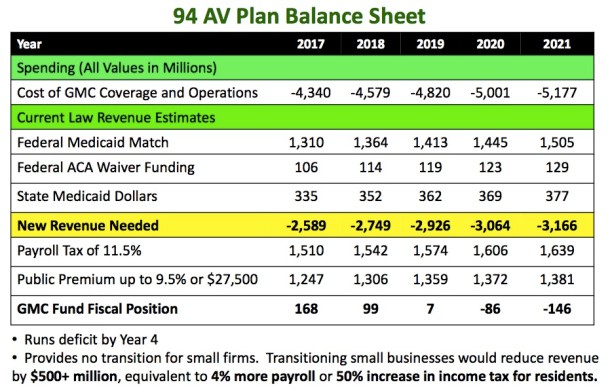
The balance sheet for Shumlin’s single payer proposal. source: Green Mountain Care Financing Presentation Dec. 17, 2014
The plan Shumlin presented had a first year cost to Vermont of $2.6 billion. That’s $400 million more than the high end of the estimate he released jointly with the Legislature last year.
The governor proposed a plan that covered 94 percent of people’s health care costs, i.e. the plan’s actuarial value. He could have, however, pitched a plan with an actuarial value of 87 percent that would have cost $300 million less.
Act 48, Vermont’s single payer law, directed the administration to shoot for a plan that covered 87 percent of costs — a target the governor decided was too low.
The average private sector health plan covers 86 percent of health care costs.
Twenty-two percent of Vermonters have coverage at a 95 percent actuarial value and another 25 percent are between 90 percent and 95 percent, according to administration officials.
Shumlin has said it would not be fair to ask these individuals to pay more toward their health insurance.
However, most of those high-value health plans are held by teachers and state employees who have negotiated for higher benefit levels over time, and the teacher and state employee plans will likely become less generous when they are hit with a federal “cadillac” or excise tax that goes into effect in 2018.
Several other policy choices also significantly increased the year one cost of single payer, and run counter to what the governor outlined in his 2013 report.
Most significant was Shumlin’s choice to include out-of-state workers in the program, which adds more than $200 million to its cost. That’s a departure from the 2013 UMASS report on single payer.
Shumlin said excluding out-of-state workers would be too complicated for employers who would “have to pay for Green Mountain Care and a separate plan for out-of-state workers.”
The governor repeatedly blamed the numbers spit out by the economic model they were using, but deciding not to include workers that commute to Vermont is a policy choice, critics say. One that decision was made late in the game it significantly increased the program’s cost.
Including out-of-state workers could have been an option instead of a requirement of the plan. Instead, Shumlin declared that excluding out-of-state workers was a nonstarter.
Shumlin did the same with Vermont’s provider tax. Virtually every state has a provider tax on hospital revenue. States then use the revenue to draw down federal match money for their Medicaid programs.
Scrapping the provider tax eliminates $160 million in revenue.
The administration’s argument was that in a single payer system, the tax becomes “circular.”
“You’re taxing yourself,” said Michael Costa, the governor’s single payer tax expert. “There’s a policy imperative to be done with the provider tax,” he said when the governor made his announcement.
In other words, if the state of Vermont is making all the payments to hospitals, then taxing their revenue would be “circular” and a bad policy choice.
But Green Mountain Care was never a pure single payer system. It anticipated there would still be Medicare, federal employees, military, large-employer-sponsored insurance plans and payments from the private insurance of people who live outside Vermont.
Removing the provider tax was a policy decision, and other financing scenarios in the report did include a provider tax.
Finally, and less significantly, the Shumlin administration assumed there would be zero administrative savings to the program in year one.
The administration’s 2013 report suggests there would be $8 million to $20 million in savings in year one, and $39 million to $211 million by year three.
The above factors are all policy choices that have nothing to do with surprises served up by the economic model, which increased the program’s cost by more than $1 billion.
Alternate financing plan buried
Starting on page 260 of the appendices to Shumlin’s 2014 report are 15 single payer financing proposals that “more closely” match the assumptions of the 2013 report.
All were run through the economic model to vet the numbers.
None of the models were presented to lawmakers or the public — and none were highlighted in the governor’s report.
At a press briefing, the members of the governor’s health care reform team — Costa, Robin Lunge and Lawrence Miller — were available for questions, but they opted not to walk reporters through the report and point out salient details in the hundreds of pages of appendices, briefing documents with the governor and the business and consumer councils.
Among the 15 different models in the document dump is Financing Concept 12, which uses an 87 percent actuarial value and would require $1.6 billion in state revenue for the first year.
It excludes out-of-state workers and does not offer supplemental coverage to federal employees or people with employer sponsored coverage, all of which is contained in the plan Shumlin chose.

Balance sheet for Alternate Financing Concept 12. source: complete appendices to 2014 GMC coverage and financing report.
What the public reception of such a plan might have been on Dec.17 is unknowable.
But critics like Davis and Franco argue it would have been a more reasonable starting point if Shumlin wanted to continue the fight for single payer in 2015.
Many advocates would have undoubtedly expressed disappointment with an 87 percent actuarial value. But they were already prepared to push for stronger benefits in the Legislature. Now they have nothing to fight for, and many are deeply disappointed.
Meanwhile, Shumlin is able to say to state employees and teachers unions that he would have only moved forward with the program if it preserved the richer benefits they have now.
For business leaders and health care providers, who were always leery of the program, his decision was welcome news because it provided greater economic certainty in the near future.
Though business leaders voiced support for eliminating employers’ responsibility for health insurance, they roundly applauded Shumlin’s decision as pragmatic on Dec. 17. No one in the business community suggested he should press forward.
Hospitals, which were always concerned that the government would be an unreliable financier for Vermont’s health care system, also praised Shumlin’s decision.
Correction: A sentence in an earlier version of this story was incorrect: The average private sector health plan covers 86 percent of health care costs, not public sector as originally written.

