

VERNON — Vermont’s sole nuclear power plant, Vermont Yankee, is no longer producing power. The plant was unplugged from the grid at 12:12 p.m. Monday.
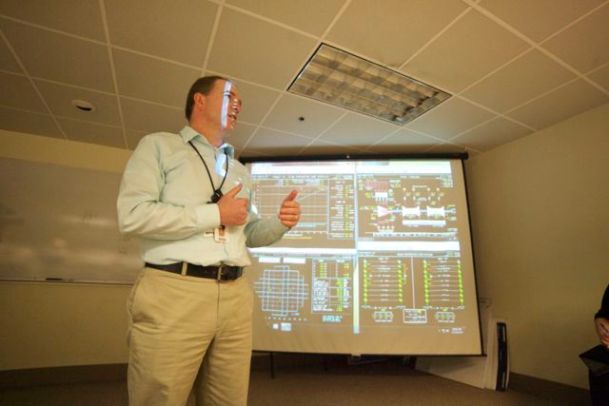
A half dozen employees gathered at the Vermont Yankee Joint Information Center to watch a computer generated display of the shutdown process. Among them was Paul Paradis, Entergy’s decommissioning director, who watched as boron control rods were inserted into the reactor core to “poison” the fission reaction, as he described it.
“The plant is running well, and it can still run well for a long time,” Paradis said. “It just doesn’t feel right that it’s going away.”
From a control room, workers used a computerized system to place boron rods into the reactor to absorb the free neurons in the reactor and deactivate the fission reaction. By 8 p.m. the reactor water temperature dropped from 550 degrees to 212 degrees Fahrenheit.
Dan Jeffries, an engineering instructor at Vermont Yankee, will retire on Feb. 12 after beginning work for the company in 1995. The end of his career aligned with the shutdown of the plant.
“I feel good about it. I’m kind of celebrating 42 years of safe operation of the plant,” Jeffries said. “They all have to be shut down eventually. It’s either the regional economy or just the aging of the facility. Eventually they get shutdown. No surprise there.”
Entergy, a Louisiana-based company that owns four nuclear reactors in the Northeast, officially shutdown the plant in Vernon for economic reasons. Until Monday, the 42-year-old nuclear-powered steam turbine supplied baseload electricity for more than half a million homes in New England.
“Economic factors, especially related to the natural gas market in the Northeast, are the primary reason for the shutdown,” said Bill Mohl, president of Entergy Wholesale Commodities, in a statement on Monday.
The shutdown ends an era in Vermont. For more than four decades, the plant has been a regional source of energy and economic gain. It has also been a source of contention. Anti-nuclear activists have long argued that the radioactive emissions from the plant present environmental and safety issues.
Regional planners say the closing of the plant — and layoffs of about 550 well-paid plant workers over time — will reduce economic activity in the region. Anti-nuclear activists celebrated the closing as a win for public health and safety.
A short history of Vermont Yankee
Steve Terry, former Times Argus editor and a retired Green Mountain Power executive, remembers the 1966 fight in the Legislature over energy. Phil Hoff, the first Democrat to ascend to the governor’s office in 100 years, was determined to invest in a new hydro dam to be built at Churchill Falls in Newfoundland. The proposal passed in the state Senate in a 28-2 vote, but failed in the House, Terry says.
Instead, private utilities in New England decided to build one of the Yankee plants in Vermont.
The plant went online in November 1972. Central Vermont Public Service owned 35 percent of the plant, while Green Mountain Power had a 20 percent stake. Other New England utilities owned the remaining 45 percent. The utilities, which faced financial problems in the late 1990s, sold Vermont Yankee in 2002 to Entergy for $180 million.
Forty-two years after Vermont Yankee was billed as a source of cheap power, the cost of nuclear energy now outstrips hydro and natural gas, and Entergy is closing the plant because it’s too expensive to maintain, Terry says.
In 2008, Vermont Yankee supplied 35 percent of power used in the state. Two years later, Gov. Jim Douglas signed an historic power purchase agreement with Hydro Quebec, paving the way for Vermont utilities to shift away from Vermont Yankee. In 2012, Green Mountain Power, the state’s largest utility, stopped buying electricity from the nuclear power plant.
“It is ironic that Vermont Yankee was sold in the Vermont Legislature as too cheap to meter, and then it was closed because it’s too expensive to run,” Terry said.
In the intervening decades, Vermont Yankee became a proving ground for the environmental movement in Vermont, Terry says. Groups like the New England Coalition, Citizens’ Awareness Network, VPIRG and others galvanized around closing the plant. Terry describes the anti-nuclear activism at state hearings in Brattleboro as contentious, even raw.
It also became a “constant” front page newspaper story. “Vermont readers voters they were being educated long and hard about energy issues and electric rates and so that’s why I think to a certain extent energy still becomes such a prime focus in Vermont,” Terry says.
For decades, public opinion on Vermont Yankee was split 50-50 for and against the plant, until the past few years when trust in Entergy’s management of the plant was questioned.
“We didn’t know what we would read in paper the next day,” Terry said. “Would there be more cool tower collapses, more leaks in underground pipes or more evidence they were misleading the Public Service Board? It was not a cause they could get any support for. Frankly, we were at the point where we start to develop other energy resources, distributed energy and energy conservation for example have played a strong role here. We didn’t need it anymore, and it wasn’t cheapest from a business perspective.”
State’s relationship with Entergy

At the Nessbitt’s Portside Tavern, a bar in Vernon less than one mile south of the Vermont Yankee plant, several plant workers said they were frustrated by the “sensational” media coverage of the controversial plant. When asked for an interview, one of the men countered: “First, what do you think of nuclear power?”
The workers declined to identify themselves because they didn’t want to violate their contracts with Entergy. One employee said the media often wore “blinders” and ignored the plant’s benefits, such as Entergy’s contribution to local and state property taxes, charitable donations to nonprofit organizations — not to mention continuous, carbon-free power generation.
Vermont’s relationship with Entergy has been fraught from the beginning. Shortly after the Louisiana company bought the plant, it sought to upgrade the amount of power it produced to 120 percent of the plant’s original capacity. The upgrade went into effect in 2006, despite vehement local opposition. A year later, a cooling tower on the compound collapsed.
The plant was licensed to operate in Vermont through March 2012 under the original agreement with the state, and could have closed that year, but Entergy wanted to continue running the plant through 2032. To do so, the company needed a license extension from the state. Though Entergy eventually obtained an extension, the ongoing operation of Vermont Yankee became untenable for financial and political reasons.
At the end of his term as Senate President Pro Tem in 2010, Gov. Peter Shumlin maneuvered a legislative vote that effectively cut off Entergy’s bid for a 20-year extended license to operate the plant. The vote came on the heels of a highly publicized tritium leak and revelations that company officials misrepresented the existence of underground pipes (the source of the tritium leak) on the Vermont Yankee compound.
In March 2011, an identical GE Mark I boiling water reactor model melted down in the wake of power losses caused by an earthquake and tsunami in Fukushima-Dai-ichi, Japan. In the wake of the disaster, the Nuclear Regulatory Commission tightened up safety rules for reactors in the United States. To satisfy federal regulators, Entergy would have had to have spent tens of millions of dollars to upgrade Vermont Yankee.
A year later, the Nuclear Regulatory Commission granted Entergy a license to operate Vermont Yankee through 2032. The company meanwhile sued the state, arguing that the state had attempted to pre-empt federal law.
A federal judge axed the state’s attempt to police Vermont Yankee in the summer of 2013, and Entergy obtained a license to operate the plant through 2032. Within days of the decision, the company announced it would close the plant because it was losing money.
Now Shumlin says his administration will work with Entergy to ensure a smooth and timely decommissioning process.
“I believe the ceasing of operations today after nearly 43 years represents a positive step for our state and our energy future,” Shumlin said in a statement. “Today, thanks to investments in renewable energy such as solar, Vermont’s energy future is on a different, more sustainable path that is creating jobs, reducing energy costs for Vermonters and slowing climate change.”
Deb Katz of the Citizens’ Awareness Network, a nuclear watchdog group, led the charge to shut down Massachusetts’ Yankee Rowe, Connecticut Yankee and Millstone 1 in the 1990s. She said she felt relieved Monday when Entergy pulled the plug on Vermont’s lone reactor.
“We cut off all the avenues they could have use to try to keep themselves afloat,” Katz said said.
Failures of management at the plant spurred an intense negative public reaction.
Entergy officials denied the existence of underground pipes that leaked tritium into soil on the Vermont Yankee compound in 2010. There were other ongoing infrastructure problems, and the state’s utilities in 2012 did not purchase Vermont Yankee’s power. Instead, the state’s largest utility contracted with a nuclear power plant in New Hampshire owned by NextEra Energy Seabrook.
Others say it was a mistake for politicians to pressure the plant to close. Brad Ferland, president the Vermont Energy Partnership, a group that supported the plant’s operation, said Vermont Yankee has generated about three-quarters of the state’s energy, which he describe as low-cost and low-carbon electricity.
“For 42 years, it has provided approximately 650 high-paying jobs and hundreds of millions of dollars of local and state tax revenue,” Ferland said.
‘Economic pillar’ wanes and decades of decommissioning remain ahead
When the plant is shuttered, officials predict there will be a trickle of economic activity when plant workers spend less money locally. Nonetheless, decades of work at the plant remain. The structure must be dismantled and cleaned of contamination within 60 years.
Dimitri Leristis, a Brattleboro native and owner of the House of Pizza, serves Entergy employees food almost every day. He said his aunt, who works at another restaurant across the street, often deliver pizza to the Vermont Yankee plant.
“We’re not going to lose sleep and go out of business over it. But it’s going to affect sales. The revenue that comes in gets scattered across the local economy,” Leristis said during an interview a week before the plant went offline. “It’s a great business to have in the area. It exports energy and imports dollars into the local economy.”
Entergy has not sold power to Vermont since 2012, but the state receives tens millions of dollars from the company through charitable donations to nonprofits, a revenue sharing agreement with the state’s largest electric utility and contractual payments for economic development and other purposes. Vernon valued the Vermont Yankee plant at $280 million this year, enough in property taxes to cover about half the municipal budget.
The plant on the southeastern edge of Vermont currently employs about 550 people. On Jan. 19, that number will fall to 316. And when all the spent nuclear fuel is placed in dry casks, which is expected in 2020, the company says it will employ between 24 to 58 personnel to guard the fuel, among other tasks.
By the end of the decade, regional economic development planning officials say more than 1,100 jobs and $480 million of economic activity will be forgone when employees stop spending money in the region.
But Tom Hudon, a Brattleboro native who owns the Sonny’s Deli and two Sunoco gas stations, is optimistic. He said most of the plant workers will find similar work elsewhere and new plant workers will arrive to decommission the the plant.

“I don’t see anybody struggling that bad,” Hudon said. “Another group will come in a take that plant apart. You’re going to have a whole new outfit come in.”
When the reactor core cools, the company will begin removing the fuel rods and placing them into a cooling pool. By 2020, the fuel will be removed from the pool and placed in 58 dry cask to be stored in the 125-acre site indefinitely.
The company estimates it will cost $1.24 billion to decommission the plant, and Entergy has about half the money it needs to begin the process. Under federal regulations, Entergy has 60 years to decommission the plant, although the company has said the work could be completed as soon as 2040. Meanwhile, the state and the company are at odds over how to pay for decommissioning.
Entergy produces reliable power, avoids rolling ‘snake eyes’
Spills and leaks and other plant activities at Vermont Yankee have released radiological contaminants from the plant’s boundaries, according to a 2014 report. In 2009, Entergy detected tritium coming from underground pipes leaking into the Connecticut River, and also detected the radioactive material in a drinking water supply well on the plant compound. As of July 2014, tritium is still decomposing, but the “levels of tritium pose no risk to human health or the environment,” according to the report.
Arnie Gundersen, a Burlington-based nuclear engineer, said people should be rejoicing that the company did not roll “snake eyes” and experience a meltdown.
“We’re just not smart enough for this technology,” Gundersen said. “This is a technology that you can have 40 good years and one bad day. I’m happy that Vermont Yankee didn’t have that one bad day.”
In 2008, the Vermont Legislature created an oversight panel to conduct a safety and reliability review of the plant. The panel made recommendations to the company that included investments and upgrades to the plant. Gundersen said Entergy made the necessary changes and significantly improved the safety of the plant.
“After two years, all the trends started turning in the right direction. That would not have happened if it were not for the oversight panel,” he said. “Now [company employees] go to other power plants and they are bringing the systems that we developed here in Vermont.”
Warren Murphy was the senior vice president of operations and engineering at Vermont Yankee when the reactor went online in March of 1972. During a conference call with reporters on Monday, he said the plant is recognized nationally with an “excellent reputation within the industry.” The company invested tens of millions of dollars in the plant every year to improve its reliability, he said.
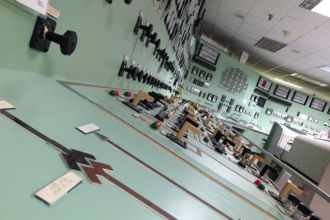
“It’s a far better plant — even though it’s shutting down for good — than it was back in 1972,” he said, “both from an appearance point of view, from an equipment reliability point of view, from a training and experience point of view to personnel.”
Nuclear power is ‘too expensive’
The nuclear industry is in decline, according to a 2014 industry report. Between upgrade costs and competition with natural gas, five nuclear plants in the U.S. announced shutdowns in 2013, including Vermont Yankee.
With the exception of four plants in the southern U.S., no nuclear power generators have been built since the partial meltdown of the reactor core at the Three Mile Island plant in Pennsylvania in 1979.
According to Peter Bradford, former commissioner of the federal Nuclear Regulatory Commission and now an adjunct professor at Vermont Law School, the nuclear industry can no longer generate power at a competitive price.
“There is no possibility of new reactors getting private financing today. They’re just too expensive,” Bradford said. “The economics just haven’t supported new nuclear construction for many, many years.”
The shutdown could have ripple effects on the price consumers pay for electricity region wide.
The 650-megawatt generator powered about 4 percent of New England in 2013. As Vermont Yankee and other power generators in the region go offline, the region’s grid operator, ISO New England, warns the region will become more reliant on natural gas for electricity. Natural gas already accounts for about half of the region’s fuel mix.
Natural gas dependence is a concern because there is more demand for gas than there are pipelines to deliver the fuel, experts say, especially in the winter when gas is used to meet contracts for heating homes and businesses.
ISO New England does not forecast electricity prices in the region, but according to ISO New England spokesperson Lacey Girard, natural gas prices last year were volatile due to high demands and and infrastructure constraints. “When there is a bottle neck in the supply and there is growing demand, it pushes up prices,” she said.
DISCLOSURE: Steve Terry is a member of the Vermont Journalism Trust board.
