

Editor’s note: Inside the Golden Bubble is an occasional political column.
In case you were wondering, there is no contingency plan for single payer health care in the Senate. There is no alternate proposal, no parallel track and no plan B — contrary to media reports last week.
Senate President Pro Tem John Campbell may have used the word “contingency,” and he engaged in his best circumlocution when pressed by reporters on the subject, but the existence of a contingency plan is, well, nonexistent.
Campbell and members of the Senate say they have no intention of substituting their own proposal for Gov. Peter Shumlin’s plans for universal health care coverage in Vermont. In fact, they are, by and large, enthusiastic supporters of his ambitious initiative.
But even Shumlin’s supporters are worried about what they describe as too many unknowns. Before lawmakers can approve a plan they need to know what the coverage will look like, what the actuarial value of the plan will be, how much it’s going to cost, who’s going to administer the plan and how the state is going to pay for it.
Shumlin was supposed to release a financing plan by Jan. 1, 2013, and after ignoring that deadline he promised to give the Legislature details earlier this session. Last month the governor again delayed the release of plans that would show how he would shift roughly $2 billion in funding from premiums to state taxes.
The governor has made it clear he will not share information that could help the Legislature grapple with the complexity of the universal health care plan this year. Shumlin has kept lawmakers, even those of his own party, in the dark, even though the administration could have given them information about some aspects of the plan.
After the myriad problems associated with Vermont Health Connect, which he initially described as a nothing-burger, Shumlin said he wants “to get it [single payer] right.”

“Every time you think you’ve got the perfect solution, you drill down into it and find out you’re leaving somebody out, or it has ramifications that you didn’t consider when you first thought of it,” Shumlin said at a recent news conference.
Ultimately, the Legislature is responsible for approving the plans, and they won’t get started on that process now until 2015. That would leave a little more than a year for the state to implement the plan.
Meanwhile, another onerous deadline looms. In order for the state to be ready for the Jan. 1, 2017, implementation of single payer, the state must apply for a waiver under the Affordable Care Act (which takes six months to a year). In addition, it must determine who will administer the program, and it must create a transition plan for public employees who work for schools, municipalities and the state.
Sen. Tim Ashe, D/P-Chittenden, chair of the Senate Finance Committee, says in past years the administration has asked the Legislature to approve bills that further refine plans for single payer. This year, the Shumlin administration has not presented a health care bill and that puts “the Legislature in an unusual position.” Constituents are asking lawmakers about what single payer will look like, and at this point, they don’t have any answers.
“As a result, there is a lot of anxiety,” Ashe said.
In an attempt to address the “known unknowns,” as Ashe puts it, the Senate last week passed S.252, an uncontroversial piece of legislation that outlines what must be done by the administration and when in order to implement Act 48, the enacting legislation for the single-payer system.
Ashe said the bill creates a framework for “what we need to know in 2015 when we’re asked to cast the most significant vote in our careers in terms of financial impact.”

“The Legislature is capable of spending four-and-a-half months fighting over a couple of million dollars,” Ashe said. “What we face is a four-and-a-half-month fight over $2 billion. That gets to the heart of what we’re trying to do, which is to ready ourselves for that discussion and debate.”
Meanwhile, Shumlin, who is viewed as one of the most nimble politicians the state has ever seen, has taken a flat-footed approach to the single-payer waltz, and his dance with the Legislature is beginning to look more like an awkward political two-step.
Even though Shumlin has staked his political career on single payer, he’s letting lawmakers lead.
Naturally, they’re stepping all over his feet.
Meanwhile, that perceived leadership void has been filled — with worry and in some cases doubt.
Last week, frustrated House lawmakers attempted to gut funding for the Green Mountain Care Board by the end of the fiscal year (June 30), unless the administration cries uncle and releases a financing plan for single payer. Meanwhile, Rep. Cynthia Browning, a renegade Democrat from Arlington, is suing the administration over “work products” created by Michael Costa, the governor’s health care financing czar, that she believes the Legislature and the public has a right to see. These attempts were easily quashed in the House by the majority Democrats.
But this isn’t about one of Browning’s crusades. Nor is it the result of doubts sown by Darcie Johnston, a Republican operative who has questioned the efficacy of single payer since Act 48 was passed in 2011. Nor is it about a partisan knee jerk reaction from a contingent of Republicans who are chary about where the state is headed with single payer.
Even rank-and-file Democrats in the Senate and House say they are nervous about the implementation of the governor’s plan and its potential impact on the economy.
Sen. Peter Galbraith, D-Windham, has gone so far as to create a series of tax scenarios from Joint Fiscal Office figures.
Each one of the following hypotheticals would raise $2 billion: a 17 percent employer payroll tax; a $7,500 per person “public premium” (if large, self-insured companies are excluded); adding a 30 percent increase to each tax bracket; or raising the sales tax to 29 percent (and eliminating the exemption for food and clothing).
Faced with those prospects, who wouldn’t be anxious about staring down a roughly $2 billion question with no detailed strategy and a looming deadline of January 2017?
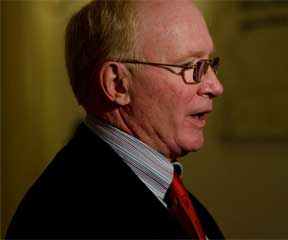
Sen. Kevin Mullin, R-Rutland, a proponent of single payer, is particularly concerned about the impact of new taxes on the business community. He developed the so-called Mullin trigger — a list of economic criteria in Act 48 that a financing plan must meet in order for single payer to move forward.
Mullin blames the governor for a “total lack of leadership,” at a time when “people want answers.”
“We don’t know what the benefit plan is, who’s in, who’s out, and we can’t even do a financing plan until we have the benefits plan,” Mullin said. “It’s frustrating for every legislator in that building. The uncertainty is really hurting people.”
If the actuarial plan is set at 94 percent, the benefit level for state employees and school workers, for example, the cost of the plan would be roughly $2.3 billion.
Ashe says he hopes to address the benefit package question in S.252 before the end of the current session.
Determining the actuarial level will be crucial, Mullin says. If the level is not high enough, unions will fight the plan, if it’s too high, “those of us who don’t want huge taxes will be in trouble.”
“All the decision points require political courage to lay out what you think is right,” Mullin said. “The governor is showing no political courage whatsoever. You can’t just pass a bill, say you’re going to do something, then do nothing.”
Meanwhile, single-payer supporters are sending panicked emails to lawmakers and are questioning Democrats’ resolve to follow through with the program.
Political courage is typically in short supply in an an election year, but in his unwillingness to share what he knows until all the stars align, Shumlin risks alienating the business community and supporters of single payer alike — both of which have become part of his electoral base.
