

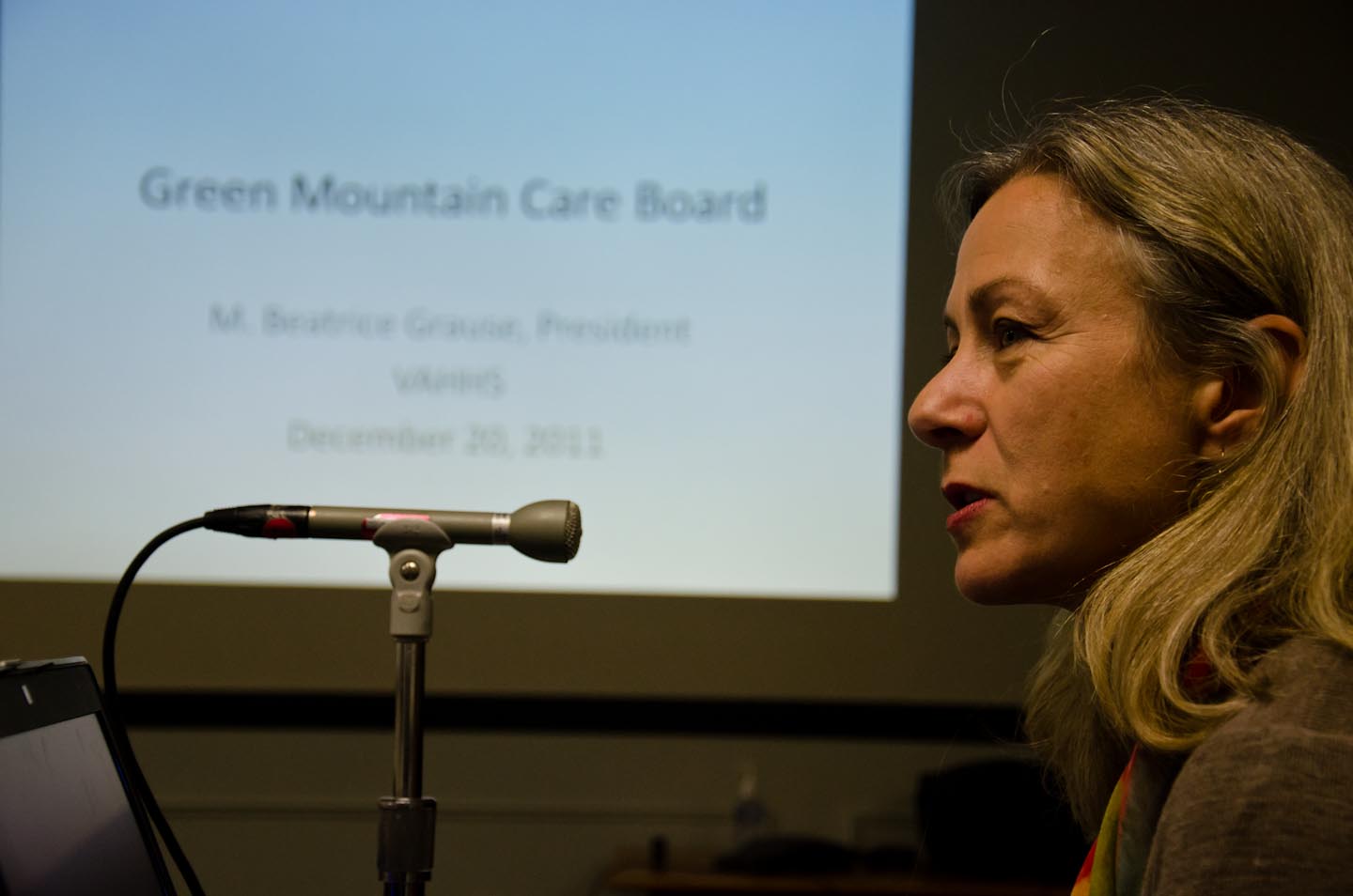
Health care reform makes hospitals nervous. That was the message Beatrice Grause, president and CEO of the Vermont Association of Hospitals and Health Systems, sent to the Green Mountain Care Board Tuesday.
“If health care was easy to fix, we would have done it already,” Grause said.
The first issue hospital administrators worry about is compensation. Grause advocated for a pilot program for changing payment mechanisms from the traditional fee-for-service model to a different model like bundled payments.
“Changing how hospitals, doctors and other providers are paid is an important first step,” she said. “The pilot approach really does fit for Vermont.”
The hospital association and the state have already applied for pilot “bundling” payment programs through the Center for Medicare and Medicaid Innovation program. The new system would create one payment matrix for a set of services surrounding one episode, like a surgery, rather than an a la carte payment approach for all of the ancillary services, such as the preliminary and follow-up care visits.
Grause’s presentation to the board also showcased some of the underlying issues facing hospitals and physicians.
More physician practices are being acquired by hospitals, Grause said. This trend means more doctors are earning salaries and instead of operating small businesses they are working under the hospital system umbrella, she said. The shift from private practices to the larger nonprofit health care entities will make it easier for the system as a whole to align incentives and move forward with a specific plan, according to Grause.
Dr. Allan Ramsay, a member of the board, questioned the wisdom of moving toward larger, more centralized facilities.
“A small, efficient practice is good and creative about controlling costs,” he said. “We’re losing that creative side of practice in the state.”
Another apparent tension is the overarching need to control costs through efficiencies balanced against hospitals’ ability to provide quality service. Rather than setting a budget and trying to bring in revenue above a target amount, hospitals may have to come in under budget as a means of controlling costs, Grause said.
“It is a whole different paradigm when you want to be under budget,” Ramsay said.

At issue is the balance between access to capital and reining in spiraling health care costs. Expenditures on medical services are going up $1 million a day according to the Department of Banking, Insurance, Securities and Health Care Administration.
“A lot of people like to talk about administrative waste,” Grause said. “It’s not sitting there waiting to be excavated.”
Hospital administrative costs are driven by billing and reporting requirements. If the state needs hospitals to cut back office expenditures changes in the rules might be required, Grause said.
Member hospitals in the association she represents want to know how the state defines successful reforms.
Board member Con Hogan said the board is in the process of drafting a document that will address system indicators of quality. It should be final by Jan. 11, he said.
“Population health is an important piece of it,” Hogan said.
The board also approved a contract with Policy Integrity, a limited liability company founded by Steve Kappel, to develop a data analysis plan. Green Mountain Care Board Chair Anya Rader Wallack recused herself because an employee of Kappel’s had worked for her husband’s firm.

