Editor’s note: This article first appeared in The Commons.
The curtain went up Wednesday night on three days of meetings, public comment and an injunction hearing for the Entergy v. Vermont lawsuit.
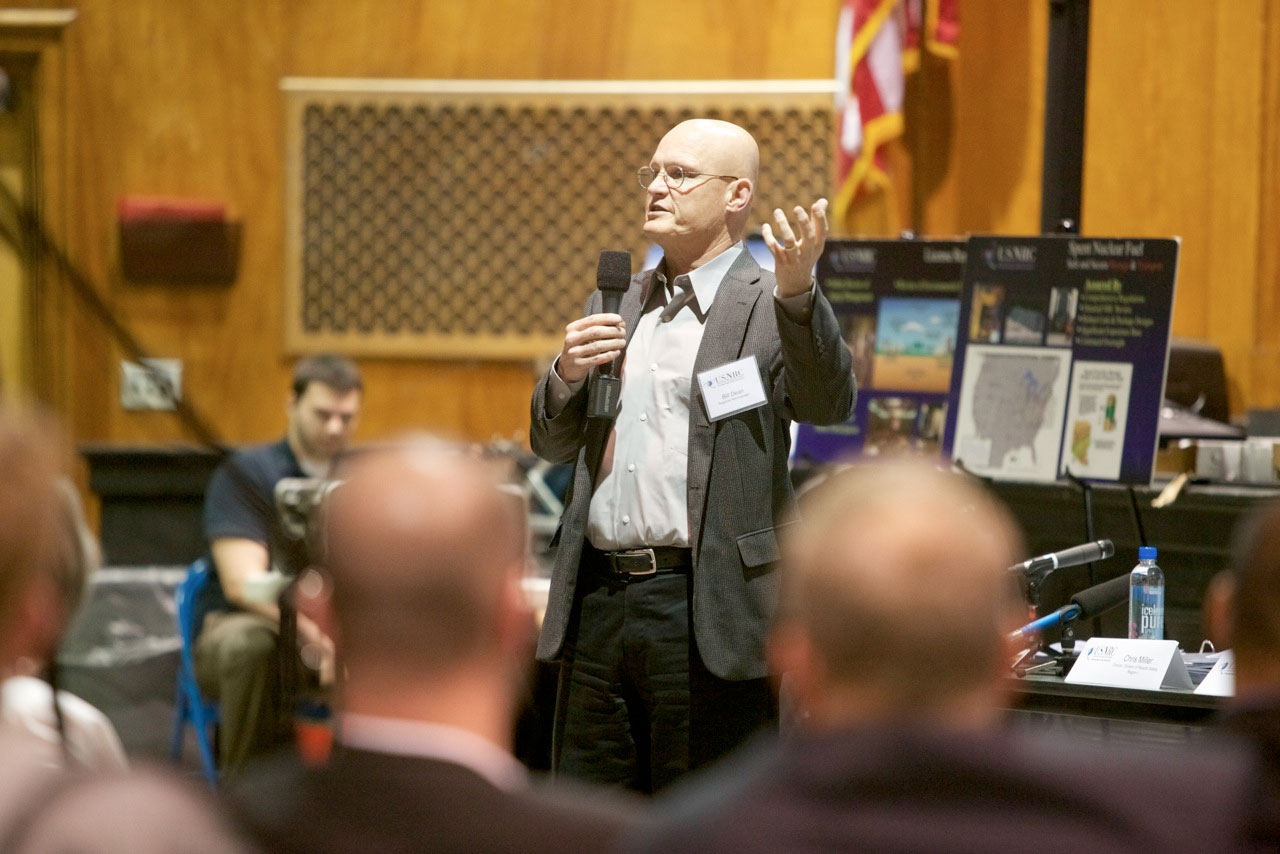
It all began with the U.S. Nuclear Regulatory Commission’s presentation of Vermont Yankee’s safety findings for 2010 before nearly 200 people at the Brattleboro Union High School auditorium.
Foes and supporters both voiced their concerns for the health and safety of Entergy’s Vermont Yankee 600-megawatt nuclear plant in Vernon.
Members of the International Brotherhood of Electrical Workers, the largest union at Vermont Yankee, grumbled in the back row while anti-nuclear activist Gary Sachs paced the auditorium heckling officials.
The intent of the meeting was to provide a brief discussion of Vermont Yankee’s 2010 safety performance. NRC representatives also spoke about the commission’s evaluations of nuclear plants in the United States in response to events at the Fukushima-Daiichi plant in Japan.
At the recommendation of the Brattleboro Police Department, the NRC had followed increased public safety measures and maintained a security check point in response to a recent heated and verbally abusive public meeting in New York state on the future of the Indian Point plant.
The NRC’s presentation lasted about 20 minutes. Public comments took up the remainder of the evening.
According to David Spindler, the NRC’s Senior Resident Inspector at Vermont Yankee, the plant “operated in a manner that preserved public health and safety and met all cornerstone objectives.”
In its Annual Assessment Letter, the NRC wrote that all inspection findings at the plant received a “very low (i.e., green) safety significance (rating).” Inspections also indicated that “your performance was within the the normal, expected range.”
The NRC gave Vermont Yankee the same rating in 2009. According to Vermont Yankee spokesperson Larry Smith, the plant has received this green significance rating for multiple years.
According to Bill Dean, NRC Region 1 administrator, the commission is still conducting extra inspections related to the 2010 tritium leaks through a Demand for Information letter.
The first portion of the letter addressed inaccurate statements made by Entergy employees to the state over the existence of underground piping. Dean said the NRC wanted to ensure the same employees had not made any erroneous statements to the commission.
He said that Entergy has satisfied the first part of the Demand For Information.
The second portion involved increased inspections related to the remediation of the 2010 tritium leaks. Dean said the NRC is waiting on a hydrogeological site mapping but expects the final reports in a few weeks.
No good information
NRC officials called for a moment of silence for the people affected by the earthquake and tsunami in Japan.
Wayne Schmidt, NRC Senior Reactor Administrator, Division of Reactor Safety, said, the NRC still did not have “good information” to assess what happened at Fukushima-Daiichi but is focused on health and the environment.
“That’s our sole job,” he said, adding that the NRC believes that U.S. plants were not compromised by events in Japan.
Plants on the Atlantic Seaboard would not be subject to the same environmental conditions as Japan, or be affected by aftershocks or a tsunami, he said.
The NRC was concerned about West Coast plants, such as those in Washington state.
Schmidt also said despite the fact that Fukushima-Daiichi and Vermont Yankee reactors are the same design, he assured the audience that Vermont Yankee is a different animal.
For example, said Schmidt, Vermont Yankee has a diesel generator to help charge back up batteries in the event of a blackout. The plant also has nitrogen in the containment around the reactor to limit the level of oxygen in the event of a hydrogen explosion similar to Fukushima-Daiichi’s.
Finally, Vermont Yankee is “one circuit breaker away” from the Vernon hydroelectric dam.
The NRC is investigating “what we can do to enhance safety,” in the long-term as part of a “lessons learned” process after events are Fukushima-Daiichi, said Dean.
Dean said there were thee key concepts he wanted to share with the audience. The first was that given what the NRC knows about Fukushima- Daiichi, it believes U.S. nuclear plants are safe to operate.
Second, the commission is taking a systematic look at procedures and changing the requirements accordingly.
Finally, he said, despite Vermont Yankee being an “unsettled situation” the NRC is committed to the public and “we’re going to do what ever needs to be done” to keep the public safe.
Public comment
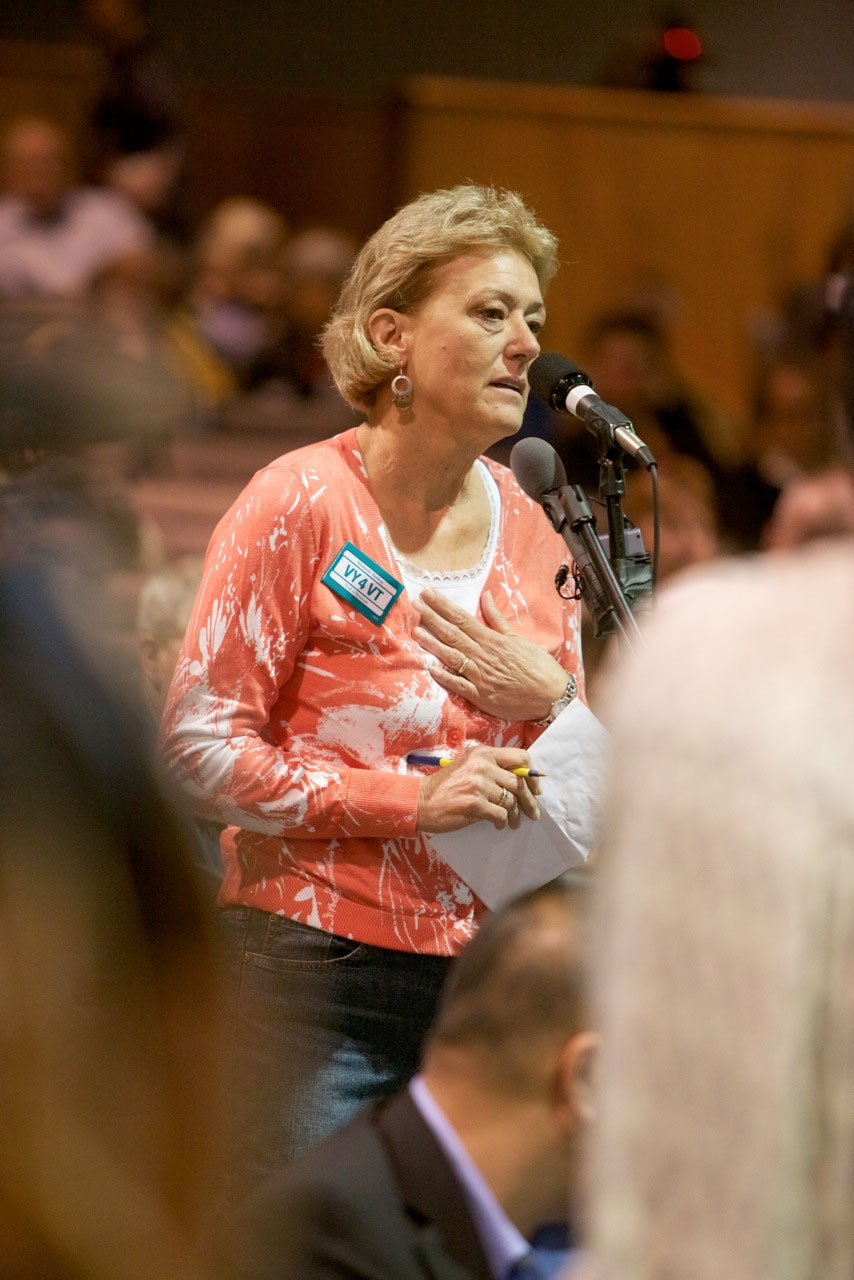
During the question and answer session, 44 out of the estimated 170 audience members asked to speak. Speakers had three minutes to comment. Not all kept to that time frame.
Audience members raised concerns about the plant’s safety. Others about the loss of jobs. Many expressed a distrust of the NRC.
“The stuff [spent fuel] is a disaster out there waiting to happen,” said Walter Klinger of Pownal, a member of the Bennington County Regional Planning Commission.
Officials told him that spent fuel pool and dry cask storage is relatively safe. Of the two, dry cask is safer because the passive storage system relied on circulating air. The casks are stored on-site above the max projected flood level but can also survive submersion.
Raymond Shadis, technical adviser for the New England Coalition, took the NRC to task for thinking plants were “Scot free” because they couldn’t be hit by a tsunami and earthquake simultaneously.
He pointed out that a tsunami hit Newfoundland with 90-foot waves in 1924 after an underwater landslide.
“We’re concerned about the quality of information and research at the NRC,” he said.
Jared Cobb called for Vermont Yankee’s closure in 2012. The NRC is “too often a lap dog not a watch dog,” he said.
Cobb also pressed the officials about the commission’s alleged vote to request the U.S. Department of Justice intervene in the Energy v. Vermont court case on Entergy’s behalf.
Dean refuted the lapdogs charge, and said that he has no knowledge of a vote taken by the commission. He added that the NRC had no intention to get involved in the case as long as there’s “no transgression.”
After the meeting, Dean said, in light of the pending injunction hearing, if Vermont Yankee temporarily shut down it could restart later, provided the plant met any new NRC regulations. Other plants, such as Millstone in Connecticut and Indian Point, have done so.
Pitting neighbor against neighbor
Community members said the Vermont Yankee issue has pitted neighbor against neighbor.
Vernon Selectboard member Patty O’Donnell said to a round of shouts of disagreement, “There are thousands and thousands of Vermonters that support Vermont Yankee.” O’Donnell served 12 years as state representative for Vernon and Guilford before she retired last year.
O’Donnell said she understood how controversial Vermont Yankee is, but she said the plant is safe. In the aftermath of the Sept. 11, 2001, terror attacks, O’Donnell said she spent the night at the plant and witnessed how the employees responded.
“We know the people at Vermont Yankee,” she said. “Never would the employees jeopardize their families for the sake of a paycheck.”
She also chided the state for buying nuclear power from a New Hampshire plant with a lower safety rating and apologized to the NRC representatives for the audience’s “rudeness.”
“Real, true Vermonters respect the fact that we’re all different,” O’Donnell said.
Andrew Davis, a Brattleboro Town Meeting representative from District 3, said the good people at Vermont Yankee are as good as Fukushima-Daiichi operators, and as Chernobyl, and as at Three-Mile Island.
“It’s a little unfair to pit neighbor against neighbor,” he said.
Davis challenged the NRC’s lax oversight of the nuclear industry. He cited an article in The New York Times that reported plant officials in Japan ignored issues with the plant prior to the March earthquake.
“Could any of you stop the events at Fukushima-Daiichi?” asked Sachs.
He said the NRC “is out of their league” and it’s time to let the industry die.
“It’s these hands here that check the equipment you speak so passionately about,” said Vedrana Greatorex, to the anti-nuclear supporters.
Greatorex works at Vermont Yankee, but she said she spoke as a private citizen. She accused the anti-nuclear activists of ignoring safety issues in the interest of shutting the plant down.
“If you ever have questions, reach out to us,” she said. “We’re not biased. We want our kids to be safe.”
“[Many] spoke but nobody heard a thing,” said Claire Chang of Gill, Mass., after the meeting.


Permalink |
As I pointed out elsewhere on this site, as I recall, the NRC made a public statement that the Fukushima reactors were “stabilized” shortly after the quake. I have tried to find the news item via google, and have yet to find it. When, and if, found, I will post it here. If any readers recall that public statement by the NRC, please, speak up. Or post it here if you can find it.
A short time after that purposely disingenuous proclamation, they made the ridiculous assertion that the situation at Fukushima “will not worsen”, or, words to that effect.
And in light of the recent AP report outlining the NRC’s prostitution to the nuclear energy sector, what kind of gullible idiot finds the NRC spokespeople as credible or deserving of respect?
If one considers the Chaos Theory, which, basically, is merely the use of common sense in forecasting the utter unpredictability of future natural events, one must surely arrive at the conclusion that making nuclear plants “safe” is an absurd premise. Qfter all, wasn’t Fukushima touted as a “safe” facility?
It is one thing to con us into a sense of false security when the health of isolated communities is involved. But it is quite another to jeopardize the global environment, and the lives of BILLIONS of human beings in the corporate pursuit of profits. The NRC is complicit in BOTH practices, and as a “regulatory agency”, is little more than a bad joke.
Permalink |
From the NYTs on Mar 21…..
“Although officials of the U.S. Nuclear Regulatory Commission said Monday that conditions at the Fukushima Daiichi nuclear power plant appear to have stabilized and that the containment vessels at three reactors had not been seriously breached, smoke was reported rising from two reactors Monday evening”
http://articles.latimes.com/2011/mar/21/science/la-sci-japan-reactor-damage-20110321
Yet, we now KNOW that there was knowledge of ongoing meltdowns just mere hours after the quake, and that the situation at Fukushima on Mar 21 was far from “stabilized”. Two possibilities arise out of NRC statements that are so far removed from reality;
1) That the agency is so incompetent, misinformed, and inept that its ability to monitor the “safety” of our nuclear plants is highly questionable.
0r….
2) The spokespeople are merely mouthing scripted platitudes, (lies), designed to lull the American public into a dangerous sense of false security about outdated nuclear plants and reactors that are jeopordizing the lives of MILLIONS of Americans.
Permalink |
“Many spoke but nobody heard a thing”
That is exactly what I thought would happen as she said “talking to the NRC resembled banging your head against a brick wall”
As I’ve said before “The NRC is an advocate for the nuclear industry and NOT a regulator” As Mr Sachs said “the NRC is out of its league and it’s time to let the nuclear industry die”
I hope VY doesn’t have any more accidents and that they can stop the leaks. I have little faith that that will happen as I’ve seen little or no effort to repair the existing leaks.
I’m sorry I was in the hospital getting a total knee replacement or I would have gone to the meeting and asked the questions I had written earlier. I hope folks asked my questions but have not heard from anyone if they did.
Like most Vermonters I try to be decent but it is getting hard to be polite to the NRC or Entergy.
Permalink |
And here, again, from the Los Angeles Times, we see a disingenous bit of fluff about this disaster that favors an “account” that seems designed to placate the people’s concerns rather than present us with the truth….
“Japan nuclear crisis ebbing, U.S. experts say”
“Nuclear Peril Although the situation at the Fukushima Daiichi nuclear plant is far from stabilized, evidence suggests that a complete meltdown is unlikely, Obama administration experts say”
http://articles.latimes.com/2011/apr/08/world/la-fg-japan-nuclear-20110408
Ya have to love that “Obama administration experts” part, doncha? Of note in the article??? Not one “expert” is mentioned by name, nor is credentialing or affiliations offered as to the credibility of these so-called “experts”.
Quite a job the author did, eh? So much for the concept of a “Fourth Estate”.
But worse, one must assume that these un-named netherworldly “Obama administration experts” were a construct of the White House, and the author of this “news” article was just giving us the business by rote. Unfortunately such media/ government collusion in advancing such despicable deceptions is hardly rare. But egads, can’t they at least confine this kind of propaganda to issues of far less import? Is our collective health and welfare really so inconsequential and irrelevent to their pursuit of power and wealth?
Permalink |
The NRC has no responsibility, and will not share the consequences, if there is a disaster at Vermont Yankee. It is the people who will be subjected to radiation leaks who would be effected. It is their ultimate fate they have to consider. The NRC may say that the plant should remain safe for another 20 years, but what criteria do they use, when we are seeing weather extremes unlike anything that has ever happened before? Rainfalls, river levels, in many places in the USA and the world, are far beyond anything ever seen: currently 6′ higher in Minot, ND than ever recorded. So I question the NRC’s basis for this decision. Based on what.. old data? I will not take their assessment for safety to be at all reliable. Their assumptions regarding rainfall, river levels, dam reliability upstream, and even earthquake hazard, are not founded upon the changing condition we are witnessing. Since the NRC members are not effected but, New Hampshire, Vermonters, and Mass. residents are, it will be our decision whether the plant will close in March. We have made that decision, so Entergy needs to be so advised. It is no longer a question… it is a fact. If Entergy is not prepared for the shutdown, that could be irresponsible of them as well. I suggest that a team of citizens and regulators be required to begin the shut down schedule. Regardless of any court decision, the plant will be close by the people of Vermont who’s judgment compels it. I hope that the federal government will not become an obstacle to this serious undertaking, but will help facilitate the closing.
Permalink |
The NRC seems to have an agenda of doing nothing, but when will they know they are done?
I honestly think the NRC needs an overhaul and we need some people working to keep Americans safe. Obviously the NRC is sound asleep on the job ( I’m being kind ).
The NRC lies and advocates for the nuclear industry. When will the NRC start doing its job?
Permalink |
Unfortunately, it is not just the NRC that is in collusion with the nuclear energy sector. If you google “EPA radiation monitoring”, you will find that the EPA has dropped the ball in measuring the levels of radiation we are recieving from the Fukushima disaster. Our milk, food, air, and water is being subjected to intermittent testing, insufficient to detect spikes, or hot spots.
http://www.truth-out.org/epa-halted-extra-testing-radiation-japan-weeks-ago/1308835471
In addition, when the EPA was monitoring responsibly, early on in this global disaster at Fukushima, their detection system was exposed as seriously flawed, with many system monitors malfunctioning or not functioning at all. (With all the hype about the danger of terrorists attacking us with a so called “dirty bomb”, for our system to be so flawed one wonders about the credibility of this so-called threat, as well as the ability of our so called “regulatory” and “enforcement” agencies to react to a real emergency, man made, or otherwise). Should one of our reactors pull a “fukushima” on us, apparently we can’t even depend on the EPA to provide us with timely and accurate data about degrees of radiation exposure.
Permalink |
Many spoke passionately & articulately at this event, but one speaker–Andy Davis–hit the nail on the head with questions that left only more questions.
We learned that Entergy owns the spent fuel rods now stored in our community. This puts Entergy in a win-win situation, gambling as it is with taxpayer (“our”) money, not to mention our health, our homes and our livelihoods. Some, but not all, disturbing facts are:
– the NRC, funded w/ our money, is supporting Entergy’s position and siding with the billion-dollar company in a lawsuit pitting them against the State of Vermont. We are, in fact, paying for NRC lawyers and professionals to mount a campaign against us. The meter is running.
– the U.S. Justice Dept is siding with Entergy against the State of Vermont in the same court case. Again, our money is being frittered away as these high-priced “public servants” whose salaries are paid by us pit their wiles against our community, our state and our people–all the while with their hands deep in our own pockets.
– Entergy, using the NRC and the U.S. Justice Dept resources as theirs, named our governor, Peter Shumlin, in the pending lawsuit, meaning that they’ve tied his hands and siphoned his energy away from governing this state forcing him to, instead, put his energies into defending himself. This is the same tactic used by the notorious special prosecutor Ken Starr, who wasted $64-million of U.S. taxpayer money pursuing impeachment against President Bill Clinton and we all know what happened there. With the president’s attentions diverted from business-at-hand, a number of sinister plots against our country flowered.
– The current business-friendly U.S. justice system favors large corporations in myriad ways. Not only can Entergy, should it “lose” the court case, appeal it until everyone involved in the case is long dead (the Exxon Valdez model), but the conglomerate can also declare bankruptcy and leave the spent fuel rods to be cleaned up by the federal government and local governments.
– When a nuclear “accident” occurs–an incident that cannot be ignored as the current underground tritium plume is being ignored–it is not Entergy that will be on the hook, but FEMA, should that federal agency still exist (remember, Romney wants to dismantle it). Entergy’s army of attorneys, aided as they are by NRC and U.S. Justice Dept goons, will quickly disengage from the issue (after all, it was “approved” by citizen watchdog agency, the NRC) and leave the federal government, the state government (whose pockets they emptied in a long-running lawsuit) and the communities surrounding the aged nuclear plant holding the bag.
It’s a closed loop, folks, and Entergy has no money in the game, no risks and the dice are loaded.
Permalink |
If the power generated from Yankee cannot find a power-line that connects to the outside grid, why wouldn’t it shut down?
And if personnel might have to go into the plant to work, it could get expensive for them to pass the tolls to get in… and really expensive to get out; after all, Vermont Yankee is looking like it is going to be an extra expense for the state.
Based upon the new data about weather extremes that could be expected, the NRC approval must be rejected as obsolete and dangerously under estimated. The battle may not be with Entergy, but a dangerously flawed NRC.
The NRC needs to be directly challenged as being inept. Maybe the NRC needs to be sued by all interested parties nationally.
Permalink |
I’ have been on the NRC case for a while now. They have me upset to say the least.
http://www.kansascity.com/2011/06/20/2963616/nuclear-industry-regulators-work.html
The article gives credence to my rant.