

Agency to begin “quick-look” review of Vermont Yankee reactor
On Monday, the Nuclear Regulatory Commission officially granted Entergy Corp.’s license to continue operation of the Vermont Yankee Nuclear Power Station for 20 years beyond its scheduled shutdown date of March 2012.
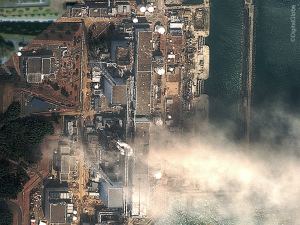
The commission issued the license 10 days after partial meltdowns of reactors at the Fukushima-Daiichi nuclear plant in Japan triggered hydrogen gas explosions in the wake of a devastating 9.0 magnitude earthquake and subsequent tsunami.
A few days after the catastrophe in Japan unfolded, The New York Times published a report about flaws in the design of the aging reactors used at the plant. The Fukushima facility’s six reactors, two of which have partially melted down, are nearly identical to the Vermont Yankee boiling water reactor. The Mark 1 model, manufactured by General Electric, was discontinued in 1972, the year Vermont Yankee was built and one year after the Fukushima plant was constructed.
In 1972, a nuclear scientist with the Atomic Energy Commission, forerunner of the Nuclear Regulatory Commission,) raised concerns about the containment system’s capacity to forestall a nuclear meltdown in the event of an extended power blackout and problems with backup generators, according to the New York Times. Electricity keeps pumps constantly flushing cool water over the fuel rods in the reactor and the spent fuel pool. If the pumps stop working, as they did in Japan, the fuel can overheat and cause hydrogen buildup in the reactor to explode and a fire to erupt in the spent fuel pool area, releasing highly radioactive material into the atmosphere.
Last week, President Barack Obama called for a review of nuclear power plants in the United States. Sen. Bernie Sanders, I-Vt., wrote to the president on Friday, requesting a moratorium on license renewals by the Nuclear Regulatory Commission.
That request was ignored by the NRC, which issued the 20-year license extension to Louisiana-based Entergy Corp. without taking time to consider the implications of the nuclear accident in Japan. Though the commission plans to review plants in the next few months, it’s not clear the flaws of the Mark 1 model will be part of its evaluation.
Sanders, who is chair of the Senate Environment and Public Works Committee, asked NRC Chair Gregory Jaczko in a hearing last week to re-evaluate the decision (made on March 10, the day before the earthquake in Japan) to grant a license to Vermont Yankee. Sanders was flabbergasted by the NRC’s response. “The idea of keeping Vermont Yankee running until it is 60 years old defies comprehension,” the senator said. It is an “especially questionable” decision by the NRC “at a time when a reactor with a similar design is in near meltdown.”
Neil Sheehan, communications director for the NRC’s Region 1 District, said the agency approved the license because of what he characterized as a thoroughgoing examination of the plant. The analysis, he said, began five years ago and included a hearing process, complete staff reviews of the plant and an environmental assessment.
In response to the nuclear meltdowns in Japan, Sheehan said: “We’re going to do a few things,” including a “quick-look” analysis over the course of the next 90 days at reactors around the country. The NRC will review redundancy systems for loss of off-site power, seismic “resistance” and hydrogen releases, Sheehan said.
“There will be significant attention paid to all U.S. reactors in light of events in Japan,” Sheehan said.

Larry Smith, communications director for Vermont Yankee, said in a statement that Entergy is pleased with the NRC’s decision to extend Vermont Yankee’s operating license through March 21, 2032.
“Today’s action comes after five years of careful and extensive review and confirms that Vermont Yankee is a safe, reliable source of electricity and capable of operating for another 20 years,” Smith wrote.
Vermont Yankee is also subject to a state statute that requires Entergy to obtain a certificate of public good from the Vermont Public Service Board to operate beyond the March 2012 shutdown deadline. A year ago, the Vermont Senate denied the corporation the right to seek that approval.
Vermont is the only state in the country to require that a nuclear operator obtain state permission for license renewal.
Gov. Peter Shumlin, who as president pro tem spearheaded the state Senate decision, called the NRC’s decision to relicense the plant “puzzling.”
“Fortunately, Vermont has taken steps to close down the aging Yankee plant, and I have urged other states with older nuclear facilities to follow our example and take control of the lifespan of their plants,” Shumlin said in a statement.
Vermont’s congressional delegation urged the NRC to respect the state’s right to impose a shutdown of the plant. In a joint statement, Sanders, an independent, and Democrats Sen. Patrick Leahy and Rep. Peter Welch wrote: “We believe that Entergy should respect and abide by Vermont’s laws and the MOU (memorandum of understanding) signed with the state in 2002, which require approval by the Vermont Legislature, and then the Vermont Public Service Board, for the plant to continue to operate beyond 2012.”
The New York Times reported that a month ago, Tokyo Electric Power Company granted a 10-year license extension to the oldest of the six reactors at Fukushima, which was built in 1971.
According to the Times, Tepco “admitted that it had failed to inspect 33 pieces of equipment related to the cooling systems, including water pumps and diesel generators, at the power station’s six reactors, according to findings published on the agency’s Web site shortly before the earthquake.”
Arnie Gundersen, a nuclear expert with Fairewinds Associates based in Burlington, said: “We always knew NRC would approve because that’s what NRC does. It’s appalling. The smoke literally hasn’t cleared over Fukushima, and they’re greenlighting VY.”
NRC’s “rubber stamp”
Anti-nuclear activists in Vermont weren’t surprised by the NRC’s decision. The agency has renewed licenses for 62 plants around the country; it has never denied a relicensure application.
As Bob Stannard, a lobbyist with Citizens Action Network, put it: “They’re as predictable as deer walking the same trail every day.”
“Frankly, for many people out there who have concerns and suspicions about the NRC rubber stamping licenses for the industry, that’s confirmation,” Stannard said.
In Germany and China, nuclear plants have been shut down or put on hold. Stannard accused the Nuclear Regulatory Commission of assisting Entergy at all cost.
“This is about losing face for them, as opposed to losing people,” Stannard said. “They’ve raised the middle finger at the congressional delegation and the state of Vermont.”
James Moore, VPIRG’s clean energy program director, said: “I think if anyone wasn’t sure the NRC was a rubber stamp machine for the nuclear industry, this should make that really clear. With what is going on with this very same design in Japan, for the NRC to not even pause and reconsider giving this old reactor
a license past the 20-year expiration date is almost unconscionable.”
Moore said the NRC can’t seem to accept the idea that aging nuclear plants are prone to break down.
“They’ll spend 90 days looking at the paperwork so we can convince ourselves we did the right thing,” Moore said. “They’re supposed to be looking out for the public not the industry and that’s what it smells like in this case.”
Rep. Tony Klein, D-East Montpelier, chair of the House Natural Resources and Energy Commitee, feigned surprise: “God, I’m shocked.”
“It’s like getting a certificate of wonderfulness from the local trade association,” Klein said. “It just shows you how numb people are and how they refuse to look at the world any differently. Because whatever you think could happen, could happen, and we’re not prepared.”
Could a Fukushima-Daiichi accident happen in Vermont?
Vermont is half a world away from the Pacific Rim’s ring of fire, but we, too, have seismic shifts, floods and hurricanes.
State geologist Larry Becker says the seismic resistance design for nuclear plants should be revisited because earthquakes are getting stronger, even in the Northeast. Plants like Vermont Yankee were designed in the 1960s for 500-year earthquakes. “These days we look at longer return periods,” Becker said.
Vermont Yankee is designed to withstand a 6.2-magnitude quake; the last big quake, which hit the 5.8 mark was in Lake Ossippee, N.H., in 1940according to the U.S. Geological Survey.
Moore, of VPIRG, said Vermont Yankee doesn’t pass modern seismic criteria. “You wouldn’t be allowed to build VY today because it’s not a safe enough design, yet somehow we think it’s safe for it to keep going 20 years past expiration. The only prudent thing for NRC to do is to halt any licensing procedures and possibly consider pulling the plug at all plants that are the same make and model until proven safe.
Arnie Gundersen, a Burlington-based nuclear expert and now a national TV commentator on nuclear issues (he is now a regular on CNN), said an earthquake threat at Vermont Yankee is unlikely. The more likely worst case scenario would involve a 1,000 year flood of the Connecticut River, which could knock out the service water that cools the plant.
Vermont Yankee, he said, has more than one “point of vulnerability,” or hole in the plant’s protective armor.
“Entergy is trying to turn the Fukushima argument into earthquakes and giant waves at Vermont Yankee,” Gundersen said. “It’s not about earthquakes or tsunami. It’s about ‘single points of vulnerability.’”
In his view, a Connecticut River flood or a terrorist attack could be as devastating as the earthquake and tsunami in Japan.
“If a tsunami had not knocked out the diesels at Fukushima, it also knocked out the service water that cooled the plant, so the net result is the same,” Gundersen said.
Another point of vulnerability is Vermont Yankee’s BWR Mark 1 “Net Positive Suction Head,” or reactor pressure suppression containment system, according to Gundersen. It’s not clear that this was the cause of the explosions that occurred in Japan, he said.
“The NRC staff makes VY’s Net Positive Suction Head issue (and others) disappear because it has told the Advisory Committee Reactor Safeguards in October 2010 that the probability of a containment failure is “zero,” Gundersen wrote in an email. “The NRC’s way to avoid VY’s Net Positive Suction Head accident is to assume it can’t occur.”
Another problem at VY is related to power outages. The backup batteries for the VY’s electrical control panels last eight hours of a station blackout in which there is no offsite or onsite power.
The biggest potential hazard, however, could be the spent fuel pool where used fuel rods are kept cool under water in a vat 40 feet deep. The rods stay hot for five years after they’ve been used.
The pool is on a 50 foot dais, which makes it more vulnerable to quakes, according to Gundersen. It’s also covered with a tin roof, and in the event of a terrorist attack, is a potential source of high level radioactive contamination.
Smith, the spokesman for Entergy, said the pool was designed to be open at the top. The only protection it has from the elements is a sheet metal roof with “blow away panels if you have to relieve pressure.”
Smith said the corporation will soon be removing fuel rods in the pool and putting them in longterm storage in dry fuel casks on the VY site.
