

Editor’s note: The video embedded at the end of this post is from the press briefing that occurred several hours before Shumlin’s address.
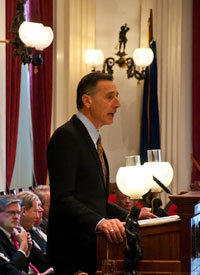
Gov. Peter Shumlin delivered on what he promised: He has proposed a balanced budget without raising income taxes or dipping into the budget stabilization plan at a time when the state faces a $176 million budget gap.
And his budget reflects his No. 1 objective: controlling health care costs. Shumlin asks medical providers to pay $36.7 million in provider taxes, and he forces them to accept thousands more Medicaid patients. Consumers also pay more: The 12,000 Catamount Health patients would become part of the Vermont Health Access Plan and would see their deductibles more than double.
All of these proposed changes in the medical sector herald Shumlin’s single-minded focus on cost containment as a prelude to health care reform.
Dig Deeper
Key Documents
But let’s back up a second. You might well ask, wasn’t the gap $130 million, or $150 million? Where did the $176 million come from?
Until Shumlin’s final budget was released, the shortfall was something of a moving target. The $176 million gap now takes into account the unmet reductions set under Challenges for Change, the state’s government restructuring plan. (When the gap between state spending and tax revenues was first identified last year, the total was $112 million, plus $42 million in Challenges reductions. In December, the shortfall grew to $150 million; a few weeks ago, it dropped to $130 million. Neither figure included the government restructuring targets.)


In his speech on Tuesday, Shumlin put an end to the Challenges (without explicitly saying so) and any doubt about what the total gap is. The governor effectively rolled the $26 million in unidentified Challenges savings into the budget gap for fiscal year 2012, and the reorg name will quietly fade away from Vermont legislative history, though the concept of “getting more with less” will likely linger.
So how did Shumlin resolve the $176 million shortfall? What miracle did he perform to arrive at the magic number — zero? He got there the way every other governor has achieved a balanced budget: by cutting programs and raising taxes.
The Agency of Human Services budget is the target of most of the governor’s reductions and adjustments –$110 million, in all. The remainder of the savings would come from a variety of sources, including a $23.2 million reduction in the amount of the General Fund transfer to the Education Fund.
Shumlin fills the gap without proposing to raise income or sales taxes, however. He also said he would not use money from the budget stabilization reserve (though he relies on $29 million from a money leftover from the fiscal 2011 budget now deposited in a caseload reserve fund in the Agency of Human Services to balance the budget).
The budget includes a $25 million structural cut in General Fund expenditures. If the budget, as presented, passes the Legislature, it would be the first time in a decade that state spending would be lower than the previous year, Shumlin said.
Most of the money comes from cuts in subsidized medical programs for middle- and low-income Vermonters, reductions in programs for the mentally ill and developmentally disabled, and large tax “assessments” on medical providers and hospitals. Dentists and health insurance companies would be assessed provider taxes for the first time, and hospitals and home health agencies would be asked to significantly increase their contribution to the state’s coffers. In all, providers would be liable for $36.7 million in “revenue enhancements.” Shumlin’s proposed cuts to the Agency of Human Services total $44 million.
Shumlin has found $176 million in reductions from what would have been a $1.358 billion budget. The total amount of state expenditures for fiscal year 2012 under his plan would be $1.209 billion.
The revenue forecast doesn’t anticipate significant growth in the state’s gross state product in the next few years, and a budget gap of $35 million will persist into fiscal year 2013 — even if the Legislature adopts Shumlin’s budget proposal or comes up with another way of balancing the budget. The House Appropriations Committee took up Shumlin’s budget (and the Big Bill) shortly after the governor’s address. They will take testimony from agency officials all week.
Here is a rundown of the largest cuts:
- $5 million. Catamount Health, a subsidized insurance program for middle and low-income Vermonters, would be folded into the state’s expanded Medicaid system, the Vermont Health Access Program as of Oct. 1.
- $1.2 million. The 12,000 Vermont patients who now pay a $500 annual deductible through the Catamount plan will pay a $1,200 deductible. Providers will receive Medicaid reimbursements for all VHAP patients.
- $4 million. The Choices for Care program, which keeps elderly Vermonters out of nursing homes, will be asked to reduce programs including home and community based services, respite care, and help with activities like grocery shopping and housecleaning.
- $5.3 million. Changes in Medicaid programs including utilization of emergency rooms, limiting access to certain drugs and limits on radiology.
- $3.3 million. Cuts to mental health programs. Shumlin’s budget, like that of the Douglas administration’s last year, banks on the Vermont State Hospital being recertified by the Centers for Medicare and Medicaid Services. Medicaid recertification has eluded the state for seven years.
- $1.4 million. A 5 percent reduction to the “designated agencies,” the nonprofit groups that provide mental health services in most of Vermont’s counties. The DAs have already absorbed small percentage cuts in the last three budget cycles.
- $4.7 million. Services for developmentally disabled Vermonters will be cut by 5 percent. Area Agencies on Aging to absorb a 4 percent reduction, with the recommendation that the nonprofit groups make up some of that cut through charging fees for services.
- $7.2 million. The governor plans to move the women’s prison in St. Albans to the Chittenden County Correctional Facility. He would move 20 Vermonters who are now housed out of state to the facility in Franklin County and rent out 40 beds to the federal government. Under his plan, Corrections would also see savings through the creation of transitional housing and fewer incarcerations.
Here is a rundown of “revenue enhancements” and tax changes:
- $17.3 million. An increase in the “provider tax” for hospitals. In the past, hospitals have paid a 5.5 percent assessment on revenues. Under Shumlin’s plan, they would pay 6 percent.
- $10 million. Health insurers would be charged a 1.33 percent tax on revenues.
- $2.8 million. Nursing homes would pay an increased assessment.
- $3 million. Shumlin anticipates raising more money through cigarette revenues. (Sales are up because New York has increased taxes on cigarettes.)
- $6 million. Dentists would be taxed 3 percent of revenues. Providers who serve Medicaid patients could earn about half of this money back.
Stakeholders react: Hospitals
Bea Grause, the president and CEO of the Vermont Association of Hospitals and Health Systems, said the health care facilities she represents are “disappointed.”
“We think the direction the governor’s budget goes in is in opposition to the direction of health care reform,” Grause said. “We want to work with the state.”
The state matches provider tax revenues with Medicaid funds and then funnels that money back into hospitals. Every dollar the state receives in provider tax revenues buys down $1.60 in Medicaid match funding, Grause said. This arrangement has been in place since 1992.
This year, Shumlin proposes increasing the tax from 5.5 percent to 6 percent and keeping $17.3 million of that total. The provider tax is projected to be $115 million to $120 million this year, Grause said. The match would bring in about $300 million in revenues total.
As a result, Grause said hospitals will need to find $17.3 million in other sources of revenue.
Hospitals, she said, work within tight budgets. She hoped that the provider tax increase, which for the first time would penalize hospitals (in the past the state has returned most of the revenue through Medicaid payback system), would not result in a cost shift for Vermonters who have private insurance.
Stakeholders react: Designated agencies
Nonprofit mental health providers (also known as the “designated agencies”) say they can’t take a 5 percent reduction without cutting emergency services for patients, and they predicted that more mentally ill Vermonters will wind up in hospital emergency rooms and police stations as their conditions spiral out of control.
Eric Grims, the executive director of Northeast Kingdom Human Services, said 80 percent of the patients in his regional mental health group are on Medicaid. No other health care (organization) is able to operate on that kind of funding,” Grims said. “We do it because we’re extremely efficient, and we’re out of efficiencies. These reductions will come directly in consumer services.”
Vermonters with developmental disabilities will lose about $4,000 in services each on average, according to Julie Tessler, executive director of the Vermont Council on Developmental and Mental Health Services.
“If you take $4,000 away, they’re in trouble,” Tessler said.
Without those supports in place, individuals with developmental disabilities who have difficult behaviors to manage will end up needing emergency room care, she said.
“We run the most efficient managed care organization for developmentally disabled patients in the country,” Grims said. “No one does more with less. We’re out of things to cut.”
The state has asked the nonprofit groups to help keep mentally ill patients out of prison; the 5 percent reduction will make it difficult, Tessler said, for the agencies to achieve that goal.
Stakeholders react: advocates
Peter Sterling, the executive director of the Vermont Campaign for Health Care Security, agitated for the creation of the Catamount Health plan in 2006.
Sterling gives the idea of folding Catamount into VHAP a thumbs-up. “Bringing Catamount into Vermont’s family of publicly subsidized health care programs (VHAP, Dr. Dynasaur and Medicaid) makes administration and enrollment simpler,” Sterling said.
He’s not so enthusiastic, though, about the $700 increase in deductibles, which he says will push many Vermonters out of the program. Catamount is designed to help Vermonters whose incomes are at 200 percent of poverty. A single person in that income range makes $1,812 a month, gross.
“Raising the deductible will lead Vermonters to drop coverage or cause hundreds not to enroll,” he said.
“Douglas proposed exactly the same thing and the Legislature rejected the idea,” Sterling said. “We hope the Legislature will do that again.”
Legislative reaction
In contrast with Shumlin’s inauguration, lawmakers gave a less than enthusiastic response to the governor’s budget address. There wasn’t a single standing ovation, and the scattered applause was muted.
That mood carried over in the House Appropriations Committee, where the state’s fiscal situation is well understood. Members asked Jeb Spaulding, the secretary of the Agency of Administration polite questions, and complimented Jim Reardon, the commissioner of the Department of Finance and Management, for his very clear budget presentation.
Their focus was the structural impact of the decisions they may face in fiscal year 2012 on the prospects for 2013. The budget projections include a 3 percent increase; revenues will still trail the budget by $35 million.
“We need to make decisions this year to position ourselves next year,” Reardon said. “2013 will still be hard, but it will be a disaster if we don’t make tough decisions now. That’s why we’re not utilizing the budget stabilization funds.”
House Speaker Shap Smith said the muted reaction from lawmakers wasn’t unexpected.
“Members have understood this was going to be a difficult budget,” Smith said. “I think they’re going to review it closely to see where the impacts are and see if there are alternatives. Everyone understands we have to close the gap.”
Smith said the House will listen to medical providers’ and hospitals’ concerns about Shumlin’s tax proposals, but he supports finding a way to control costs.
“Health care costs are one of the larger pressures in the budget,” Smith said. “We need to make a fundamental change in the way we do business.”
As for the fate of Challenges for Change, Smith said the Legislature will continue to focus on performance-based budgeting. Yesterday, he named the new members of the Government Accountability Committee, which spearheaded the Challenges effort last year.
“I believe that if we are going to continue to ask Vermonters to make investments in human services, they have the right to find out what outcomes are being achieved,” Smith said.
Sen. Randy Brock, R-Grand Isle-Franklin, praised the governor for looking at human services spending, though he predicts lawmakers “will resist even the modest cutbacks he is proposing.” He paints the current fiscal situation as a cliff that could have been avoided, in a statement to the press.
Brock argues human services spending in Vermont “has exploded.”
“Time and time again concern was raised that these costs were unsustainable over the long term, but in large part those warnings were disregarded,” Brock said. “In that light, we may need to make even bigger cutbacks than the Governor proposed today if we are to get Vermont back on a sustainable track.”
Brock also chastises the governor for not addressing education spending levels and for proposing to move ahead with pre-K education, which he says “will only increase the pressure on Vermont ‘s property tax rates.”
Lastly, the senator takes Shumlin to task for raising the tax on hospitals and nursing homes, and broadening the tax to include health insurers and dentists. Brock says those levies will be passed on to Vermonters.
“It may be an interesting way to bring more money into the state treasury, but I question whether that is the best public policy given the difficulties many Vermonters already face,” Brock wrote.
For a full range of “reviews” from budget policy wonks, go to Vermont Tiger.
