


Last week’s discovery of tritium in a well that until last February supplied drinking water to a building at the Vermont Yankee Nuclear Power Plant is again raising questions about who has authority to oversee the plant’s safety and reliability.
Vermont’s two candidates for governor have staked out starkly different positions on the plant’s continued operation beyond its 2012 scheduled closing date. Republican Lt. Gov. Brian Dubie supports relicensure by the federal Nuclear Regulatory Commission. Sen. Peter Shumlin, the Democrat, spearheaded a vote in the state Senate last spring to deny Yankee an opportunity to seek a 20-year extension of its license.
Despite news reports to the contrary, those basic positions haven’t changed since last week’s new revelations that extremely low-level amounts of tritium have been found in a well connected to a “fractured” bedrock aquifer that flows toward the river, according to the Nuclear Regulatory Commission.
Dubie’s campaign has added some nuance to his public position, however. The lieutenant governor, who has said the Public Service Board should have the final say on relicensure of Vermont Yankee, is now saying the Nuclear Regulatory Commission should determine if the plant is safe enough to continue operation for an additional 20 years.
Dubie adds that he wants “answers” from the Vermont Department of Health, the Nuclear Regulatory Commission and Entergy before further action on renewing the plant’s license is taken.
Shumlin, who continues to unequivocally oppose relicensure, has now called on Entergy to take new steps to mitigate the amount of contaminated water that could flow into the well. He also says he would levy fines on the corporation and possibly ask the Vermont Attorney General to seek civil penalties against Entergy.
The question is, however, just how much authority does the state have?
The question is, however, just how much authority does the state have? Can it crack down on an out-of-state corporation that is under the jurisdiction of a national agency, the Nuclear Regulatory Commission? Is a wait-and-see approach the only option? Or can the state take action to force Entergy to further remediate the radioactive substances that have been found in the soil, groundwater and now a self-contained, 360-foot well on the site?
Recent actions taken by the states of New Jersey and Illinois suggest that Vermont officials, who have not penalized Entergy, could pursue civil litigation or issue a directive dictating the cleanup of the tritium leak and mitigation of further contamination of soils and groundwater at Vermont Yankee.
Yankee, a political football
The 38-year-old nuclear power plant in Vernon has been plagued by problems over the last four years.
Yankee was owned by local utilities until 2002, when Louisiana-based Entergy Corp., a large publicly-traded energy company, bought the plant.
Over the course of the last 10 months, Yankee has been the subject of extensive investigations, testing and remediation in the aftermath of revelations that the plant was leaking high concentrations of tritiated water, a low-level radioactive isotope of hydrogen that has the chemical characteristics of water.
The highly radioactive substances, cesium and strontium, have also been found in the soils on the Yankee compound. Strontium-90 was found in a fish caught in the Connecticut River, located 30 feet from the plant.
Entergy has taken pains to fix the leaks and conduct exhaustive testing on the site. It has also removed tons of contaminated soil from the contaminated area. At no point has there been an immediate threat to public safety, according to plant officials.

Until last week, it appeared the tritium had been largely contained.
On Friday, Entergy announced that tritium had been found in a 360-foot well on the Yankee compound. The concentration of tritium was “extremely” low, near the minimum level of detectability, according to Neil Sheehan, spokesman for the Nuclear Regulatory Commission, and 1/20th of the concentration deemed harmful by the Environmental Protection Agency. The well in question, which was used by Vermont Yankee employees for drinking water, was taken out of service on Feb. 22.
“They have one sample from the well, and it did indicate tritium at low levels, so contamination of the aquifer is a concern — with the caveat they don’t know enough at this point with a single sample about the extent of contamination,” Sheehan said in an interview. The single data point is “insufficient to draw any conclusion as to impact of the tritiated groundwater plume on the bedrock aquifer,” Sheehan also wrote in an e-mail.
The aquifer is not an underground lake; it is water that flows through fractured rock, according to Sheehan. The aquifer is isolated from other drinking wells in Vernon, which are up grade from the Yankee plant. The new development prompted a response from Dubie, who told reporters that his No. 1 concern is safety. He said he wants answers from Entergy, but he didn’t suggest any other action. Dubie did not, for example, call for the state to intervene with fines or other sanctions on the corporation, nor did he demand that Entergy embark on mitigation efforts. He supports relicensure of the plant “only if the Nuclear Regulatory Commission says it is safe,” according to Kate Duffy, his communications manager.
His opponent, Shumlin, in a press conference, said he would take steps to sanction Entergy and he remains committed to blocking relicensure of the plant.
“Brian says I’m going to want answers to questions before they regain our trust,” Shumlin said. “Entergy Louisiana will never regain my trust.”
In an interview on Saturday during his “Pure Leadership” tour, Dubie said: “From day one, I have always said safety will be the No. 1 consideration. Trust that was lost by Entergy needs to be reestablished. And I’ve also said I’m mindful of the fact that there’s 650 men and women that work there, and so, consistent with that position – in light of the fact that tritium … was found in a closed drinking well, public health considerations have to trump everything else.”

As he talked, Dubie repeatedly made the time-out sign with his hands as he said he would seek explanations from the Vermont Department of Health, Entergy and the NRC.
Experts had told him it was unlikely that tritium would contaminate the deep water well on the Yankee site, Dubie said. “I’ve heard the explanations – the fact that it was found there, it wasn’t predicted to be found there, that’s unacceptable. So if you lay out safety as part of public health, and this is where we were told not to expect it, it’s there, it’s unacceptable.”
At a press conference on Monday, Shumlin called on Entergy to take immediate steps to mitigate tritium contamination in the area around the drinking water well.
Shumlin said if he is elected governor, he would insist that Entergy install four additional extraction pumps around the well. He said this is necessary to prevent more tritiated water from leaching into the bedrock and finding its way into the well.
Shumlin also alleges that Entergy plans to shut down the two extraction pumps on site in December.
Larry Smith, spokesman for Vermont Yankee, said Entergy will “re-evaluate” whether it should halt the extraction once the corporation has reached its target extraction total of 300,000 gallons. So far, the company has pumped 267,000 gallons of contaminated water from the site.
Shumlin said: “It’s my belief that they can continue to run those pumps … and put in additional pumps immediately to ensure that not only tritium, but the cesium and strontium does not get deeper in to the aquifer. We know it’s in the wells, it’s gone through the bedrock, and the question is, how much and what gets into the aquifer that the town of Vernon uses for their drinking water.”
Shumlin said the states of New Jersey and Illinois required nuclear power plants leaking tritium to take significant steps to mitigate the flow of contaminated water into local aquifers.
“There is a difference between our leak and those in New Jersey and Illinois,” Shumlin said. “In New Jersey and Illinois, there was only tritium leaking from the plants. In Vermont, it includes the radioactive isotopes of cesium and strontium, highly radioactive substances that cause leukemia and cancer.”
The pumps, he said, would cost about $200,000 to install. “Think about what Entergy Louisiana is going to have to spend to find a new aquifer for the town of Vernon,” Shumlin said.
Shumlin used the press conference Monday as a platform to attack Dubie’s support for the continued operation of the plant. He said Dubie is an apologist for the stockholders of Entergy and is unwilling to crack down on the corporation.
“I think it should be clear that despite Brian Dubie’s theoretical change of heart regardless of the number of lies and leaks and environmental disasters, Brian will stand up for the stockholders of Entergy Louisiana instead of protecting the pocketbooks and the health and safety of Vermonters.” Shumlin added: “We need a governor who stands up to power when it’s wrong, and insists that Entergy Louisiana do the right thing, install the pumps and try to mitigate this disaster.”
“All we’ve seen is tritium”
Test results from Entergy show that tritium is present in the drinking water well at 200 feet at a concentration of 1,040 picocuries per liter, about 1/20th of the level deemed harmful by the Environmental Protection Agency. Entergy received the test results on Oct. 2, and released the information to the public six days later, on Friday, Oct. 8, just before Columbus Day weekend.
The Construction Office Building drinking water well is located in the middle of the tritiated water contamination plume, which extends to the banks of the Connecticut River.
The well is 360 feet deep and penetrates a bedrock aquifer; the tritium was found at 200 feet, originally at a concentration of 1,380 picocuries per liter of tritium. A confirmation test of the same sample showed the level at 1,040 picocuries per liter. Samples taken at 320 feet did not contain detectable levels of tritium. A tritium level of 1,000 picocuries per liter is about 1/30th of the limit of 30,000 pico-curies per liter set by the NRC.
Entergy equipment is sensitive enough to pick up levels as low as 700 picocuries per liter, according to Neil Sheehan, spokesman for the Region 1 district of the Nuclear Regulatory Commission.
William Irwin, radiological health chief for the Vermont Department of Health, said the amount of tritium found in the well is significantly below limits allowable under national regulations. “People should recognize that this is a very low concentration of tritium,” Irwin said.
The state will continue to monitor other drinking water wells nearby, he said, including the one used by Vernon Elementary School, which is located across the street from the nuclear power plant.
Smith, speaking as spokesman for Entergy, said the corporation is testing for cesium and strontium, which was found in soils on the site. No traces of those two highly radioactive substances have been found in the well, he said.
“All we’ve seen is tritium, based on samples we continue to take,” Smith said.
Water from the deep well is flowing upward, according to Smith. He said it is “unlikely” that the tritium reached the aquifer.

The source of the contamination is tritiated groundwater that has leached through a fracture in the bedrock, or the radioactive isotope could have been transferred there by accident – through the sampling process, Irwin said.
Sheehan suggested that the casing around the well could be compromised. In September, Entergy began hydrogeologic studies of the bedrock aquifer, which included sampling of groundwater at “discreet zones in the Construction Office Building bore hole,” according to an e-mail from Sheehan.
Sheehan wrote that more data and analysis are required to establish a conclusion.
The NRC is actively engaged in inspections of groundwater monitoring, assessment and remediation, and he said hydrologic experts from NRC and the U.S. Geological Survey are “following” Entergy’s studies and “independently evaluating and assessing the information and data developed and analyzed by the company’s hydrologic experts.”
Irwin: Extraction effort is “critical”
Vermont Yankee has been pumping tritiated groundwater from two “extraction” wells on the plant compound since March 25, according to Smith. A contract hydrogeologist hired by the corporation set a target of 300,000 gallons to be extracted from the area around the deep water well, Smith said. So far, 267,000 gallons of contaminated water have been removed.
Smith said once the company has reached the 300,000 mark, Entergy will re-evaluate whether it will continue to pump water from the area.
Arnie Gundersen, the nuclear engineer Shumlin appointed to the Vermont Legislature’s Public Oversight Panel, estimates Entergy will have reached that target by December.
Four more extraction wells would keep tritiated water in the deep water well from dropping lower, Gundersen says. The pumps would also dry out the soils and prevent cesium and strontium, which were found in soils around the leak, from migrating further into the ground, he said.
“(Entergy) should make an effort to continue the extraction as long as tritium is in the water,” Irwin said.
“It’s important to pull up what’s in the soil so that it doesn’t go into the bedrock,” Gundersen said.
Irwin, Health Department radiological chief, said the 300,000-gallon mark shouldn’t be an end point for the extraction process. He said cold weather is an impediment, but Entergy should continue to pump and store tritiated water through the winter. Irwin described the “extraction” wells as “critical.”
“(Entergy) should make an effort to continue the extraction as long as tritium is in the water,” Irwin said.
Should Entergy install four more extraction wells as Shumlin and Gundersen have suggested?
Whether the corporation will install four more extraction wells on the site, Smith said, will be “a determination made by experts based on science.”
Sheehan, the NRC spokesman, said until more samples from the well are tested, and further analysis conducted, he didn’t think additional pumps were necessary: “It would be premature at this point to say the answer is to increase the number of extraction wells.”
Irwin said he hoped “the extraction will continue to be provided in the most efficient manner.”
Irwin describes the presence of tritium in the well as “quite serious,” particularly since Entergy and a contracted hydrogeologist had told Irwin previously that it was unlikely that tritium would be found in the deep water well.
Still, Irwin said Entergy has been cooperative. “I think that the important thing to know is that the corporation is not subject to regulations – they aren’t required to do this,” Irwin said. “The company
has volunteered to do remediation, and we continue to recommend remediation and request that it to be aggressive.”
Gundersen: Leak is three years old
Gundersen, the nuclear engineer who has advised the Legislature on Vermont Yankee and first asked questions about the viability of underground piping at the plant, says the tritium leaks began three years ago. He points to the sink holes that formed on the Yankee compound in the summer of 2008 as evidence that the soil had to have been completely saturated for a year beforehand.
“The train left the station three years ago,” Gundersen said. “Some tritium has been migrating downward since 2007.”
Other plants that have had similar problems with radioactive tritium leaks, such as Braidwood Nuclear Generating Station in Illinois and Oyster Creek Nuclear Generating Station in Forked Hook, N.J., have contended only with tritium.
Vermont Yankee’s leak was different, because it came from the off-gas system, in which strontium and cesium can be present.
Vermont Yankee’s three reported leaks have included small amounts of cesium and strontium, and Gundersen says it’s only a matter of time before the highly radioactive substances are also found in the well unless Entergy takes steps to mitigate the contaminated soil and groundwater at the site.
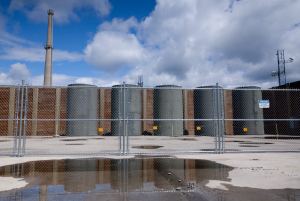
No tests have shown evidence of cesium and strontium in the well, according to Sheehan, Smith and Irwin.
Cesium is a “muscle seeker”; it replaces potassium in the body. Strontium is a “bone seeker”; it replaces calcium. Cesium has a half life of six years; strontium lasts 29 years.
Gundersen says the two radioactive isotopes, which move slowly, like boulders in a stream, have already migrated about 20 feet through plant soils in one year.
At the current rate of speed, the contaminants would be in the river by 2020, unless the extraction wells keep the ground dry.
Smith wouldn’t confirm the migration distance; Sheehan says contaminated soil around the location of the leak has been removed. Irwin said the isotopes have moved about 10 feet. Gundersen says only contaminated soil within three feet of the leak has been removed, because complete removal of more tainted dirt would undermine the buildings. He also says Entergy hasn’t tested beyond the 10-foot mark.
The most recent tritium leak at Vermont Yankee, discovered in May, came from a dime-sized hole discovered in a piping system that is 40 years old, Gundersen said. Tritiated water emanating from the hole was discovered in July when the plant was repowered after a refueling shutdown. “Dime-sized holes don’t just happen overnight,” Gundersen said.
That leak, in his view, is one of the sources of cesium and strontium found in soils on the site. The first two leaks – found in an underground vault – was also a longtime source of radioactive contamination, Gundersen said.
What, if any, authority does Vermont have?
Shumlin said at his press conference that the NRC has jurisdiction over the relicensing of the plant, but the state can regulate the pollution of groundwater.
“Vermont is not limited on safety when it comes to polluting our groundwater with highly radioactive isotopes that cause cancer in children,” Shumlin said. “If an oil company would dump oil into our groundwater, we would react, we would fine them, we would cry foul, we would require them to clean it up.”
The NRC’s Sheehan says that’s true — the state has a role to play in regulating groundwater affected by the plant particularly if an aquifer used for drinking water has been contaminated. “The state would have a clear interest in that,” Sheehan said.
States have taken action in the past to protect groundwater and drinking water, according to Sandra Levine, an attorney with the Conservation Law Foundation.
But where one authority ends and the other begins isn’t “crystal clear,” particularly in a case where there has been months of inaction, as in the case of Vermont Yankee, Levine said.
Levine said it is “irresponsible” for the state not to take action. She said officials should be looking for stronger cleanup requirements. CLF has asked the Vermont Public Service Board to shut down the plant until all leaks are stopped and remediation is complete. The request is pending.
CLF filed testimony with the PSB in June that showed the deep water well was already polluted or soon would be, based on data from Entergy concerning the leak, she said.
“This should not have been a surprise,” Levine said. “They (the Vermont Department of Health and Entergy) certainly knew this was coming, and they were irresponsible in not assuring it was addressed.”
State agencies, Levine said, have an obligation to protect groundwater under the Vermont’s public trust doctrine.
“There is a request pending for the plant to shut down until leaks are repaired and the tritium is cleaned up,” Levine said. “That request is not being acted on. They are waiting to determine if they have jurisdiction over the NRC. Unfortunately, more pollution is going into the ground and in the waterways, which shouldn’t come as a surprise to anyone.”
Illinois, New Jersey take action
The attorney general of Illinois and state’s attorneys from three counties took Exelon Generation Co., owner of three nuclear power plants in Braidwood, Byron and Dresden, to court. In March, winning $1 million in civil penalties against the company. The money will be used to pay for “supplemental environmental projects” in the communities where the plants are located.
The settlement also includes requirements that the corporation, which is a publicly traded wholesale electricity producer based in Chicago, to modify a wastewater piping system that had leaked tritiated water into the Kankakee River, install alarms and leak-detection monitors, and remediate tritium contamination found on and near the Braidwood Nuclear Generating Station property.
In addition, Exelon, which found significant contamination in drinking wells in the town of nearby Godley, donated $11 million to pay for a new water plant.
The Braidwood tritium leak was discovered in 2006. That year, the attorney general obtained a preliminary injunction ordering Exelon to take steps to “protect public health and the environment” at that plant.
Like Illinois, the state of New Jersey has weighed in on the mitigation of tritium leaking from the Oyster Creek nuclear plant owned by the same corporation, Exelon.
On April 9, 2009, the NRC granted a 20-year license renewal to Exelon to operate Oyster Creek through 2029. Tritium was found leaking from the plant on April 15, 2009.
The Department of Environmental Protection issued a directive to Exelon in May of this year. The department found that the corporation did not take sufficiently appropriate and timely action to address the leak. It ordered Exelon to drill monitoring wells, delineate the extent of the contamination and take remedial action.
CORRECTION: The third leak, identified in the Advanced Off-Gas System, was found in May, not July, as reported previously.
