

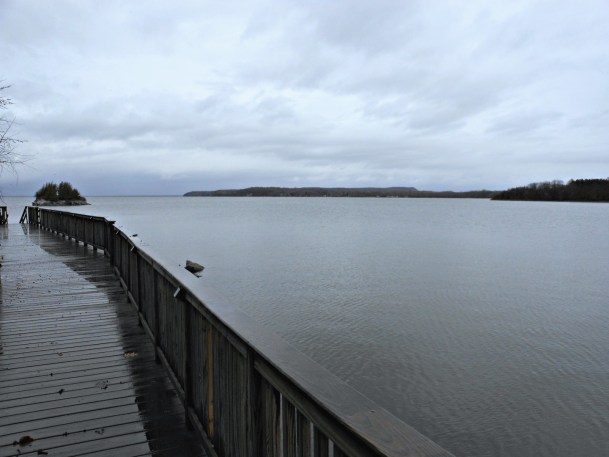
State and local officials and others are hoping to reduce phosphorus pollution in the bay, which contributes to algae blooms that can have toxic effects. But the question is what steps would best achieve that goal.
With roughly $4 million available, the Northwest Regional Planning Commission recommended spending it on road-related improvements intended to stem erosion that carries pollution, instead of removing up to 330 feet of the Missisquoi Bay causeway.
The causeway, which was built in 1938 to carry Route 78 across the southern end of the bay, contains an 830-foot opening already, where a drawbridge once stood. A new bridge built in 2007 spans the entire distance formerly covered by the drawbridge and the two arms of the causeway.
The $4 million is left from an $18 million earmark for building the new bridge and removing the causeway, or else improving nine other state-maintained bridges. However, those other bridges don’t require additional funding.
A federal law passed in 2015 allows the money to be spent on transportation-related projects within 50 miles of the original project site.
Some say the money should be used for its original purpose.
“I’ve been on the lake all my life, and one of the things that really baffles me is that nobody seems to understand the lake is stagnating because it doesn’t have the natural flow,” said Mark Cobb, of Grand Isle. “To me, this is an opportune time to open this up and let the lake breathe.”
Opening the channel could have a number of unforeseen consequences, scientists have said, but several studies have indicated that doing so would flush out a small portion of the excess phosphorus in Missisquoi Bay. That portion of Lake Champlain contains the greatest concentration of phosphorus pollution in the lake, due to the intensity of dairy farming in the area. Phosphorus is present in fertilizers and manure.
Studies project about a 1 percent decrease in phosphorus pollution in Missisquoi Bay if the causeway were removed, said Angela Shambaugh, an aquatic biologist at the Department of Environmental Conservation.
Although the causeway may appear to hamper lake currents, Shambaugh said it “is not impeding flow that much. There’s already a good flow going through there.” Since the time the study reports were published, a 330-foot section of the causeway was removed, which means the lake’s currents are probably even less constricted than the studies suggest, Shambaugh said. That means the phosphorus reduction would be even less than the studies predict, she said.
Greater reductions in phosphorus might be achieved by spending the money elsewhere, Shambaugh said.
That’s what regional planners thought, said the Northwest Regional Planning Commission’s executive director, Catherine Dimitruk.
The choice of what to do with the money ultimately lies with the state Agency of Transportation, Dimitruk said, but the commission last week recommended it be spent elsewhere than on the causeway because doing so would more effectively reduce phosphorus in Missisquoi Bay.
The money should go toward things like fixing road culverts that promote erosion and improving roads in agricultural fields — “things that’ll reduce the phosphorus going into the Missisquoi basin,” she said.
But that’s not what the money’s for, said James Ehlers, executive director of the advocacy group Lake Champlain International.

He said that’s “certainly not ethical, and it’s inappropriate.”
The causeway should be removed because it’s an enormous artificial structure that disrupts the lake’s natural ecology, Ehlers said. The constriction, although it does permit lake currents to flow through, also speeds up those currents. That alters where predator fish gather and where their prey spend time, and it influences other characteristics of the lake, many of which may remain unknown, he said.
“It’s a complicated dynamic,” he said. “That’s not the way the lake was created.”
Removing the causeway was never about reducing phosphorus, Ehlers said, and if it were, the money would have been misappropriated. The funds came from taxes motorists paid on their fuel, and they’re meant for transportation-related projects, such as removing an old highway’s foundations where they obstruct the mouth of Missisquoi Bay.
“We’re asking fuel-tax payers to subsidize the dairy industry. That’s who should be paying, not the motorists,” Ehlers said.
But U.S. Sen. Patrick Leahy, D-Vt., who secured the funding, intended simply to improve Missisquoi Bay’s water quality, and removing the causeway doesn’t appear to accomplish that, said his press secretary, David Carle.
“Ultimately it was determined that removal (of the causeway) would have no impact to improve water quality in Missisquoi Bay, and that removing the causeway would harm softshell turtle habitat and population,” Carle wrote in an email. “We have been talking with (the agencies of Transportation and Natural Resources) about redirecting those funds to other transportation projects that would have a positive impact on the lake’s and the bay’s water quality.”
The executive director of another organization devoted to the lake — the Lake Champlain Committee — expressed a similar sentiment.
“If the causeway were proposed to be built today, LCC would oppose it,” said Lori Fisher, the group’s director. “That said, there’s no current scientific justification for causeway removal.”
Water quality improvements to be had by flushing pollution and sediment out of Missisquoi Bay would likely diminish water quality wherever that material ends up, Fisher said.
“Additionally, removing the causeway also removes important winter habitat for the spiny softshell turtle, a threatened amphibian,” she said. “The money for causeway removal would be better spent reducing nutrient loads to the bay.”
As described in a recent Transportation Agency report and elsewhere, the spiny softshell turtle is endangered within Vermont’s borders and is dependent on the causeway and nearby waters.
Successful relocation of the turtle, the report says, “is extremely unlikely, and the cost and additional time associated with such an effort would be significant.”
In the report, nevertheless, the agency advocates removing a portion of the causeway’s eastern arm, since the turtles are found primarily on the western arm.
This would improve water quality somewhat, the report states, but more importantly, it would accomplish the recommendation of a U.S.-Canada International Joint Commission that has also studied the issue.
“The IJC recognized that causeway removal will have a limited effect on water quality,” the report states, “but recommended removal to refocus public attention on necessary phosphorus reductions from the bay’s watershed and to remove what they described as, ‘an obstacle to expanding the cooperative efforts by farmers, municipalities, taxpayers and others that will be needed to achieve nutrient reductions.’”

