


[S]t. ALBANS — Prosecutors and defense attorneys selected a jury of seven men and five women Tuesday to hear sex charges in the first of two trials for Sen. Norm McAllister, R-Franklin County.
McAllister, 64, faces two felony counts this week that he sexually assaulted his former Statehouse intern while she was working as a farmhand on his Highgate property.
The young woman, who was a teenager when the assaults allegedly began, is expected to take the stand Wednesday morning when the trial begins. She told investigators McAllister forced her to have oral sex or intercourse close to 30 times. The charges, however, are limited to two alleged instances.
The felony charges each carry a potential sentence of three years to life in prison and fines of up to $25,000. McAllister has maintained his innocence.
Prosecutors plan to call as a witness this week the woman who is McAllister’s accuser in his planned second trial, which involves different charges. She too worked for McAllister as a farmhand and alleges that he repeatedly sexually assaulted her over a period of more than two years. The trial stemming from her allegations has yet to be scheduled.
Franklin County Superior Court Judge Robert Mello previously granted a defense motion to exclude evidence of sexual assaults that are not the subject of the counts being presented.
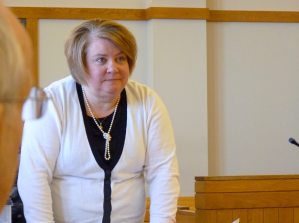
Deputy State’s Attorney Diane Wheeler, who is prosecuting the case, said it’s common practice to limit testimony from witnesses and that McAllister’s other accuser will limit her testimony to the specific charges being heard in this trial.
Four sitting lawmakers are expected to testify. Though the incidents that are the focus of these charges predate sexual assaults alleged to have occurred at McAllister’s Montpelier apartment, the state plans to call his two roommates, Sen. Kevin Mullin, R-Rutland, and Rep. Timothy Corcoran, D-Bennington.
The defense plans to call Sen. Dustin Degree, R-Franklin, and Rep. Cory Parent, R-St. Albans, both of whom were close with McAllister and knew the accuser. Lt. Gov. Phil Scott’s chief of staff, Rachel Feldman, may also be called as a defense witness.
Judge Mello upheld his earlier ruling allowing prosecutors to subpoena two reporters who have covered the case to testify, despite the objections of the defense and an attorney representing their employers.
The state plans to call Seven Days’ Mark Davis and Vermont Public Radio’s Peter Hirschfeld to testify.
In an October interview with McAllister, Davis asked whether the senator had sex with his accusers. McAllister said, according to Davis’ report, “After my wife died. Months after. I’ve never denied that I had sex with them.”
Hirschfeld is being called to testify because three months later, just after McAllister was suspended by the Senate, he asked McAllister during a scrum with reporters outside the Statehouse whether he had sex with his intern — the accuser in this week’s trial.
On a recording of the incident, McAllister can be heard letting out a high-pitched laugh before responding, “You’ve got to be kidding.”
“It’s a real question,” Hirschfeld says.
“No, no,” McAllister responds. The exchange can be heard just after minute 6:00 in the recording below.
Wheeler said she respects Davis’ First Amendment rights but needs him to authenticate the report and clarify whom he was referring to when he wrote “the two women,” and whom McAllister is referring to when he’s quoted as saying, “I’ve never had sex with them.” Presumably, Hirschfeld is needed to authenticate his report.
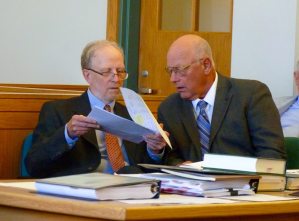
David Williams, one of McAllister’s defense attorneys, argued Tuesday that Davis’ reporting, and therefore his testimony, is irrelevant because the statement attributed to McAllister refers to sex acts that may have occurred some time after those specified in the charges.
The young woman stopped working at the farm in the spring of 2013, when McAllister sent a final shipment of goat’s milk before selling his herd. McAllister’s wife died in September 2013.
“If my client had some sort of sexual relationship with (the young woman) after his wife died, it has nothing to do with this at all,” Williams said.
An earlier defense motion that Mello granted required the state to narrow the charges, so prosecutors focused on specific sexual acts within a set timeframe.
Wheeler resisted providing a tighter timeframe, arguing that “dates are an issue” for the accuser and that specific dates are not an element of the crimes McAllister is accused of committing.
The acts are instead differentiated by where they occurred, Wheeler said, such as in an old barn, a milking barn, McAllister’s home and Montpelier.
The defense and prosecution ultimately agreed to specify in the charges that the sexual assaults occurred while she was working for McAllister as a farmhand — a period from the summer of 2012 to spring 2013, which is why, according to the defense, Davis’ account should not be presented at trial.
Davis’ testimony is still relevant, Wheeler said, because it helps establish an element of the crime, which is that McAllister had sex with the young woman.
It should be up to jurors to determine whether McAllister’s statement that the sex began after his wife died is true, or whether they believe the accuser, who will testify the sex began before McAllister’s wife died, Wheeler said.
Brooks McArthur, McAllister’s other attorney, requested a hearing prior to Davis’ testimony, which is scheduled for Wednesday afternoon, indicating the defense would like to discuss, away from the jury, whether there are notes or recordings that can substantiate Davis’ reporting.
Mello said he would take their request under advisement.
Seating the jury
The 12 jurors and four alternate jurors who will hear McAllister’s case were culled from a pool of close to 90 Franklin County residents, though only about 40 were questioned as part of the selection process.
Several were excused for personal reasons, such as having booked travel during the trial or for a child’s medical appointment. One potential juror was eliminated sight unseen, because he is McAllister’s nephew.
When asked if they had heard of McAllister, virtually all the potential jurors said they had, but only a few said what they knew about him would affect their ability to be fair and impartial.
The same was true when potential jurors were asked if they had seen media reports or social media posts about the case. Most said they had, but only a few said they had an opinion as to McAllister’s guilt or innocence as a result.
Those who said it would be hard for them to be fair and impartial, or that they had made up their minds about a verdict, were dismissed.
Potential jurors who said they had experienced sexual abuse, or that a friend or relative had experienced sexual abuse, were eliminated as well, either because they said it would affect their ability to be fair and impartial, or during the peremptory strike process — when the prosecution and defense are allowed to eliminate up to six potential jurors without explanation.
The prosecution and defense both had an opportunity to interview potential jurors before making their peremptory strikes.
State’s Attorney Jack Hughes handled the process, known as voir dire, for the prosecution and focused on jurors’ understanding of the process, whether they knew any witnesses and whether they had strong feelings about the police.
Four witnesses for the prosecution are members of law enforcement.
Williams handled voir dire for the defense and focused on potential jurors’ experiences or thoughts about false accusations. He also asked about “major life events” and whether potential jurors thought it was reasonable for people to recall them well enough to tell them the same way to different people on successive days or within a reasonable span.
The jury must render a unanimous verdict on the two felony charges, or the case would have to be retried.

