

This story by Scooter MacMillan was first published in The Charlotte News on Sept. 3, 2026.
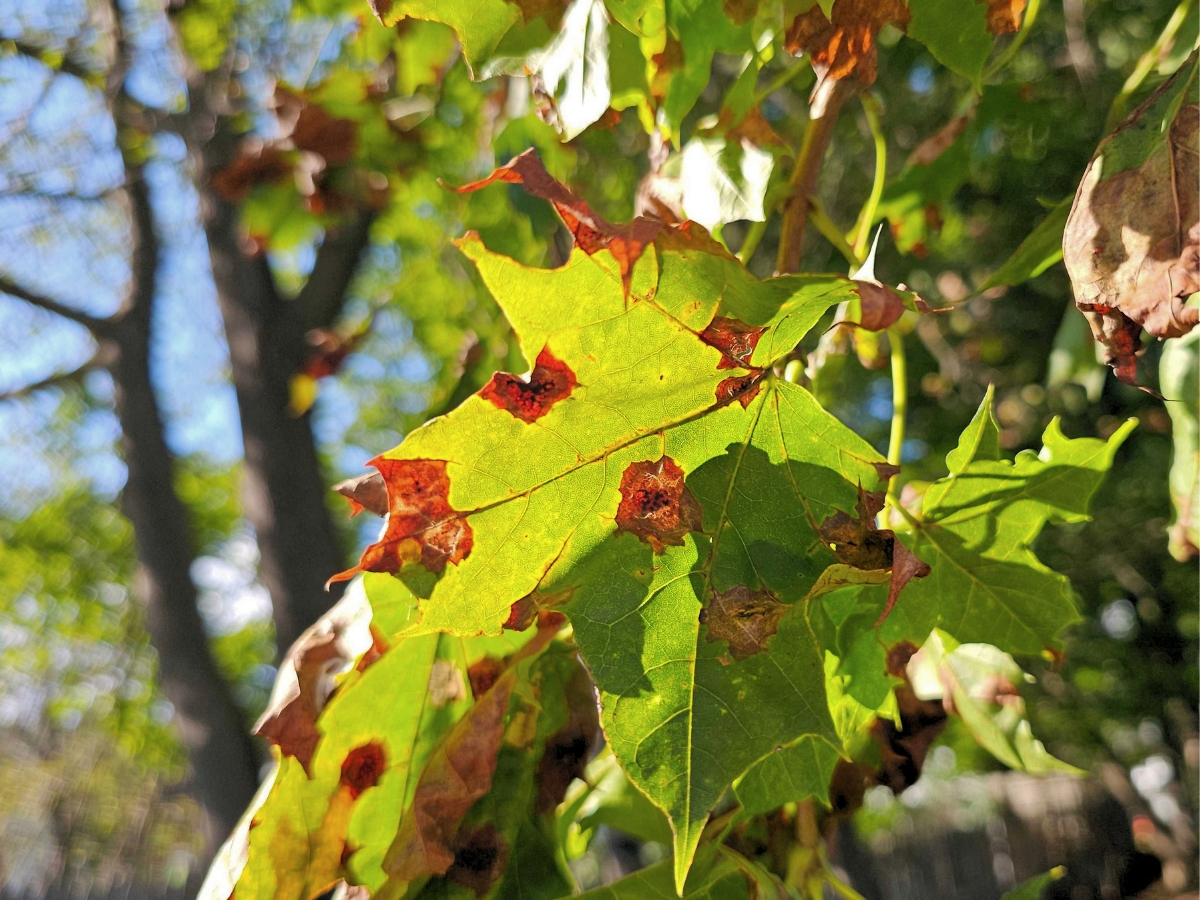
You may have noticed browning trees with crinkled, dried-up leaves on Thompson’s Point Road in Charlotte.
You may also have noticed these trees were sugar maples, and you might have worried that the premature browning of what is traditionally one of our brightest performers in the annual polychromapalooza could indicate we’re in for a less than optimally colorful fall.
Birding aficionado and spice connoisseur Hank Kaestner said he has also seen isolated patches of similarly afflicted trees in Vergennes and Shelburne.
These prematurely browned and dried leaves are the result of tar spot fungus.
Charlotte town tree warden Cliff Mix said tar spot fungus, like most funguses and many pathogens, is spread by spores.
“The spores overwinter in the leaf litter, so they’re always around,” Mix said. But they come out in years when the living is easy — if you’re a plant pathogen.
We had a cool, wet spring and a moderate summer where, even when it got hot, it was generally wet. “It’s been perfect conditions to have this problem explode,” he said.
But it’s not much of a problem. Tar spot fungus does not hurt the trees, and next year things should be back to their normal chromatic brilliance — unless there has been another wet spring and summer. And if trees are afflicted with tar spot fungus for two or three years in a row, it could cause problems, Mix said.
Mix said he had also noticed that the isolated patches of browning trees seem more prevalent on Thompson’s Point Road than other places in town, but he doesn’t know why. Proximity to the lake could be part of the cause, but not the sole explanation since fungus-withered leaves don’t appear so prominently in other places in town near the lake.
There are other funguses and leaf diseases that can afflict trees, many of which are much harder on them than tar spot fungus, Mix said. Anthracnose is one of those. It is also a fungus that hits a lot of different trees but is particularly hard on sycamores, which we don’t have many of. But it can also be a problem for sugar maples.
Anthracnose is a group of common fungal diseases that cause dark, sunken lesions on the leaves, stems, flowers and fruits of many plants, but it also doesn’t usually kill trees, unless it recurs every year.
Last year, Mix said, people were learning a lot about the powdery mildew that was getting on lilacs. Like the others, it was given a leg up by a wet spring. It’s a problem particularly for lilacs growing in shaded areas. Lilacs in sunny places with good air flow often don’t have problems with powdery mildew.
“No matter which one of these pathogens it is, it’s just an annual thing,” Mix said. “The biggest problem would be if it happens consecutively year to year.”
If a pathogen recurs yearly, it can affect the roots, which can cause stress that will lead to decline, he said.
The occurrences of tar spot fungus-afflicted trees appear to be limited. Mix has 112 acres and hasn’t seen any evidence of the fungus anywhere on his property.
Mix doesn’t think the few, isolated patches of brown and withered leaves will affect our fall overall. He thinks conditions are ripe for a dazzling autumn with the mountains ablaze in color.
