

BARRE — At Good Samaritan Haven, a homeless shelter along the Gunner Brook in Barre, there is a ruler spray-painted onto one of the old brick walls.
It’s there “to help us know when and how fast the brook is rising — so that we have enough time to evacuate guests safely,” said Julie Bond, the shelter’s executive director.
Bond and her staff have had to transport people staying at the shelter to higher ground multiple times in recent years. During the deluge in July 2023, floodwaters swept away Good Samaritan’s van on one of those runs, just after the driver and a lone passenger abandoned it.
She described the makeshift measuring stick as a reminder of what flooding has forced her, and the city, to do: things like “texting my family that I love them, in case we didn’t make it across town alive.”
Bond was among a group of people from across the state who came out to the Old Labor Hall in Barre on Wednesday to recount their experiences during and since the devastating flooding three years ago this week, and in the same week in 2024.
The labor hall itself flooded; its basement is still stripped down to the framing. On Thursday night, Barre saw flooding again, though not nearly to the extent of years past.
The storms in 2023 and 2024 earned Washington County the bleak distinction of receiving the highest number of federal disaster declarations of any county in the U.S. over the preceding decade, according to a study released last year.
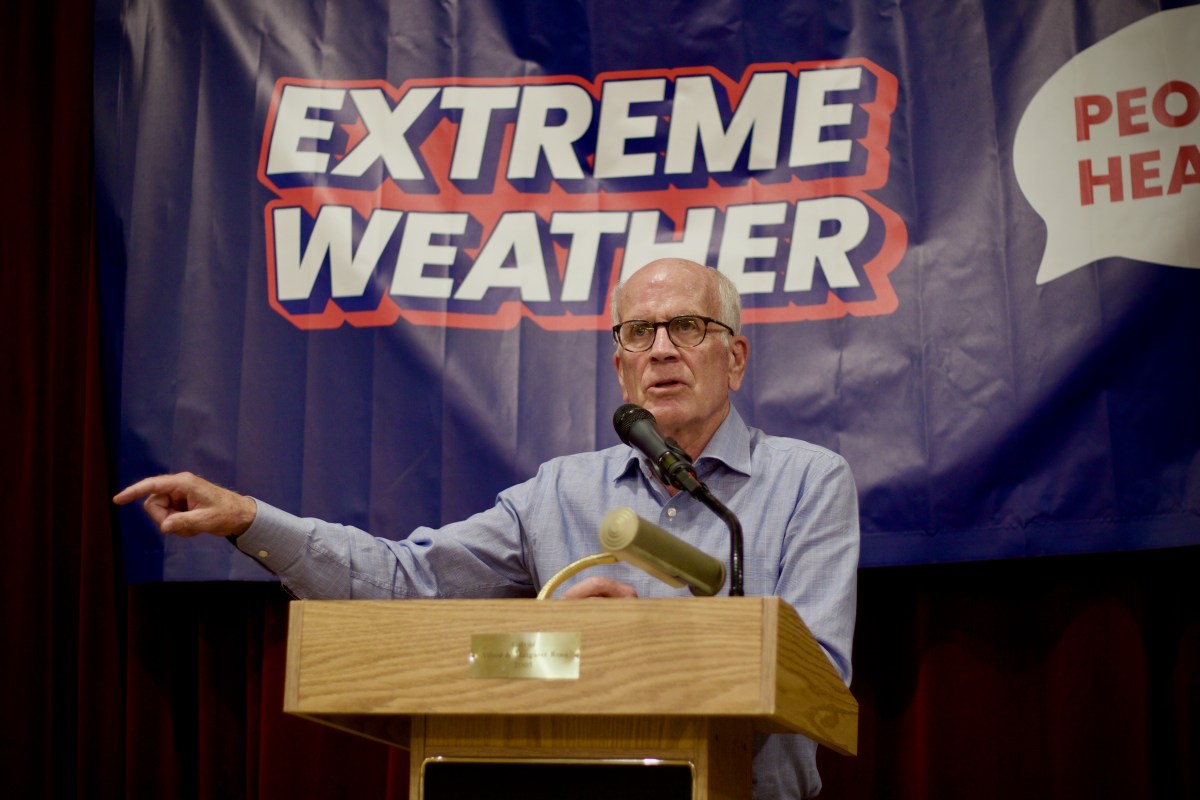
Wednesday’s public event, called the Extreme Weather People’s Hearing, was organized by a coalition of climate advocacy groups. At the event, they voiced support for Vermont’s law aiming to make fossil fuel companies pay for damage caused by climate change. According to the National Oceanic and Atmospheric Administration, climate change is bringing more extreme weather, including floods, to Vermont.
Also in attendance was a panel of some of Vermont’s top elected officials who decried what they called the increasing politicization of federal disaster aid since President Donald Trump took office a second time in 2025.
Vermont was among several Democratic-leaning states that saw applications for Federal Emergency Management Agency aid denied in 2025. In that case, the funding would have helped pay for repairs to flood damage that several Northeast Kingdom towns suffered that summer. At the same time, several Republican-leaning states saw aid approved. Vermont is now footing the bill for those repairs.
A number of speakers at Friday’s event described the process of navigating the federal government’s disaster response as even more challenging than cleaning up their flooded homes. There was broad consensus that individuals and municipalities would not receive nearly the amount of aid they would need to fully recover.
U.S. Sen. Peter Welch, D-Vt., called the flooding itself just the first trauma.
“Trauma two was FEMA never giving you an answer on what the hell is going on,” he told the crowd. “We have to have a FEMA where there’s much more local control in making decisions about how to build back — and where you’re going to have an opportunity to speak to officials and get a ‘yes’ or a ‘no’ sooner rather than later.”
Lengthy timelines for dealing with FEMA are not unique to Vermont, or the recent years’ storms. A policy implemented by Kristi Noem, the since-fired secretary of the U.S. Department of Homeland Security — under which Noem had to personally sign off on many disaster aid requests — somewhat slowed Vermont’s recovery, according to state officials. FEMA is part of the Department of Homeland Security.
But the state has seen some progress since then. Last month, FEMA advanced 88 properties where owners are seeking a buyout after the 2023 or 2024 floods to the next stage of the agency’s review process, according to Doug Farnham, Vermont’s chief recovery officer.
Overall, as of the end of June, there were 110 properties with buyout applications stemming from the 2023 and 2024 floods yet to be approved by FEMA, while 142 had been approved, according to the latest data compiled by a state contractor.
Meanwhile, 134 public assistance projects — such as repairs to municipal infrastructure — are still awaiting final approval across both years, out of 2,384 total projects, according to the contractor’s data.
‘When the water recedes’

Some of the most significant damage caused by 2024’s flooding was in Plainfield. Recovery is still very much a work in progress there two years on; Lauren Geiger said she’s still making repairs from the 8 feet of silt, sand and water that burst into her home from the nearby Great Brook.
Over the last two years, Plainfield has “lost property, tax base, economic activity and residents” who decided to move elsewhere, said Peter Youngbaer, the town’s selectboard chair. A stretch of one road is still impassable. Youngbaer’s own home was flooded with 4 feet of water in 2023, when Plainfield saw some but overall less destructive flooding, he said.
Some speakers recounted impacts on other essential services. Robert Areson, a primary care doctor at an independent clinic in Richmond, said that in both 2023 and 2024 the facility essentially became an island with flooding cutting off access for many of its patients for several days at a time.
One of his patients walked to the clinic from the closest location he could park, and in doing so, provoked what became a blockage in one of his coronary arteries, Areson said.

“Severe climate events quickly push our ability to provide reliable, high-quality care to our 6,300 patients beyond its capacity,” he said. “The cascade of events snowballs astonishingly quickly — and affects absolutely everyone.”
Several of those who spoke Wednesday also recounted the emotional impacts of the storms.
“Three years later, I still worry every time heavy rain is forecast. I wonder whether roads will wash out, bridges will become impassable and whether I’ll be able to get home,” said Corinne Cooper, who in 2023 was one of dozens of residents at a Berlin mobile home park who lost their homes.
“Disasters don’t end when the water recedes,” Cooper said, holding back tears. “They reshape lives for years.”
