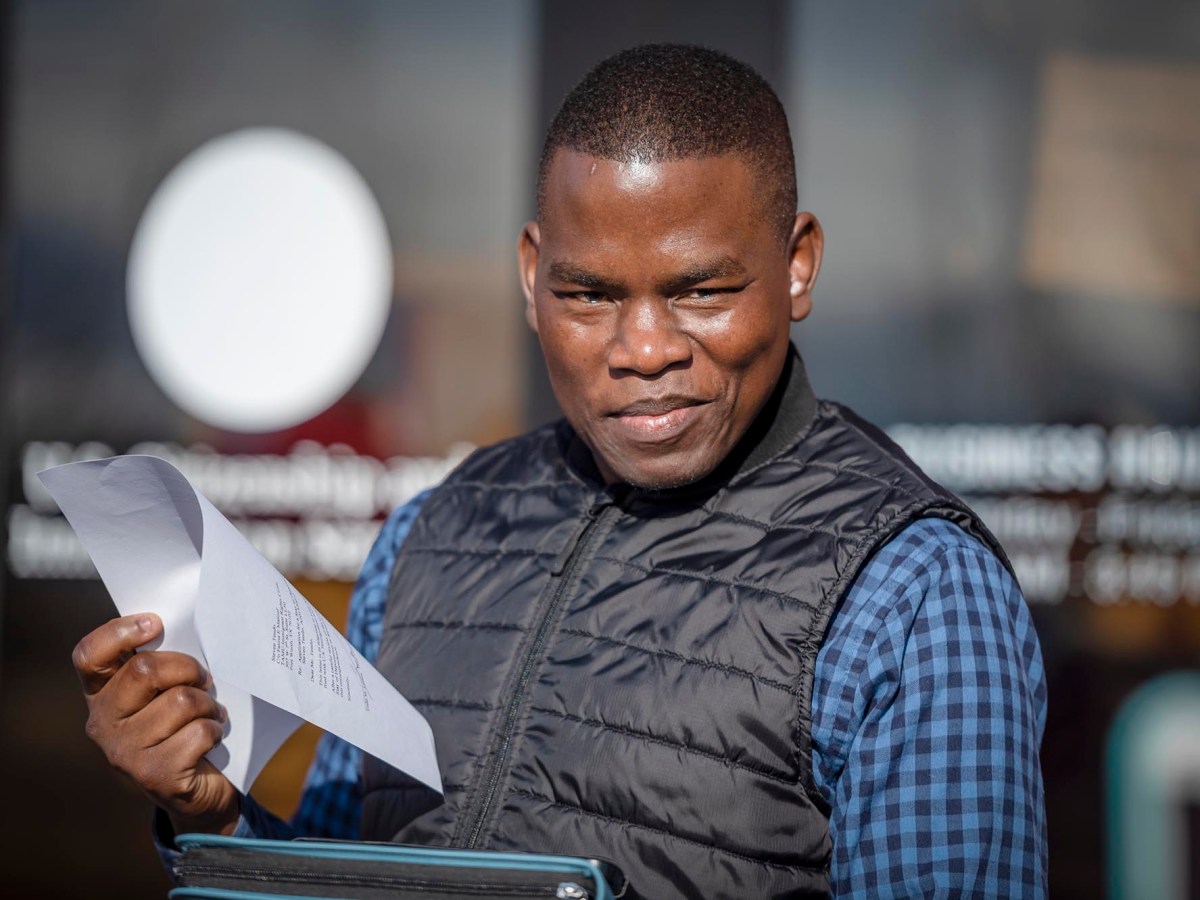
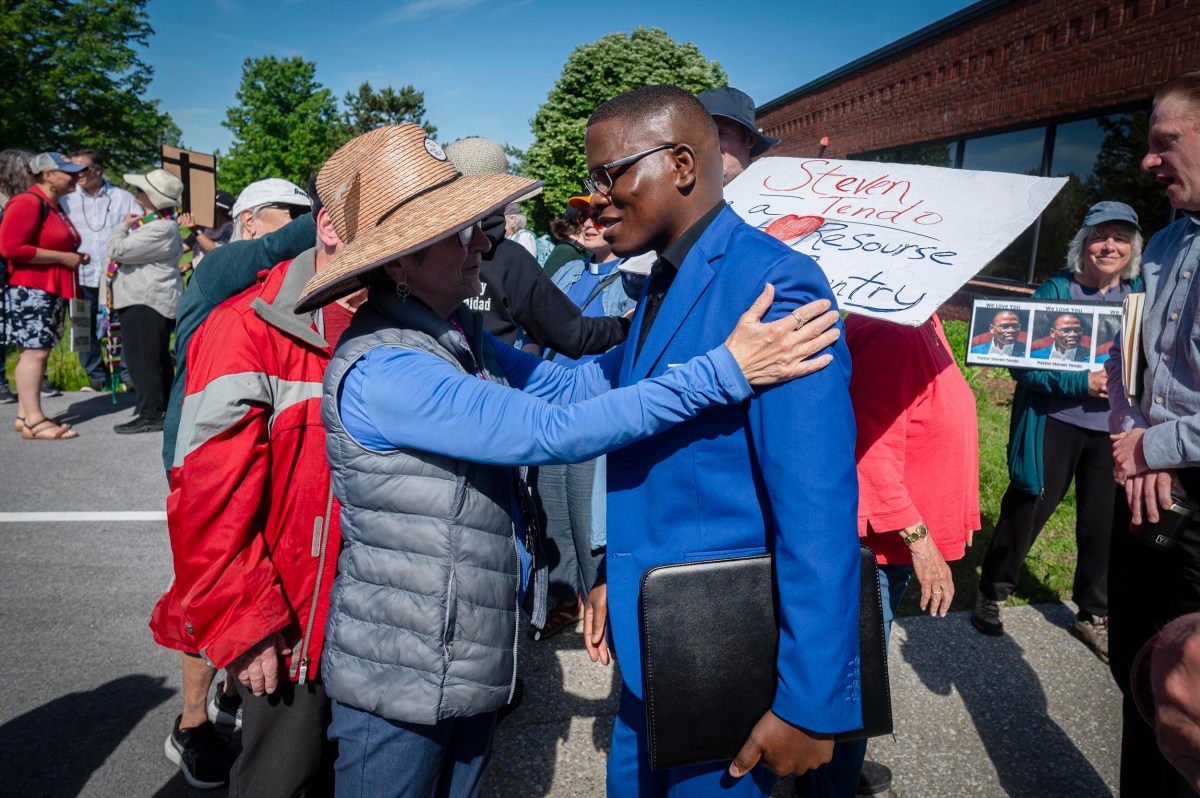
ST. ALBANS — Steven Tendo hugged and shook hands with the throng of supporters waiting outside the U.S. Immigration and Customs Enforcement office Tuesday. He was relieved, for now: He’d just walked out of a check-in with ICE, where he feared he might be detained.
But in 60 days, he’ll have to do this all again, making the journey to St. Albans from Colchester with the same questions. Will ICE let him stay in the country longer? Will they detain him? How long will the life he’s built in Vermont last?
“Even if you want to do permanent things, you can’t, because you don’t know about your tomorrow,” Tendo said in an interview Tuesday, moments after he knew he could go home again. “It’s a very hard situation to live in.”
Although Tendo’s latest appointment was in some ways routine, ICE’s handling of check-ins in Vermont has changed over the past year and a half. Asylum seekers and people with pending immigration cases who once checked in with ICE by email a few times a year are now required to appear in person, more often, at a single office in the far northwest corner of the state and with fewer people allowed in the room to help them, advocates said.
Tendo has been in and out of ICE detention since he arrived in the U.S. in 2018 and applied for asylum. He has faced the threat of deportation back to his native Uganda multiple times. ICE officials have granted Tendo multiple stays of deportation since 2022, which have allowed him to remain in the country. Community members and legislators have repeatedly rallied on his behalf outside his ICE check-in appointments.
ICE detained Tendo earlier this year on Feb. 4, two days before a scheduled check-in. Ultimately, a federal judge ordered his release after finding the agency had not followed proper procedure.
ICE check-ins are often a requirement of what’s known as an order of supervision, an arrangement in which ICE releases someone facing potential deportation or removal from the country. The order typically requires people to check in periodically while the agency considers whether to detain the person or try to remove them from the country, according to the Immigrant Legal Resource Center, a national immigration law and policy nonprofit.
The status often allows people to remain in their communities rather than a detention facility while their cases progress, according to the center. Although ICE determines the method of check-in required, it has in the past allowed those under supervision to meet virtually.
Since the start of the second Trump administration, however, people under ICE orders of supervision in Vermont have increasingly been required to attend check-ins in person, according to Migrant Justice, a statewide organization that advocates for immigrants.
Rachel Elliott, a member of the Migrant Justice team, said the organization has provided support for migrants at over 80 check-ins at the St. Albans ICE office since the beginning of 2025. Elliott said that number represents only a portion of the people in Vermont who have to attend these appointments.
ICE did not provide answers to emailed questions about how many people have to attend check-ins at its Vermont office.
When Elliott started helping with check-ins in 2024, most people were able to check in with ICE by email, Elliott said, often only needing to send the agency their basic information every six months or once a year.
But since the start of the second Trump administration, Elliott said, all of those people are now required to go to in-person appointments at the ICE facility in St. Albans.
“If someone has to come up from, you know, Bennington or has to come down from the Northeast Kingdom, that’s a huge burden for people,” Elliott said.
People are also being required to check in more often, Elliott added. “Instead of every year, it’d be every six months. Or instead of every six months, it’d be every three months.”
Brett Stokes, an immigration attorney who is part of Tendo’s legal team, said he has also seen that shift toward more frequent in-person appointments since the start of the second Trump administration.
In an emailed statement from an unidentified spokesperson, ICE said that email and phone check-ins were introduced during the Covid-19 pandemic.
“This practice did not exist prior to March 2020 and is no longer an option as such precautions are unnecessary,” the spokesperson wrote, adding that the frequency of check-ins is determined on a case-by-case basis.
However, an ICE handbook dated August 2017 outlining the agency’s Intensive Supervision Appearance Program lists telephonic reporting as one tool the agency uses to monitor immigrants who are released from custody while their immigration proceedings are pending.
Elliott said that since January of this year, restrictions on who can come along to check-ins have also changed. While Elliott and other Migrant Justice members used to attend the appointments to provide support and help interpret for people who didn’t speak English, they said that ICE is now allowing only direct family members and attorneys to attend the appointments. Stokes said he has seen the same limits imposed on his clients.
Tendo’s check-in provided some insight into the restrictions. Tendo wanted two local clergy members to be with him during the appointment. But they were turned away at the door, and only Tendo and his lawyer were allowed inside.
The restrictions have raised concerns from advocates about language barriers during appointments. Elliott said that although ICE has claimed to provide interpretation, that interpretation sometimes comes in the form of an ICE officer who speaks the language in question at less than a high-school level, or through agents using Google translation.
The unidentified ICE spokesperson said the agency “is committed to ensuring staff take reasonable steps to provide language assistance” to those who need it, adding that the agency uses bilingual staff and language assistance services to provide oral and written translation.
“In rare cases, some less common and/or indigenous languages may require prescheduled appointments with ERO’s (Enforcement and Removal Operations’) professional language assistance services contractors,” the spokesperson added.
The spokesperson said the agency allows family members and legal counsel to attend the appointments, but did not provide an explanation for the restrictions on allowing other people to attend the appointments.
In addition to being a burden in terms of the time and money it takes to attend the appointments –– time away from work, hours of travel and sometimes paying for a ride –– Elliott said the appointments take a psychological toll.
“There’s also just the fear, right? Especially now when people are seeing across the country people in their same situation getting snatched up at these appointments,” Elliott said. “There’s an incredible amount of fear and stress.”
Although there have been a handful of detentions at ICE check-ins in Vermont under the second Trump administration, Elliott said Migrant Justice has not seen the increase in detentions at check-ins that has been documented across the country.
“At least from our perspective, it is safer for people to go a lot of the time than it is for them not to,” Elliott said. Those who miss a check-in risk being detained, according to the Asylum Seeker Advocacy Project, a nonprofit made up largely of immigration lawyers.
Elliott said they asked ICE but received no explanation for why so many people are now required to attend the appointments in person, or why advocates are no longer allowed inside the appointments.
“They wouldn’t give an answer. They just said this is the policy now,” Elliott said.
After his appointment Tuesday, Tendo is again living in the anxious uncertainty between check-ins.
“You’re emotionally not OK,” he said. “The body, the mind, the brain keeps asking you questions: What if? What if?”
He’s unable to work in his job as a nursing assistant at UVM Medical Center, he said, and lost his health insurance because his prior work permit expired and his application for a new one has yet to be approved.
He said he hasn’t been allowed to work since he was released from ICE detention in February and has relied on financial support from community members for essentials like rent and prescription medication.
Tendo is in school to get a nursing degree. Meanwhile, his lawyers are pursuing multiple routes to keep him in the country, according to Christopher Worth, one of the attorneys working on Tendo’s case.
“I have not stopped focusing on building my community and building myself as an individual,” Tendo said.