MORRISTOWN — Skip Lisle stands atop a beaver dam, grabbing sticks and tossing them over his shoulder. In chest-high waders, he slowly opens a hole in the middle of the dam, and water rushes through.
Lisle might just be the biggest beaver-lover in the state. And despite appearances, he’s not destroying this dam. He’s working to help it stay.
For more than three decades, Lisle, now 67, has devoted his life to helping humans coexist with beavers, pioneering the use of “flow devices,” contraptions of wood, wire and PVC tubing designed to stop beavers from flooding roads and clogging culverts.
“I’ve never been a beaver before. That’s a real disadvantage,” Lisle said. But he’s had 30 years to perfect the craft of beaver deception.
“Fortunately, beavers don’t do much deductive reasoning,” he added. “Only reason I have a chance.”
When it comes to beavers, as many Vermonters know, it’s a mixed bag. On one hand, beavers create wetlands that can slow erosion, reduce downstream flooding and create habitat for other species. But they also flood fields, chew down trees and clog culverts, sometimes causing costly damage.
Vermonters often manage this enduring tension by trapping and killing beavers, which remains common today. Of the roughly 1,000 beavers trapped in Vermont during the 2024-25 season, about half were trapped because of conflicts with landowners, according to the Fish & Wildlife Department.
But Lisle has spent ages arguing there’s another way.
That vision recently brought him to Harriet Winter’s property in Morristown, where beavers transformed a small stream into a shallow wetland, which partly flooded a trail her family uses to reach the woods behind their home.
Winter said she appreciated the benefits beavers bring to the landscape.
“We want to find a way to share,” Winter said.

“That puts them way ahead of the average person,” Lisle interjected.
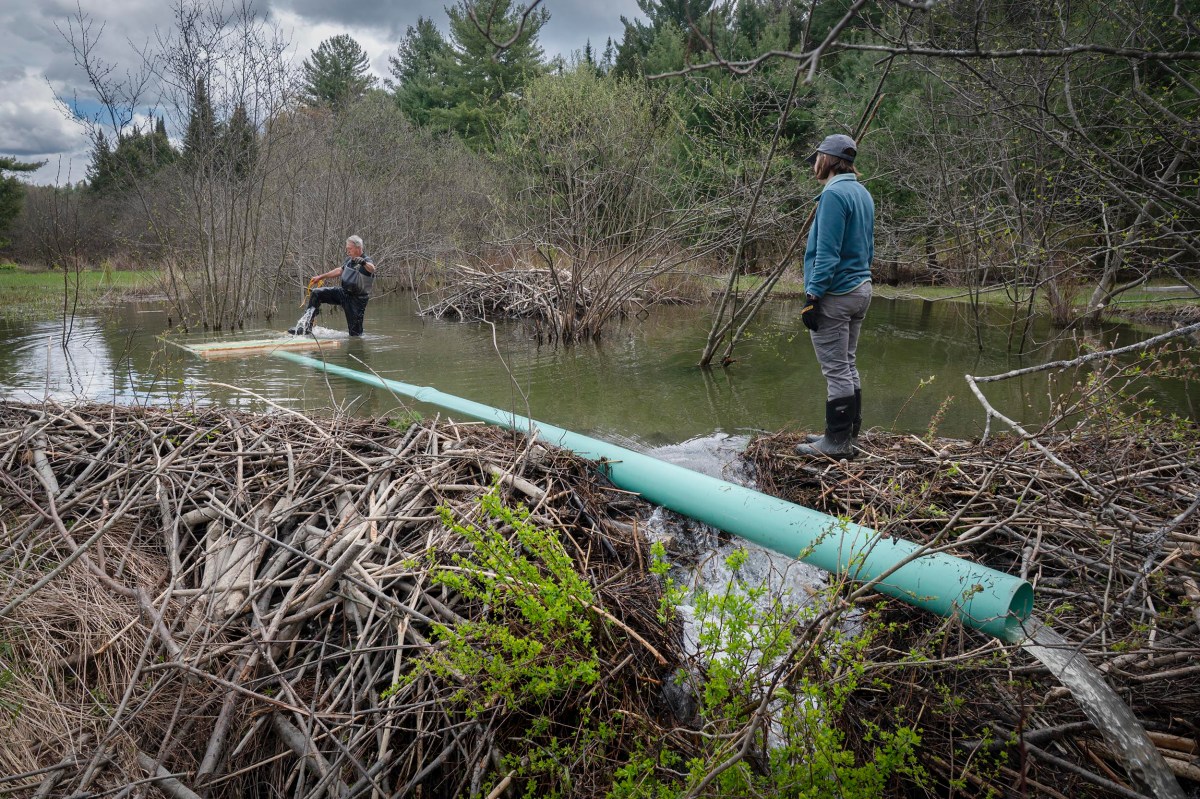
Winter called Lisle to install one of his Beaver Deceivers, a pipe-and-wire system designed to lower water levels without destroying the dam.
While the idea is simple, the installation is not. Lisle wrestled the unwieldy contraption through the water, grabbing alder saplings to stay upright as mud threatened to swallow each step. Once installed, the system quietly channels water through the dam while making it difficult for beavers to clog the pipe.
The devices can work remarkably well. In a 2008 analysis funded by the Virginia Department of Transportation, researchers found that all 33 similar devices Lisle installed at sites where beavers had caused damage still functioned more than six months later.
A lifelong fascination
Lisle’s fascination with beavers began in Grafton, where he grew up on land crossed by a town road and a troublesome culvert.
Beavers had largely disappeared from Vermont by the early 1800s after widespread trapping and forest clearing, according to the Fish & Wildlife Department. But they gained legal protections in 1910 and were reintroduced to the state in the 1920s and 1930s. Since then, beavers have rebounded across a landscape that had spent generations developing without them.
When beavers moved onto Lisle’s family property decades ago, the animals repeatedly clogged the culvert and flooded the road.
“A guy who was on the town road crew would go out in the evenings with his gun and stand on the road to shoot beavers,” Lisle recalled.
His parents weren’t fond of the animals either. After one chewed down shrubs they had planted, they told him to shoot it.
He did.
“Even then I knew it was wrong and stupid and self-destructive,” he said. “The next time a beaver came along, I refused.”
Instead, as a teenager, Lisle built a simple fence around the culvert to stop beavers from damming it. He said they haven’t had to kill beavers on that land in 50 years.

But it would take years before beavers became his career. Lisle studied geography and played football and baseball in college before spending a decade working construction.
“I was kind of lost,” he said.
In the early 1990s, he returned to school to earn a master’s degree in wildlife conservation from the University of Maine.
The topic of his thesis?
Three guesses.
Soon after, while working for the Penobscot Nation in Maine, Lisle developed early versions of the Beaver Deceiver and Castor Master, systems designed to stop beavers from clogging culverts and washing out roads.
“They saw that killing beavers wasn’t working,” Lisle said.
Lisle’s systems worked. After leaving that job, he moved back to his family’s land in Grafton and founded Beaver Deceivers International. Since then, he estimates he has installed more than 1,000 coexistence devices.
Outside Vermont, Lisle’s work helped inspire a broader movement around beaver coexistence.
Mike Callahan, founder of the Massachusetts-based Beaver Institute, said Lisle became an early mentor after Callahan and his wife began searching for alternatives to trapping in the late 1990s.
“We both really disliked how the media was polarizing [the issue of] beavers and pitting homeowners against the people who like the beavers,” Callahan said of himself and his wife.
“We just thought, ‘This is a little crazy. There must be a middle ground somewhere.’”
Eventually, Callahan founded the Beaver Institute, which trains people to install coexistence devices and promotes nonlethal approaches to beaver conflicts.
“Skip has an incredible legacy of pioneering this work, and my legacy is really an extension of his legacy,” Callahan said.
Coexistence strategies have also gained traction within Vermont Fish & Wildlife. Tyler Brown, who advises landowners on beaver conflicts for the department, said the state helps pay for and install flow devices in places where wetland habitat is especially valuable.
The work has not made Lisle wealthy, though, he said. Not by a long shot. He sometimes supplements his income by taking construction jobs. Now, at 67, Lisle fears he may eventually have to sell the Grafton land where he has spent decades cultivating beaver wetlands.
“I’ve devoted my whole life to wildlife habitat. Consequently, I haven’t gotten ahead,” he said.
But Lisle’s work goes on for now. The state still sometimes recommends lethal removal of beavers. In 2025, that was the recommendation in 15% of conflicts the department consulted on, according to public data. Lisle believes that number could be reduced to zero.
“I still feel like if there’s any state that could do it, could start, you know, heading in the right direction, it’s Vermont,” he said.
Correction: Due to a production error, an earlier version of this story was truncated.