

House and Senate lawmakers will soon iron out the state’s $9.4 billion budget in conference committee. But it’s a $700,000 funding spat over a literacy program that has Vermont Agency of Education officials and Gov. Phil Scott pointing fingers at legislators.
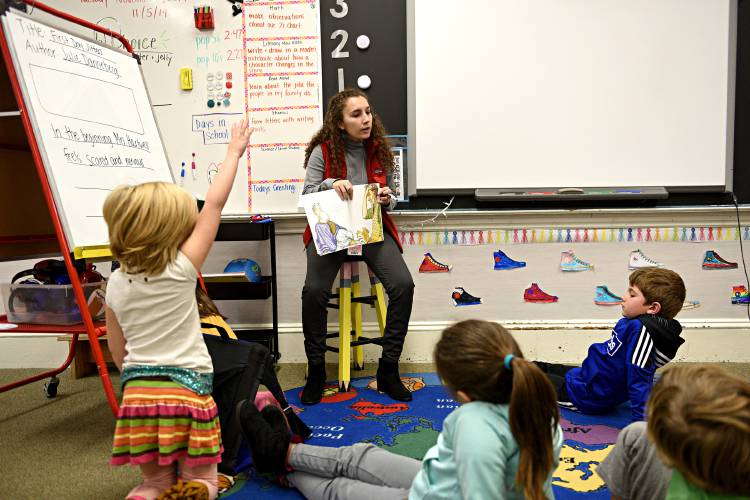
The program, called Read Vermont, is an early childhood reading initiative launched in 2024 that funds literacy coaches in school districts to help improve students’ reading.
Agency of Education officials say the initiative is critical. Only 31% of Vermont fourth graders and 29% of eighth graders are considered proficient in reading, according to the agency.
But the relatively minuscule funding request may not come to pass. Whether that’s because of crossed wires, technical confusion or something more pointed depends on who you ask.
Toren Ballard, the Agency of Education’s director of policy and communications, said the agency was “blindsided” by legislators’ disinterest in the request, while Scott in April accused lawmakers of cutting funding for the program.
Lawmakers, however, say there was plenty of opportunity to request funding for the program through their fiscal year 2027 budget process.
“Seems to me that there were a lot of opportunities on the administration side to do something if they thought something wasn’t going to happen, and they dropped the ball,” Rep. Robin Scheu, D-Middlebury, the House Appropriations Committee chair, said in an interview last month.
The initiative was first funded via pandemic relief dollars that have since run out. Agency officials this year hoped to use leftover funding from an information technology modernization project for the program, which they sought approval for through the state’s midyear budget tuneup.
Lawmakers didn’t act on the agency’s request. Scheu said her committee didn’t have enough time to fully consider the ask.
Agency officials then asked to insert the funding into their fiscal year 2027 budget, which had already been submitted to lawmakers. By then, the budget process was well underway in both chambers, with little time to take testimony on the program in the House or Senate appropriations committees, Sen. Andrew Perchlik, D/P-Washington, the Senate Appropriations chair, said in an interview.
“What I heard from some members of the committee was, ‘We just don’t know enough about whether what they’re doing is the right way. We’d like to know more,’” Perchlik said.
“Either because of timing or all of the swirl around education transformation, it’s been hard to make that a priority,” he added.
Agency of Education officials, though, have said they’ve repeatedly reached out to lawmakers in the Senate and House committees and have asked to give testimony on the program.
“We have been on record asking for this money throughout the 2026 legislative session,” Ballard said in an interview.
“I don’t think anybody would reasonably be opposed to letting the agency spend their own money on Read Vermont,” he added. “There must be some sort of confusion. … I would not assume that anybody would knowingly divert money away from literacy.”
Now, members heading to the conference committee will be limited in what they can change in the budget bill. Conference committees have specific restrictions around inserting amendments that aren’t germane to the matters at hand, Perchlik said. (Lawmakers sometimes stray from that norm.)
“At this point, the $700,000 has been spent,” Perchlik said. “We’d have to take it from somewhere else, and that makes it a substantial change.”
In a press release, the Agency of Education said the program may need to be scaled back if the funding is denied, but officials are hopeful lawmakers can include the funding.
Zoie Saunders, Vermont’s education secretary, in the release said the investment would be “an important first step in regaining Vermont’s national leadership in literacy.”
But with the Big Bill heading for the finish line, it’s not looking good for Read Vermont.
“I’m not getting the sense that this is something (Scott) is going to veto the bill over,” Perchlik said.
On the move
Senators passed a statewide ban on guns in bars Friday, voting 17-13 along party lines to approve S.329. Next, the bill will get sent to the House.
The bill is the brainchild of Senate President Pro Tempore Phil Baruth, D/P-Chittenden Central, who has long advocated for a Burlington charter change that would ban guns in bars in the city he represents, though his past attempts have failed.
The Burlington charter change has stalled in a House committee since last year. With two Democrats on the committee opposed to the bill, lawmakers don’t have enough votes to advance it. Even if the policy passed both chambers, Scott has said he would veto it.
Under the bill, it would be illegal for someone to knowingly possess a firearm on the property of an establishment that’s licensed to sell alcohol. The ban would apply to the average bar, but it would not apply to places like convenience stores, which simply sell alcohol without allowing consumption.
There is an exception for bar owners, who could still carry on their property. There are also exceptions for police and other law enforcement officers who are working in the scope of their duties.
The bill has some of the same measures as another firearm bill, H.606, which is expected to be considered on the Senate floor next week. Those measures include largely banning machine guns, including devices like Glock switches, which convert semiautomatic guns into fully automatic weapons. Machine guns, or devices that convert other guns into machine guns, are already largely banned under federal law.
— Charlotte Oliver
Representatives on the House floor passed a bill Friday that expands the list of locations in which civil arrests — which include some immigration arrests — are prohibited in Vermont.
Civil immigration violations include overstaying a visa, being present in the country without legal status and violating the terms of a visa.
The bill, S.209, would protect someone from a civil arrest while they’re at a public library, a polling place, a healthcare facility or a place of worship, among other locations. The bill also offers extended protections from civil arrest if someone is traveling to or from a school. Vermont law already protects someone from civil arrest while they’re at, or traveling to or from, a courthouse.
Under the bill, if an officer knowingly and willingly arrests someone in a protected place, the officer could be charged with false imprisonment.
Lawmakers approved the bill on second reading Thursday, voting 109-30 in favor. For months Scott has declined to say if he would support the bill.
After passing the House on Friday, the bill will get sent back to the Senate before it could make its way to the governor.
“We continue to see countless examples of federal agents creating unchecked chaos on innocent individuals and disrupting communities. Vermont has a duty to every single person who lives in our great state to protect their right to essential services and benefits without the fear of being illegally apprehended,” said House Speaker Jill Krowinski, D-Burlington, in a statement on the bill’s passage Friday.
— Charlotte Oliver
