

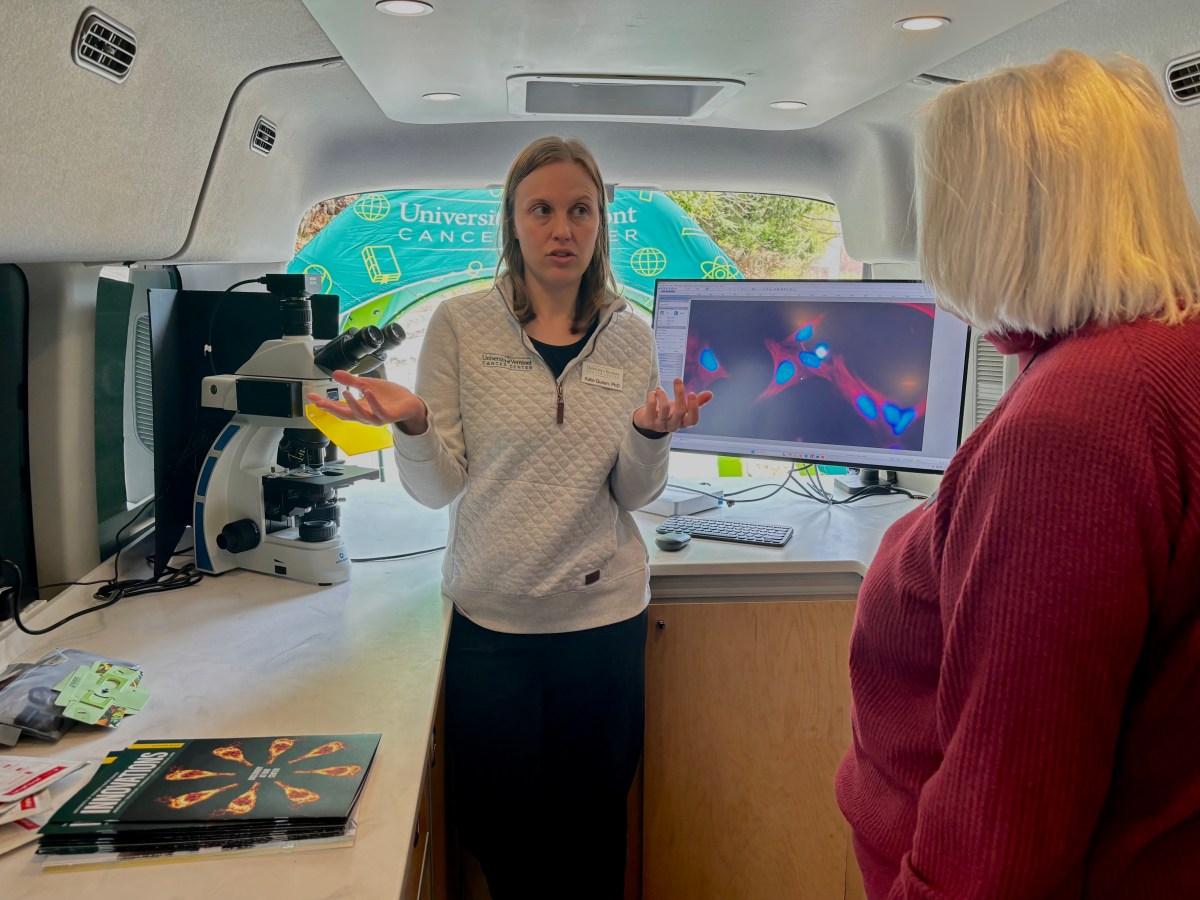
Mobile microscopes
In a cargo van parked behind the Statehouse, a high-power microscope fluoresced a multicolored view of cancer cells: red for their skeletons; blue for their DNA; a vivid, glowing green for the “feet” that help the cells move around.
It was part of a demonstration of the mobile biology lab that the UVM Cancer Center takes on the road to rural high schools across the state. The Cancer Center staff run pop-ups for students, like Tuesday’s at the Statehouse, but has also started to pilot weeks-long biology programs that slot into regular school curricula while taking advantage of UVM’s high-level technology.
“We’ve had students who look at DNA damage. We’ve had students interested in a nuclear membrane marker. And so depending on what students are interested in, we can actually provide samples for them, and they can visualize that on our microscope,” explained Katie Queen, who runs the program for UVM.
The effort aims to spark an interest in science for rural students with the hope of leading them into careers as clinicians or researchers.
But wipe down the lab bench, move the gel electrophoresis machine and pop up a privacy curtain, and the van converts to a clinical space as part of a different effort to reach people beyond the hub of the big academic medical center.
The UVM Cancer Center, with a team of dermatologists, offers skin cancer screenings in the van. The group aims to reach people who otherwise might not make it to the clinic for an annual skin check. One event with the Holland Food Shelf, in Orleans County, for instance, stood out as particularly successful to Cancer Center staff.
Soon, the Cancer Center intends to expand the types of cancer screenings it offers to take-home colorectal cancer and HPV screening kits. To administer those, though, someone needs to prescribe it, so the Cancer Center is in the process of hiring a provider, such as an advanced practice nurse, who can do so.
Up until now, philanthropy has paid for the van and its programs, said Dr. Randall Holcombe, who runs the UVM Cancer Center. But, as the state and federal government place a heightened emphasis on access to healthcare in rural areas, he is also applying for rural health transformation funds. And just last week the state posted a request for proposals seeking expertise in mobile integrated health projects.
Sen. Ginny Lyons, D-Chittenden Southeast, who chairs the Senate Health and Welfare Committee, was particularly excited about how the mobile clinic’s work fit into an overarching vision for rural health access.
The lab inside the van also gave her a familiar glimpse at her pre-Legislature life as a biological researcher. She used the same fluorescent technology to look at markers on cell surfaces that develop with the immune system.
“It was sort of lime green. It was beautiful,” she said.
In the know
The federal Centers for Medicare & Medicaid Services is demanding that Vermont renew its Medicaid care providers’ eligibility as part of the Trump administration’s effort to weed out fraud, waste and abuse, according to letters that Vermont Medicaid and the governor’s office received Thursday.
CMS Administrator Mehmet Oz asked all 50 states to give the federal department their two-year plans, within 30 days of the letters’ receipt, for revalidating Medicaid providers. He specifically requests that states undertake a “swift” revalidation of providers at high risk of committing fraud and submit a plan for doing so within 10 days. The governor’s office received a letter specifically addressing this “high-risk” revalidation.
The nationwide requests come on the heels of a March congressional letter targeting Vermont and nine other states and demanding information to identify Medicaid vulnerabilities to fraud, waste and abuse.
CMS requires healthcare providers who receive Medicaid funds to renew their enrollment periodically — typically every five years, though medical suppliers revalidate status every three years, according to a federal website.
In his letter, Oz wrote that revalidation can help identify where providers no longer meet criteria for Medicaid enrollment — such as professional credentials — but it is “just one component of a broader program‐integrity framework.” He noted that screening alone may not identify every instance of fraud, especially in cases where providers are indeed qualified to administer services.
A representative from Vermont’s Agency of Human Services said Monday the state was still assessing CMS’ request and working on its response. The agency was unable to answer additional questions Monday.
“The State of Vermont takes fraud, waste and abuse seriously,” wrote Ted Fisher, the communications director for the Agency of Human Services. “We are committed to administering a high-quality Medicaid program that supports the health of Vermonters and responsibly stewards taxpayer resources.”
Read the full story here.
— Olivia Gieger
On the move
A bill intended to safeguard constitutional rights will become law after Gov. Phil Scott allowed it to move forward Monday without his signature. H.849 will allow people to sue government officials, including federal employees, for alleged constitutional violations. Discussion around the law centered around violations by federal immigration authorities, though it applies to all government workers.
“While I feel it’s important to preserve and protect the Constitutional rights of all Americans and appreciate this bill seeks to hold government officials accountable in state court when a remedy may not be available under federal law,” Scott said in a press release, “I’m concerned about the constitutionality of this policy and other well-intentioned proposals, which may give Vermonters false hope.”
Scott said he’d see if the law and others like it in other states hold up in court. The bill has a July 1 effective date.
Scott also signed into law a raft of other bills Monday and Tuesday.
— Ethan Weinstein
Am I crazy or …?
On Friday, Strafford-born Noah Kahan released his highly anticipated fourth studio album, “The Great Divide.” Much like Kahan’s previous record, “Stick Season,” the songs are full of references to Kahan’s upbringing in the Upper Valley, and across New England.
As a student of Vermont politics, one line in particular stood out to me, however. At the beginning of the album’s opening track, “End of August,” Kahan sets a scene where he’s riding in a car with his brother, Richard Kahan. And he says this:
Endin’ of August, the bugs are just startin’ to die
All the neighbors are votin’ for someone who wins every time
Given the fact Vermont’s primary election is in August … and the unnamed candidate “wins every time” … could this line be about five-term governor Phil Scott?
— Shaun Robinson
