

Robert Langellier is a wildland firefighter and a freelance journalist who writes for New York Times Opinion, The Atlantic and Esquire. Officers can reach him at robertlangellier@gmail.com.
On March 11, 2026, six protesters — including me — were arrested by multiple state and municipal police agencies for attempting to stop the illegal abduction of a family by U.S. Immigration and Customs Enforcement on South Burlington’s Dorset Street. For several of us, arrests for disorderly conduct were dubious and nonspecific, largely because we did not do anything specific. Our presence was considered disorderly. My arrest came because I was within arm’s reach of an officer who was able to grab me.
On Wednesday, the state’s attorney, Sarah George, declined to press charges against three of us arrested by state police, while the other three — arrested by municipal police — were diverted to a restorative justice program at the Burlington Community Justice Center. After reviewing body camera footage, George determined that both sides — the protesters and the police — shared responsibility for escalating the conflict. Therefore, she asked the police and the six arrested protesters to meet in a restorative justice process, where each side could share their perspectives with each other. I found this proposition inspiring, with the potential for real understanding across a vast philosophical gulf. Most of my friends hate the police, and some of the police seem to hate us in return. I believe that is partly because the only spaces where we interact are in conflict spaces.
On Wednesday, Burlington Police Department interim Police Chief Shawn Burke wrote that the department will not participate in the restorative justice process, stating that “the rule of law must be upheld.” The Burlington Police Officers’ Association released a statement claiming that the state’s attorney’s decision “emboldens … disorderly, at times violent, and unlawful civic unrest.”
As an independent journalist, I have learned there are very few things in the world that are black and white. There is almost always nuance in conflict. But BPD’s refusal to come to the table with protesters means that, for the other protesters and me, there will be no nuance — and vice versa. There will only be our own perspectives, siloed. Both sides will be emboldened by seeing only messages of support in their feeds. Refusing to bridge divides with good faith and compassion does far more to embolden protesters than the lack of a prosecution does.
I am disappointed and saddened that I will not get to hear what might be real and nuanced points of view from Burlington police officers, and that instead, all of that nuance is reduced to a statement released by the BPOA that sounds more like a child upset at being scolded for fighting with their brother than a nuanced perspective. Simply calling us disorderly and violent in the press does not help BPD’s image, bridge any divide, or perform any public service.
In addition to being a journalist, I am also a wildland firefighter, so I understand the importance of the chain of command. There are times when immediate activities do not seem to support the mission statement. I have, for example, set fires that I knew would damage the landscape. I have put out fires that I know would be healthful. I do this because my burn boss, my captain or my squad boss ordered me to and because the facts on the ground are chaotic and rapidly evolving. In most circumstances, as easy as it sounds to follow your own personal moral code, realities on the ground mean that organizational solidarity and chain of command take precedence over individual concerns. The long-term mission outweighs the immediate one.
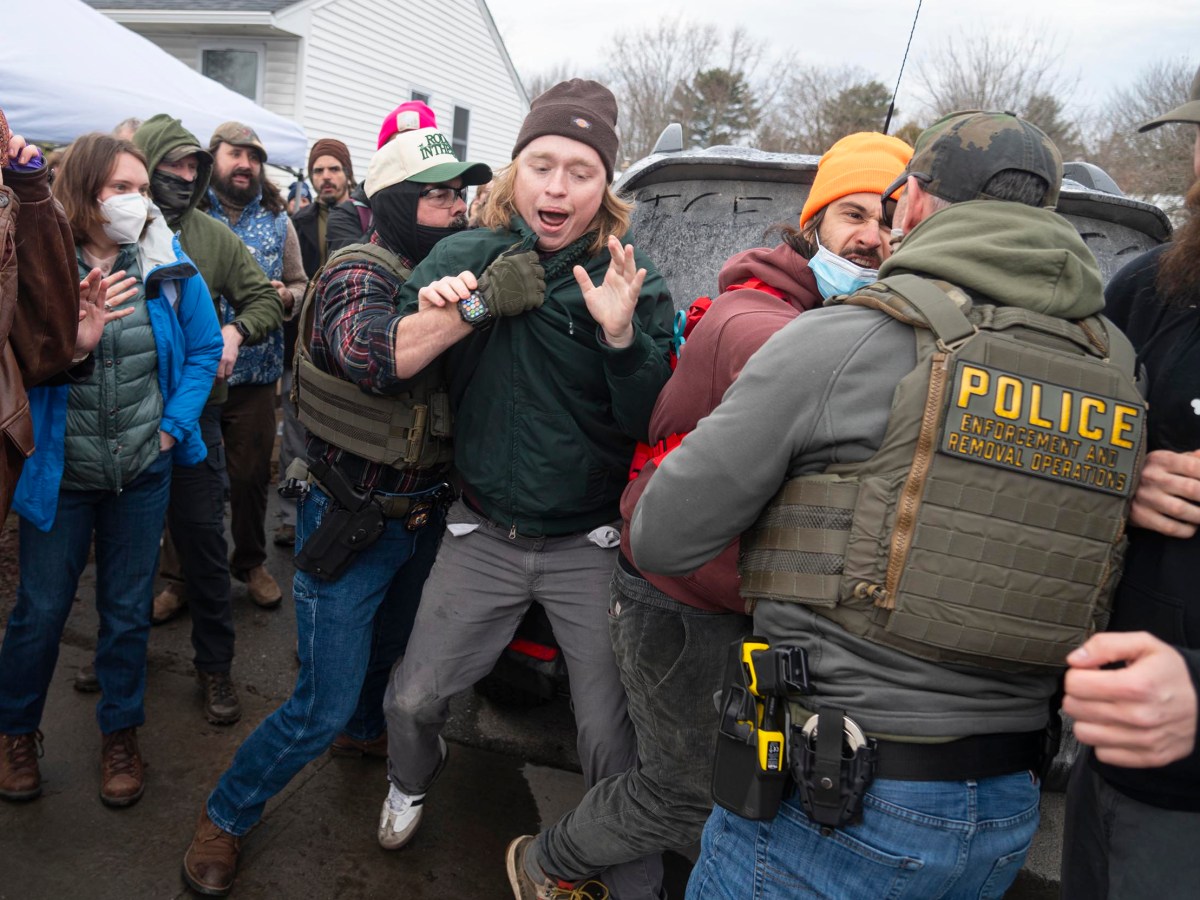
I recognize that police officers bear a burden that firefighters don’t. When firefighters make wrong decisions, we’re usually considered heroes who tried their best. When police officers make wrong decisions, they’re viewed as oppressors. When I was on the front lines of the protest, six inches from Vermont State Police officers in riot gear, one of the many emotions I saw in their eyes appeared to be doubt. In the midst of simmering chaos, I found myself moved. Some of them did not want to be there, associating with and abetting ICE’s slipshod and often-illegal tactics. That day, I heard several officers from different agencies vocally distance themselves from ICE. They were simply following orders. I believe there would be much to gain from seeing one another as full human beings rather than as agents of violence or agents of disorder. My inbox is open for police officers who would like to have coffee.
In response to the state’s attorney’s opinion that there should be an independent review of police conduct that day, BPD said its own internal investigation found no wrongdoing and that they should be trusted. It then implies that the protesters should be investigated and prosecuted. But like the BPD, I have conducted an internal investigation of my own behavior and also found myself not at fault. Happily, it seems no one has done wrong.
I understand that the Burlington Police Department, along with other agencies, feels they were in the right. But I feel the same, and in this case, public opinion is on my side. If we are unwilling to meet and share each other’s perspectives, then we do not grow as a community; we simply get angrier and more self-righteous. Now, instead of developing nuance, we will all return to our corners, and we will continue to see BPD merely as an organization of armed men and women who flung unarmed protesters to the curb so that ICE could escape with an abducted family that wasn’t named on their warrant — as an organization that kept no one safe but ICE.
BPOA claims I’m now emboldened. If I am, it is not because the state’s attorney declined to prosecute me. With genuine gratitude to Sarah George for her decision, I do not need a state’s attorney’s permission to protect my neighbors.
To the Burlington Police Department, since I will not see you at the table: I will see you at the next ICE raid. Bring your guns. I’ll be unarmed.
