

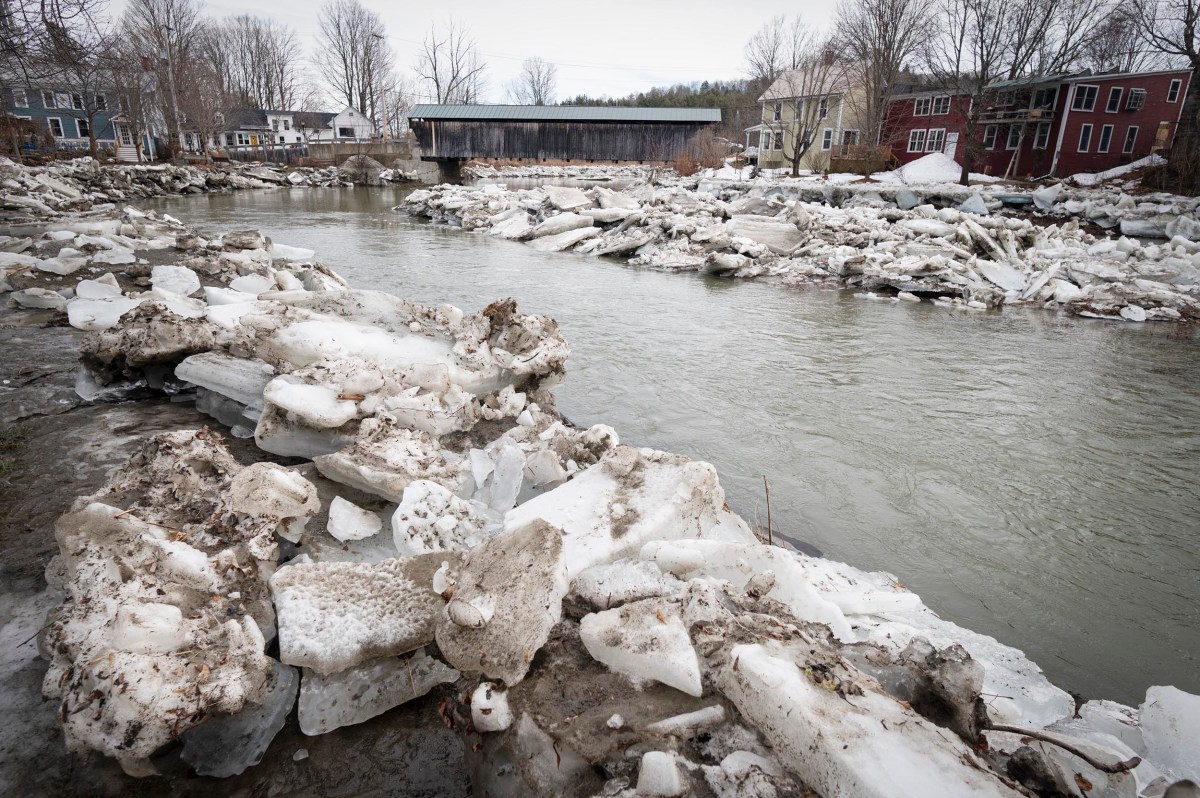
A flood watch has been issued for much of Northern Vermont by the National Weather Service as warming temperatures create conditions for ice jams.
“It basically becomes a dam, and water can flood behind it very, very quickly,” said Maureen Hastings, a lead meteorologist at the National Weather Service’s Burlington office.
“It can rise feet in just a matter of minutes, and then once that jam releases, then that can also be a surge of water that rushes downstream. So it’s very chaotic and very hard to predict.”
Temperatures were expected to rise above 60 degrees on Tuesday, and rain is expected later in the evening, causing melting snow and rain runoff to swell rivers and break up sheets of ice, according to Hastings.
Ice jams occur when large ice chunks get caught in bottlenecks of rivers. Hastings explained that both the water buildup behind a dam and the rush of water when the dam breaks can become serious hazards.
Hastings said that residents in areas prone to river flooding should be vigilant and stay away from an area if a jam forms as conditions can escalate quickly.
Ice jams have already occurred in the Mad River in Washington County and the Ottauquechee River in Windsor County. An ice jam in Missisquoi River flood forced a section of road to be closed near Enosburgh in Franklin County, on Wednesday.
The floods caused by ice jams are normally smaller than more standard flooding events that hit Vermont, but they can happen a lot faster, according to Vermont’s flood hazard mapping coordinator, Ned Swanberg.
“Flooding from ice jams can be dangerous, damaging, and costly to Vermonters,” Vermont Department of Environmental Conservation Commissioner Misty Sinsigalli said in a press release. “As multiple or mid-winter floods become more common, we must work to reduce our flood risk – especially in the face of climate change and recent flood events.”
There are some mitigation options. Montpelier, for example, allows warmer treated water from wastewater treatment plants to flow into rivers to keep ice blocks moving and flowing through bottlenecks, according to Swanberg.
But once a jam does form, there is little that can be done, according to Hastings.
“You know, Mother Nature is going to kind of do her thing,” Hastings said.

