

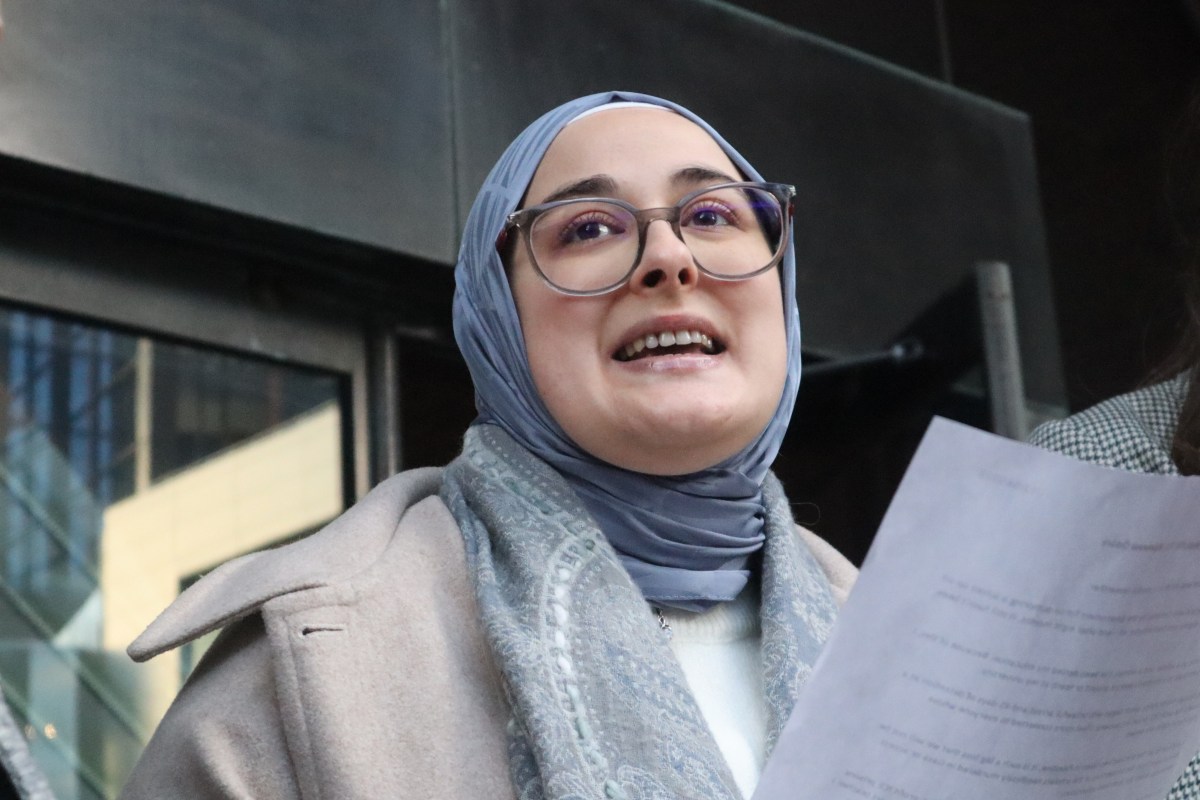
A federal immigration judge has blocked the Trump administration’s attempt to deport Rümeysa Öztürk, the Turkish student who was detained last year in Vermont and other states by immigration agents.
According to a court filing published Monday, the judge determined that the U.S. Department of Homeland Security “had not met its burden of proving” Öztürk should be removed from the country, and so halted the government’s deportation proceedings against her. The Tufts University graduate student’s case was among the first high-profile instances last year in which the Trump administration targeted students for speaking out about Israel’s military campaign in Gaza.
Even though Öztürk has been free from custody since a Vermont district court judge’s order last May, she was still facing the possibility of deportation because the Trump administration revoked her student visa before federal agents arrested her in March.

The Vermont judge, William K. Sessions III, works under the U.S. District Court system. That’s separate from the immigration court system, which is part of the U.S. Department of Justice. The immigration judge was not identified in the filing, which was written by Öztürk’s legal team.
“Today, I breathe a sigh of relief knowing that despite the justice system’s flaws, my case may give hope to those who have also been wronged by the U.S. government,” Öztürk said in a statement provided by the American Civil Liberties Union, which has attorneys representing her.
The Trump administration could still appeal the immigration judge’s Jan. 29 ruling, and in a statement Tuesday, a spokesperson for the Homeland Security Department indicated it may well do so. Öztürk’s attorneys said in the Monday filing that the government may try to detain their client again if it makes an appeal.
“This is more judicial activism at its core to keep a terrorist sympathizer in this country. We are under no obligation to admit them or let them stay here,” the Homeland Security spokesperson said in an email. “The Trump administration is committed to restoring the rule of law and common sense to our immigration system, and will continue to fight for the arrest, detention, and removal of aliens who have no right to be in this country.”
Öztürk was arrested in March by masked and plainclothes agents on a street near the Tufts campus in Massachusetts. After her arrest, which drew global press coverage, she was whisked north and held overnight at a U.S. Immigration and Customs Enforcement field office in St. Albans, Vermont. ICE is part of the Homeland Security Department.
The next morning, agents brought her to Patrick Leahy Burlington International Airport and transferred her to an ICE detention center in Louisiana. The agency then held her there for 45 days until Sessions, the Vermont judge, ordered her release on bail.
Öztürk appears to have been targeted by the Trump administration solely for an op-ed she co-wrote in Tufts’ student newspaper that criticized the school’s response to the war in Gaza. The Trump administration has not charged her with a crime or challenged her lawyers’ assertion that she was targeted in the first place over the newspaper article.
ICE officials have said the agency brought Öztürk to St. Albans because that was the closest facility it had available to detain her at the time. Her lawyers have contended, however, that the move was an effort to muddy the waters over which state her detention could be legally challenged in.
The student’s lawyers said Monday that even though her deportation has been blocked, they will continue to challenge the legal merits of her arrest, in the first place, in U.S. District Court. They’ve argued repeatedly that her detention violated the First Amendment and also posed a serious danger to the student’s health.
The Trump administration is also, still, in the process of appealing an order Sessions made last April that would have transferred the Tufts University student back to Vermont from the ICE detention center in Louisiana. That order was essentially superseded by Sessions’ decision to then order her release on bail, but the government is still challenging the legality of Sessions’ ruling.
A three-judge federal appeals panel heard arguments as part of those proceedings in September, and a decision is still pending, according to the ACLU.
