


Updated at 4:27 p.m.
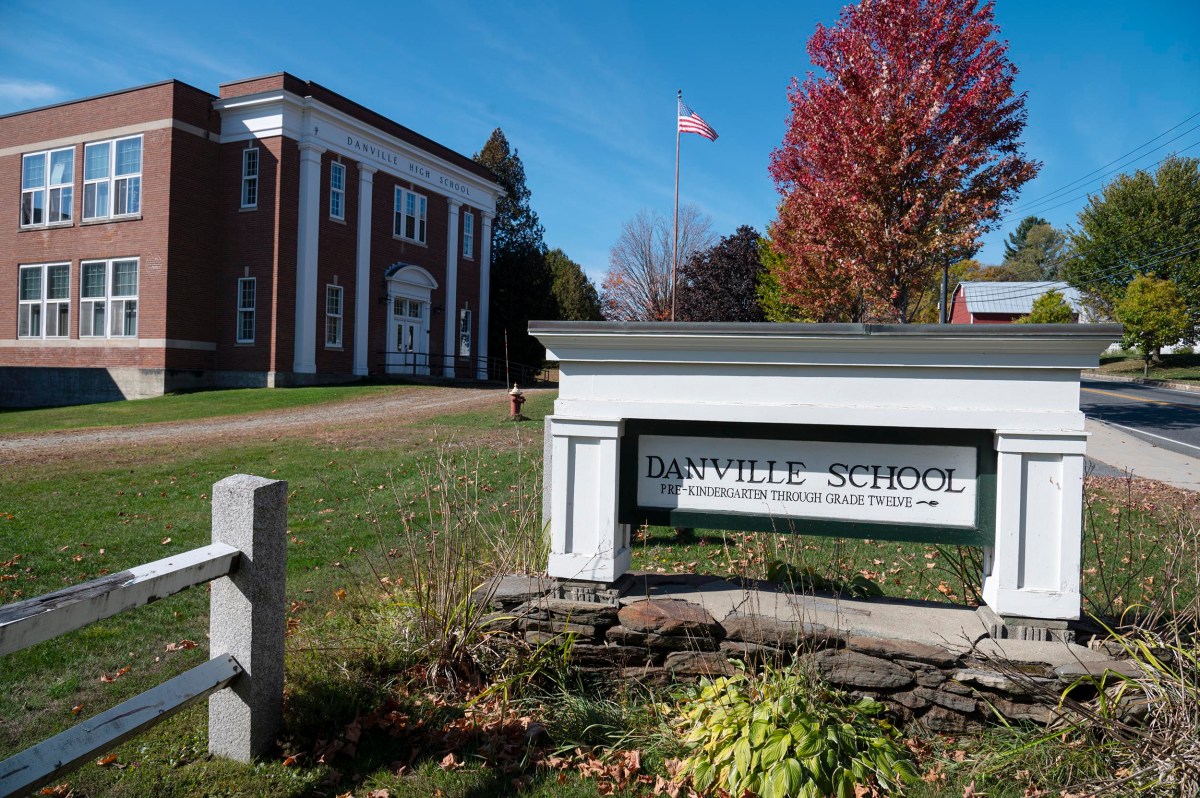
Danville residents are poised to vote in December on whether to shutter its high school grades at the Danville School and instead pay tuition for students to attend other schools, following a petition submitted to the school board Tuesday.
The petition has set the district on a collision course with a potential outcome public school faculty say would be devastating for the region’s most vulnerable students. The school board proposed a Dec. 6 special meeting for the vote, though the meeting won’t be officially set until next month. If the vote is successful, Danville School’s grades 9 through 12 would close by June 30.
The district would then pay tuition for those high school students to attend public or private schools, according to the language of the petition.
The potential closure of Danville’s high school presents troubling implications for public school students in the area, and has underscored long-held contentions around whether the region’s public and private schools share the same responsibility to serve students with disabilities or with other academic achievement barriers — a population on the rise in Vermont.
“They don’t have to take your kids,” David Warren, a Danville School social studies teacher, said Tuesday about two larger neighboring private schools. “And how do I know? Because we’ve been giving kids from those schools here in Danville a second chance.”
Danville School Principal Natalie Conway wrote to the school board in advance of its Oct. 7 meeting that the high school closure would leave “our area of the (Northeast Kingdom) a public high school desert.”
The closest high school would be St. Johnsbury Academy, followed by Lyndon Institute, both private institutions and designated by Vermont law as “independent schools” that are eligible to receive public dollars as tuition from school districts lacking public schools serving those grades.
Since 2022, Vermont State Board of Education rules have required schools that accept public dollars to educate students eligible for special education services. However, Danville public school leaders and faculty have said they believe students with disabilities would go underserved by the closure — a claim that their counterparts at St. Johnsbury Academy refute.
“Students from all walks of life and all abilities who need a second chance, a smaller school, or more individual attention and support find a home in Danville School,” Conway said in her letter. “Students with disabilities find a home at Danville School.”
‘Imagine the costs’
The Danville school district, like many in the state, finds itself on shaky ground as Vermont works toward a major overhaul of its public education system.
Act 73, the sweeping education reform bill signed into law in July, calls for a vast consolidation of the state’s 119 school districts and a reorganization of how the state funds education.
A redistricting task force, made up of legislators, former superintendents and other experts, is tasked with crafting new school district boundaries for Vermont’s public education system in time for next year’s legislative session, which begins in early January.
But many fear the law’s implementation could mean the closure of small schools, pointing to required minimum average class sizes of at least 18 students for grades 9 through 12.
The petition, Danville board members wrote in a letter to the state’s redistricting task force after the Tuesday meeting, “is a direct result of great uncertainty due to Act 73 and your task force’s mission.”
Danville School hosts about 344 students from kindergarten through high school from Danville and surrounding towns, with roughly 70 students in the high school grades, according to district board Chair Clayton Cargill.
For the past month, the school board members have weighed whether to get ahead of changes envisioned by the new education law.
Their district is a member of the Caledonia Central Supervisory Union, which includes the Cabot and Twinfield school districts. Both of those districts also operate a K-12 school, with high school grades even smaller in size than Danville’s.
The uncertainty around Danville School’s future spurred a financial analysis, presented by board member Eric Hewitt during a September school board meeting. The analysis suggested that tuitioning out Danville’s high school students may produce a lower tax rate than if it were to continue operating its high school grades.
But that analysis has since been questioned by other board members and community members.
Cargill said in an interview Wednesday that the analysis did not take into account high school-aged students in Danville whose families currently pay for private school and would take advantage of a tuition system.
There is also the expense of ensuring that the district’s obligations to students with disabilities are being met, Danville high school’s principal noted in her letter.
The next closest public high schools, Hazen Union and Lake Region Union, are each at least a 30-minute drive away from Danville School, Conway wrote.
“Imagine the costs associated with this transportation for general and special education students,” she wrote. “Imagine the costs for us as a (Northeast Kingdom) community associated with students who struggle to attend school dropping out at higher rates than we already experience.”
A state senator’s opinion
Nearby school boards have had similar discussions about potentially closing their high school grades. For Danville and Cabot, those discussions were prompted by a warning from Vermont Sen. Scott Beck, R-Caledonia, the chamber’s minority leader, according to their school board chairs. Those warnings were first reported last week by Seven Days.
Beck, a faculty member at St. Johnsbury Academy, warned school district and community leaders that lawmakers would likely seek to limit a district’s ability to offer its students the choice of attending a private school after a school closure in the next phase of educational reform.
Beck pointed to specific language that had been in an earlier version of the legislation requiring school districts that close a school to designate just three public schools to receive their students.
The Cabot School District had previously considered circulating a survey to residents about closing their schools and opting for school choice. But Cabot school board Chair Chris Tormey, said in an email this week that the board has decided to hold off on the survey “until we find out next year how Cabot School will be placed within the new statewide map.”
Audience members at the Danville board meeting were split on the urgency of making a decision about the high school. But several attendees zeroed in on accusations that Beck had unduly influenced the petitioners by spreading false information.

Warren, the high school social studies teacher, said the motivation behind the petition was “flat out wrong,” that the Act 73 process would not necessarily lead to the high school’s closure.
“Despite what you hear about small schools, we do offer a quality education. And about this decision, the politician that is behind it, in my opinion, is a coward, and worse, a bully,” Warren said.
Cargill said at the meeting that he felt he had been misled by Beck.
“I paraded this information around town, and told people this information, and I feel lied to in the situation,” he said. “I feel like I’m part of a problem here.”
Beck refuted claims that he had a conflict of interest, and said in an interview Wednesday that he was merely offering his opinion to his constituents.
“People can certainly disagree with me, that’s fine, but I was straightforward,” he said. What he has been telling school district leaders like Cargill “is that I don’t think that you have forever to have this conversation.”
“I don’t think I misled or lied to anybody,” Beck continued. “It’s the opinion I conveyed last summer and it’s the opinion I still have today.”
‘We don’t do that’
Danville School faculty argue their school plays an outsized role in serving students with intellectual disabilities and from poorer backgrounds.
And without Danville’s high school grades, “there are going to be a fair number of students who will not be provided the opportunity for the free and appropriate education that they also deserve,” Beth Nishball-Williams, a special educator at the Danville School, wrote in a letter to the school board.
“Where do our autistic, intellectually disabled, multiple handicapped students go?” Nishball-Williams wrote. “Where do our students with social anxiety, speech and concerns, depression, or trauma go?”
That claim is partly borne out in public data, released last month by the Agency of Education in response to requests from the redistricting task force about the concentration of students with individual education plans, or IEPs, in different schools and school districts.

Twenty-two percent of Danville School students are on IEPs, while 49% are eligible for the federal free or reduced lunch program, indicating they live in households earning less than 185% the federal poverty level, according to data from the Agency of Education for the 2023-24 school year.
Twenty-five percent of students from other school districts who attend Danville School are on IEPs, while 62% are on a free or reduced lunch program, according to that data. Data from previous years was not available.
Meanwhile, only 8.7% of St. Johnsbury Academy’s student body are on IEPs, according to that data, while just over 14% are on a free or reduced lunch program.
Lyndon Institute has higher percentages — 19.52% of the school’s student body are on IEPs, while just under 22% are on a free or reduced lunch program.
The data suggests that the academy is not enrolling students with disabilities. St. Johnsbury Academy officials contend that the opposite is true — that their low percentage of students with IEPs shows that they’re making progress toward the mandates in Act 173, Vermont’s 2022 special education law that sought to increase effectiveness of support services.
Academy Headmaster Sharon Howell said it was “patently false” that they are not serving students with IEPs, and said “the fact that we have fewer students on IEPs is not an indicator of failure. It’s actually a success story.”
Mathew Foster, the director of student services at St. Johnsbury Academy, said the data discrepancy is due the fact that some students are designated as being on 504 plans versus IEPs. The 504 plan categorization is another federal designation for students who need special support for learning, and does not follow the same procedures and requirements that an IEP would.
Howell said the academy’s philosophy is to shift their enrolled students with IEPs toward 504 plans or other in-house support services.
“Our philosophy is we want students to be able to do as well as they can, to be able to move into general education classes when that’s appropriate, so not just be stuck in individualized services classes in content areas, but to actually join some of the some of the gen-ed classes, if that’s appropriate,” she said.
Data provided by the academy for the 2023-24 school year shows a number of publicly funded students — about 24% — enrolled at the school are on IEPs, 504 plans, or “other support plans.”
Brian Bloomfield, the head of school at Lyndon Institute, likewise said that the claims his school enroll fewer students with IEPs were “factually inaccurate,” and said that “more than one in four students enrolled” at the school have active IEPs.
Administrators and teachers at the Danville School nonetheless say their school is the fallback serving those students in the region.
In her letter, Danville School special educator Nishball-Williams wrote that “the truth is not everyone will be successful” at the two nearby private schools. She said she works with students from most of the surrounding towns that tuition out their students.
“I know this first hand because in the past five years I’ve had students on my caseload from Barnet, Peacham, Walden, Cabot, Lyndon, St. Johnsbury, Concord and Sheffield, as well as Danville,” Nishball-Williams wrote.
Caledonia Central Supervisory Union Superintendent Matt Foster said the nearby academies “don’t have to, nor (do) they, gear to try to meet the needs” of all students.
“There is flexibility at the academies where they are able to basically say, ‘We don’t do that’ with certain populations,” Foster said.
“Those aren’t my schools, so I can’t say what exactly they’re doing or not doing at this point in time,” he added, “but they definitely have a history of saying there are certain students that they don’t feel equipped to be able to take.”
‘An existential crisis’
The petition delivered at Tuesday’s meeting was organized by Peter Mantius, a faculty member at St. Johnsbury Academy.
“It’s my hope that every voting resident shows up at our special meeting fully informed and capable of voting on maybe the most important decision this town is going to make in a generation,” Mantius said during the meeting.
Mantius did not respond to a request for comment, but said during the September board meeting and in an op-ed published in the Caledonia Record that he and others had concerns similar to Beck’s — that the Legislature may soon block the district’s ability to adopt school choice.

Hewitt, the Danville School board member, was asked during Tuesday’s meeting for his position on potentially closing the school. He said he wanted more clarity on what comes of the redistricting task force.
“The question is, how is the redistricting community committee viewing us, Danville, in our current situation,” Hewitt said.
The school board, in its letter to the task force, asked members for clarity.
“We are at risk of making a very reactionary decision that will change this town considerably in unforeseen ways,” the board’s letter reads. “With the lack of certainty or clarity around what will happen to a school like ours, which is in a remarkably unique situation in the state, we are forced to assume and plan for the worst case scenario, and do everything in our power to prevent it.”
Cargill expressed similar concerns before the meeting.
“We’ve been operating a pretty successful high school that we’re proud of throughout all these years,” Cargill said in an interview last week. “I think that’s the truth, but with what the state is forcing now, we’re sort of sitting in an existential crisis.”
This story was updated to include a comment from the head of Lyndon Institute.
